
Recently, while recovering in Cork University Hospital for six unexpected days, I had a direct view of Cork city’s northside.
Prominently visible was the Apple campus perched atop a hill overlooking the River Lee. This site employs over 6,000 individuals and has contributed tens of billions of euros in tax revenue to the state.
I vividly recall when Apple set up shop in 1980 during my secondary school years at North Monastery. Many of my friends secured part-time assembly jobs there and were truly grateful for the opportunity.
Back then, Cork faced severe unemployment. In my Leaving Cert year, 1983, a teacher conducted a survey of our class of 37 boys and discovered that 21 households, including mine, had no employed family members.
Expectations were low during that period. Even in 1987, after I graduated from UCC, numerous classmates emigrated immediately after our final exams.
Their departure wasn’t driven by high rent or housing issues but rather the pursuit of employment and, for some, a desire to escape the era’s stifling conservatism.
Fast forward to the early 2010s when I was at a business event in Dublin and then-IDA boss Barry O’Leary was seated at the same table. He called me out when he saw that I was using a Samsung smartphone.
He told me there was no benefit to Ireland in that, and that I should have an Apple phone because of the jobs the American company provided and the taxes it paid.

Tim Cook has cosied up to the Trump administration, especially in recent months
I conceded the point to him and waded into what some call the Apple ecosphere. I’m writing this on an Apple Mac, I read my Irish Daily Mail on an iPad (one of my favourite possessions which I use for many things) and, unfortunately, my almost-new iPhone is nearly attached to my hand, so much use does it get. I have Apple air pods, but thankfully drew the line at getting an Apple watch.
In recent months, I’ve watched aghast as Apple boss Tim Cook has cosied up to the Trump administration.
He went into the Oval Office and presented him with a large glass disc/plaque mounted on a 24-karat gold base with a special engraving for Trump.
But far worse was his obsequious attendance at a special White House screening of the Melania documentary on the same day agents from Immigration and Customs Enforcement (ICE) killed an American citizen on the streets of Minneapolis. Cook’s own staff have apparently kicked back hard at him for that.
I can understand his desire to protect Apple from the capricious whims of Trump – and to maintain an uninterrupted supply of products from China – but there surely are lines that should not be crossed.
To make some form of limited protest at this behaviour, I looked at what I could reduce from my own Apple dependence. But I have discovered that I’m largely trapped.

Apple CEO Tim Cook, second from right, with US treasury secretary Scott Bessent, commerce secretary Howard Lutnick, President Donald Trump and Vice President JD Vance
It would be incredibly expensive to buy new hardware to replace what I have, and inconvenient to move services to other platforms. All my photos and files are on the Apple cloud service, as are my emails and music.
I’ve limited myself to ending my Apple TV subscription as a tiny but insignificant protest against the company but am cursing my dependence on the tech giant.
I also ended my Amazon Prime subscription, another minuscule protest against owner Jeff Bezos’s payment of $40million to Melania Trump for her risible documentary, its spending of another $35million to market it and use of a mate of Jeffrey Epstein’s to direct it.
I’ve made a promise to myself to not buy anything more from Amazon’s website, even though I did so rarely, and buying in local shops will remain my priority. This was even before Bezos’s gutting of the staff at the Washington Post and his abandonment of journalists in war zones to find and pay their own way home.
Maybe if more of us reassessed our relationships with the Apples and Amazons of this world, such actions would hit these giants’ bottom line. But it’s unlikely that this will happen. Convenience dictates that most people will continue as they do.
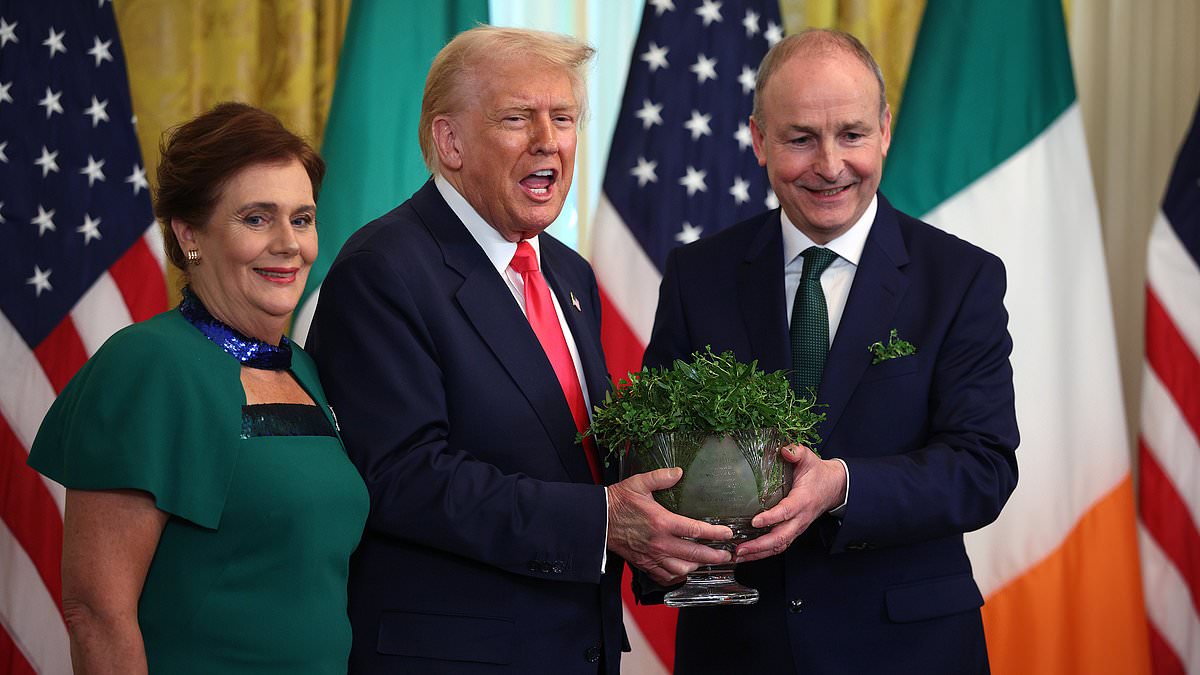
This is why I have some sympathy for Taoiseach Micheál Martin as he heads to the White House next month to meet with the despicable individual who defiles the Oval Office with his blatant racism, sexism, corruption and much more besides.
Part of me would love it if Martin refused to go and made it clear he cannot abide the man who defiles American politics. But he doesn’t have that option.
Our Taoiseach, also from Cork city, is six years older than me but would well remember the economic wasteland in which we grew up. He has no desire to return to that.
Just as I have realised my dependence on Apple, Micheál Martin knows the country’s dependence on Apple and Amazon and all the other tech giants, even when some do terrible things in their day-to-day business and when they debase themselves by sucking up to Trump.
He must be pragmatic – and it is hard to blame him for that.
Hospital staff (as well as the food!) get five stars from me
I mentioned earlier my recent sudden and unexpected stay at Cork University Hospital.
Positive comment rarely gets reported in the news. When it comes to our health service, we readily hear of the things that go wrong, from lengthy waits on trolleys in emergency departments to overcrowded wards and misdiagnoses.
I’ve heard it said previously that we have a good hospital system in Ireland but the problem is getting access to it. But my own experience of CUH was excellent. I was seen to quickly, late on a Wednesday evening in triage, taken to an area where an assessment could be made, and I was admitted within five hours.

The professionalism and care of the devoted Irish and foreign staff at CUH were excellent
The professionalism and care of the devoted Irish and foreign staff, first in the emergency department and later in the ward, were excellent.
Even the food was more than acceptable, which was a surprise given some of complaints that have been aired on my radio show in the past.
I’m not recommending a hospital stay but I’m so thankful to all the wonderful people at CUH for the timely treatment I received, which has enabled me to make a quick recovery.
Not a single brick laid as hospitals languish in limbo
The Government wants to be congratulated for seeking to rectify its own failures.
This week Jack Chambers, who is minister for infrastructure as well as public expenditure, announced new measures that should, on average, reduce the initial business case process by about 20 weeks.
Which is as it should be, but what happens then? Does an earlier approval for a project mean it will get started quickly? Not unless things change dramatically.
Take this example.
In December 2021, as part of the Sláintecare reform programme, the Government formally committed to establishing three new standalone national elective hospitals in Cork, Dublin and Galway.
They would, it said, provide high-quality, timely elective care for a growing population, adding an estimated 977,700 procedures, treatments and diagnostics annually. The move would separate elective from emergency care to reduce cancellations and delays, it said.
In December 2022, the Government approved the next stage, identifying proposed sites in Cork and Galway. But it wasn’t until May 2024 that two preferred sites for Dublin were announced and it was also that year before the HSE procured an architect-led design team and began work on detailed design and pre-tender business cases.
And that, by and large, is where we’re at.

This week Jack Chambers announced measures that should reduce the process by 20 weeks
Work is under way on detailed architectural design, pre-tender business cases and planning processes, but still no construction has begun yet.
The 2026–2030 Health Sectoral Plan, published last November, promised ‘complete detailed design and statutory planning for the Elective Care Programme with the ambition to progress these to get construction under way’.
It will be a near miracle if any of these three hospitals are ready – ten years after the initial announcement of their establishment.
Given construction inflation, it is also likely that the price has soared. Delays cost money.
Taking 20 weeks off the early stages of any infrastructure project will be useless if everything else isn’t expedited as well.
God help whoever has to organise the games against Israel
Just as the show must go on, the games will be played. The games in question are the two UEFA Nations League ties between the Republic of Ireland football team and Israel, set for the end of September and start of October.
A lot of people are very angry about the idea of the games going ahead, regarding the playing of a mere sport as a legitimisation of the off-field-of-play behaviour of this particular opponent country.
Many people in Ireland are appalled by the mass murder carried out by the Israeli armed forces against the people of Gaza, and rightly so. To play football with Israel as if nothing has happened seems unconscionable; we wouldn’t play against Russia, for example.
Already Sinn Féin came fast out of the traps to demand that the games not take place at all, that they be boycotted.
There will be lots more of this in the months to come. There will be further enormous pressure put not just on the FAI but on the Government by anti-Israel activists to prevent Irish participation in the fixtures.
At the very least, given precedent, that would mean conceding each game on a 3-0 scoreline. So what? It’s only a game after all. If Ireland is boycotting the Eurovision Song Contest because of Israeli participation, then surely it can afford to concede a couple of soccer matches?

Ireland played Israel in a World Cup qualifying match in Tel Aviv in 2005
If only it were that simple. Failure to play could have other repercussions. UEFA, the sport’s organising body in Europe, may have expelled Russia from competition but it has not acted on calls from Ireland to do the same to Israel.
UEFA might punish the Football Association of Ireland (FAI) further, possibly suspending or expelling it from European competition for failing to fulfil its fixtures.
That would do incalculable damage to Irish football while doing nothing of any consequence to punish Israel. It could even mean the loss of the right to host fixtures in Dublin at Euro28, or impede qualification to participate in the finals.
Again, the point can be made as to how this compares to the loss of 70,000 lives in Gaza.
However, to refuse to play the games on a point of principle, no matter how well-intentioned, would be, to use a football cliché, an own goal, or, to put it another way, a pyrrhic victory.
Instead, having failed in its efforts to persuade UEFA to expel Israel from competition, the FAI is prepared to act realistically and suck it up.
The main problem for the FAI now is going to be about where the home game will be played.
If it is to be staged in Dublin it would almost certainly have to be played behind closed doors. It would be impossible to guarantee the safety of the Israeli players if there’s a crowd at the Aviva – not when access to the pitch would be relatively easy – and player safety is correctly required of host countries.
There is no way that the safety of any visiting Israeli fans could be guaranteed, and while it is unlikely any would be allowed into the country from Israel, some might come from the UK, or find support from among loyalists in the North.
Similarly, it is hard to imagine the gardaí wanting to police protests outside the ground, and protests would be almost certain, with or without a crowd present inside.
It might possible to provide security for a hotel on its own grounds outside Dublin but would the owners want the hassle or publicity from being known as the host of the Israeli team?
The only other option is to play the game outside the country, assuming some other nation would be willing to host it.
For security reasons, it is most unlikely that the Irish team will be required to play in Tel Aviv – despite an Israeli statement yesterday saying that’s where the game would be played. It is more likely that Israel will continue to play home games in Budapest, as it has since 2024.
Maybe that city will host two Ireland v Israel games in a week, and our protest can be restricted to not having any Irish fans in the stadium for either game – tough as that will be on the players and management.