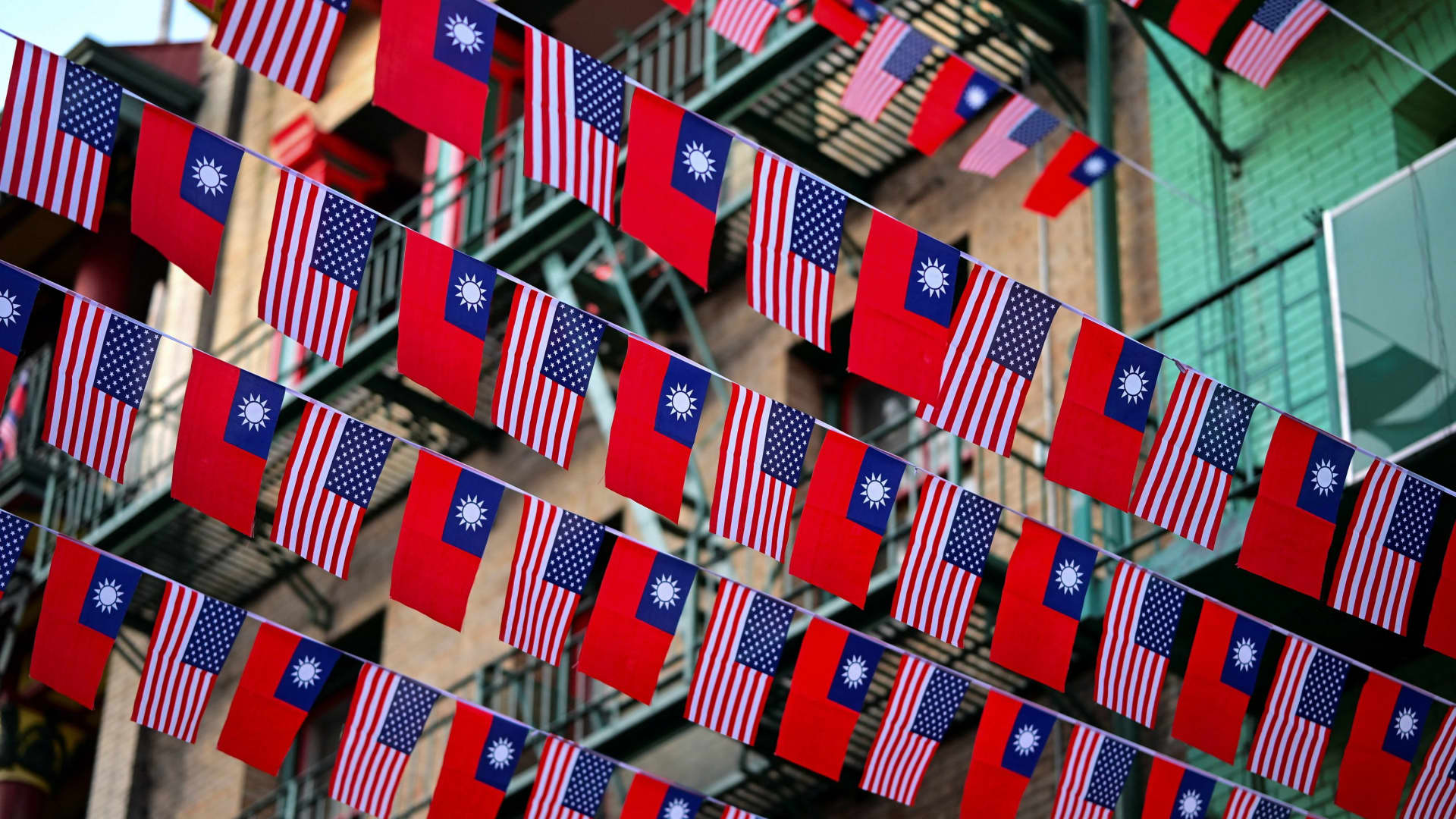
In San Francisco, California, on January 28, 2026, the flags of the United States and Taiwan were proudly displayed.
Stephen Nellis for Reuters
In a significant development, Washington and Taipei have inked a trade agreement that reduces tariffs on Taiwanese exports to 15%, aligning them with those for other Asian allies like Japan and South Korea. Meanwhile, Taiwan has agreed to open its markets wider to American products.
Under this new agreement, Taiwan will eliminate or lower tariffs on 99% of U.S. goods, granting “preferential market access” for American industrial and agricultural exports. This includes automobiles, beef, and mineral products.
Additionally, Taiwan has committed to purchasing more than $84 billion in American goods from 2025 through 2029. This procurement will encompass liquefied natural gas, crude oil, aircraft, and power equipment.
The U.S. Trade Representative’s office highlighted that Taiwan has pledged to address longstanding non-tariff barriers. Notably, they will accept American vehicles that meet U.S. Federal Motor Vehicle Safety Standards without imposing further requirements.
This deal was first announced in January when Taiwanese chip and technology companies committed to invest at least $250 billion in production capacity in the U.S., backed by an equal amount of government credit “to facilitate additional investment by Taiwanese enterprises.”
However, Taiwan and the U.S. have shared differing views on chip supply chains.
The goal is to bring 40% of Taiwan’s entire semiconductor supply chain to the U.S. during U.S. President , Commerce Secretary Howard Lutnick told CNBC last month. He also said that Taiwan-based chip companies that don’t build in the U.S are likely to face a 100% tariff.
However, Taiwan has pushed back on that proposal, telling Washington that moving 40% of the island’s semiconductor supply chain to the U.S. was “impossible,” according to Taipei’s top tariff trade negotiator.
Vice Premier Cheng Li-chiun told local media that Taiwan’s semiconductor ecosystem, built over decades, could not simply be relocated.
Taiwan’s international expansion, including its investments in the U.S., is predicated on the notion that the industry remains’ rooted in Taiwan and continues to expand domestic investments, she said in Mandarin, translated by CNBC.
China, which considers democratically governed Taiwan a part of its territory, had criticized the January agreement, saying that the deal would “only drain Taiwan’s economic interests,” adding that the ruling Democratic Progressive Party was letting the U.S. “hollow out” the island’s key industry.
Chinese President Xi Jinping regards Taiwan’s reunification with the mainland “a historical inevitability.” Taiwan rejects those claims.
While the U.S. does not have a mutual defense treaty with Taiwan and is not obligated to defend the island, the 1979 Taiwan Relations Act states the U.S. “will make available to Taiwan such defense articles and defense services” as may be necessary to “enable Taiwan to maintain sufficient self-defense capabilities.”
The U.S. in December approved $11.15 billion in arms sales to Taiwan, among its largest deals with the island as it faces growing threats from China, drawing a sharp response from Beijing, with its foreign affairs spokesperson, Guo Jiakun, accusing the U.S. of violating the “one-China principle.”
— CNBC’s Anniek Bao and Dylan Butts contributed to this story.


