
On Thursday, Asian markets enjoyed a positive upswing, inspired by a robust performance on Wall Street, primarily driven by the computer chip titan, Nvidia. This surge in optimism came amid a backdrop of geopolitical tension and fluctuating oil prices.
While U.S. stock futures showed a slight retreat, oil prices experienced a rise as reports surfaced, heightening concerns about the potential for conflict with Iran. This comes at a time when U.S. President Donald Trump is contemplating military action against Iran. The administration has been amplifying its military presence in the region, even as indirect negotiations with Tehran regarding its nuclear ambitions continue. The fear is that any military engagement could escalate into a broader Middle Eastern conflict.
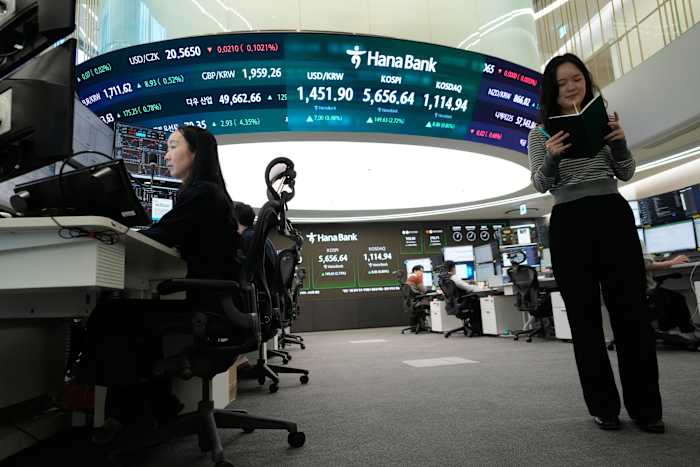
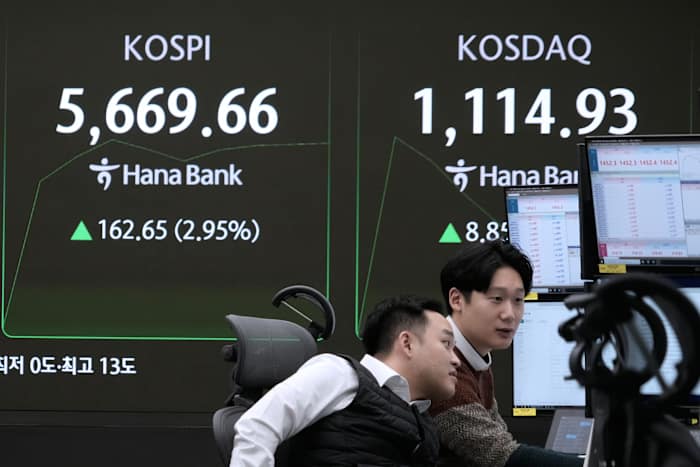
In the realm of Asian markets, certain regions, such as Greater China, remained dormant due to the Lunar New Year celebrations. However, other markets resumed trading with notable gains. In Japan, the Nikkei 225 climbed by 0.8%, reaching 57,582.93. Meanwhile, South Korea’s Kospi surged by 2.8%, hitting 5,661.22, as it bounced back from its earlier holiday closure.
Down under, Australia’s S&P/ASX 200 also saw a rise, advancing by 0.9% to settle at 9,088.70. This collective uptick across various markets underscores a renewed sense of investor confidence, even as geopolitical uncertainties loom large.
In Tokyo, the Nikkei 225 added 0.8% to 57,582.93, while in South Korea, the Kospi jumped 2.8% to 5,661.22 as markets reopened following holidays earlier in the week.
Australia’s S&P/ASX 200 advanced 0.9% to 9,088.70.
Southeast Asian markets surged, with Thailand’s SET up 0.9%. India’s Sensex edged 0.1% higher.
During European trading Wednesday, London’s FTSE 100 climbed 1.2% after the latest update on U.K. inflation bolstered expectations that the Bank of England may soon cut interest rates.
On Wall Street, the S&P 500 rose 0.6% to 6,881.31 and the Dow Jones Industrial Average added 0.3%, to 49,662.66. The Nasdaq composite gained 0.8% to 22,753.63.
Nvidia helped lift the market and climbed 1.6% after Meta Platforms announced a long-term partnership where it will use millions of chips and other equipment from Nvidia for its artificial-intelligence data centers.
“No one deploys AI at Meta’s scale,” Nvidia CEO Jensen Huang said. Because his company is the most valuable on Wall Street, Nvidia’s stock was the single most powerful force pulling the S&P 500 higher.
That performance demonstrated the upside of AI development for the U.S. stock market. But investors have also focused on the potential downsides recently, which has led to sharp swings in share prices.
Meta’s stock fell as much as 1.7% before recovering and rising 0.6%.
Another worry is that if AI succeeds in creating tools to do complicated tasks more cheaply, companies in industries as far flung as software, legal services and trucking logistics could see their businesses get undercut. Investors have suddenly and aggressively sold stocks of companies seen as under threat in what analysts have likened to a “shoot first-ask questions later” mentality.
Several profit reports from companies helped to lift stocks Wednesday. They continued what’s been a strong reporting season for the big U.S. companies in the S&P 500.
Outside of earnings reports, Moderna jumped 6.1% after saying regulators at the Food and Drug Administration will review its flu vaccine candidate after earlier refusing to consider it.
In the bond market, Treasury yields ticked higher following reports on the U.S. economy that came in better than economists expected. The yield on the 10-year Treasury rose to 4.08% from 4.05% late Tuesday.
One report said industrial production improved last month by more than economists expected. Another said orders for computers, fabricated metal products and other long-lasting manufactured goods also rose more in December than economists had forecast, when not including airplanes and other transportation equipment. A third report said homebuilders broke ground on more new homes in December than anticipated.
Such strong data could encourage the Federal Reserve to keep interest rates steady.
The Fed has put its cuts to interest rates on hold, but many on Wall Street expect it to resume later this year. The widespread forecast is that will come during the summer, after a new chair is scheduled to step in atop the Fed.
Minutes released Wednesday from the Fed’s last meeting showed many officials want to see inflation fall further before they would support additional interest rate cuts this year.
Lower rates can give a boost to the economy and prices for investments, but that comes at the cost of potentially worsening inflation.
In other dealings early Thursday, U.S. benchmark crude oil gained 30 cents to $65.36 per barrel. Brent crude, the international standard, was up 27 cents at $70.62.
Prices of gold and silver held steady.
The price of bitcoin fell 1.3% to about $67,000.
___
AP Business Writer Stan Choe contributed.
Copyright 2026 The Associated Press. All rights reserved. This material may not be published, broadcast, rewritten or redistributed without permission.