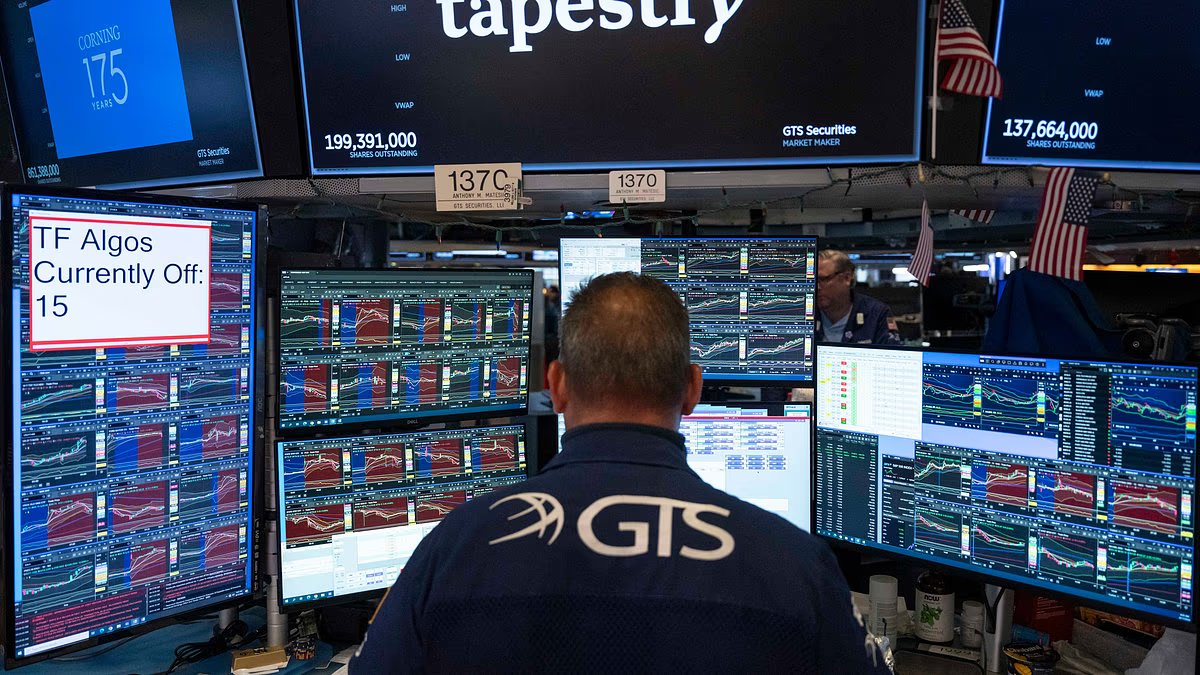

For many years, a colleague of mine channeled the majority of his pension and savings into investment trusts, firmly believing that active management paired with a long-term strategy would yield fruitful results.
However, in recent years, the landscape began to shift. Exchange-traded funds, known for their ultra-low fees, started delivering impressive returns of 60, 70, 80, and even over 100 percent in just a year, particularly in thematic funds centered on US technology and precious metals.
During this time, the appeal of investment trusts dwindled as their share prices frequently traded at increasing discounts relative to their net asset values.
Yet, there are now signs indicating a resurgence in favor of investment trusts.

Investors are seeking diversification in investment trusts despite cheaper alternatives
Research from the Association of Investment Companies reveals that, over the past year, the average investment trust has outperformed an S&P 500 ETF. This trend has been consistent since the beginning of 2026.
“It makes sense that ETFs tracking the US stock market have been in vogue recently, especially as the largest US corporations have delivered such strong returns,” notes Nick Britton, the AIC’s research director.
The dominance of US mega-cap stocks like Nvidia, Apple and Alphabet, along with outsized moved in precious metals last year, have made passive exposure look irresistible.
It could be said that low-cost investment platforms reinforced the trend, as default portfolios are ETF-heavy. But for investment newbies, thematic funds package growth stories neatly and actively managed ETFs promise skill without discounts or structural friction.
Yet the balance is starting to change.
‘No investment trend lasts forever,’ says Britton. ‘Investment trusts give you the chance to diversify outside large US companies into regions and sectors where valuations are more attractive and recent performance has been much better.’
That claim is supported by longer-term data. Over 10 years, the average global investment trust outperformed its fund equivalent by around 0.95 per cent per year, according to an AIC study. Research by Interactive Investor found trusts outperformed funds in almost every major sector on an annualised basis over both ten and twenty years.
Based on returns from the average trust, an investor putting £1,000 in got £3,062 back over the past ten years, Britton notes.
The picture has not been uniformly positive, however, with ETFs leading in some sectors and periods.
But part of the appeal of trusts lies in their being different, and part from their unique structure offering more for certain types of investors, such as those wanting income.
‘Investment trusts give you the chance to diversify outside large US companies into regions and sectors where valuations are more attractive and recent performance has been much better,’ says Britton.
‘You’ll get professional management, independent oversight from a board of directors, and all the shareholder protections that come with being a London-listed company.’
Other advantages include that trusts can invest in everything from stocks to private companies and infrastructure, while ETFs have to stick to liquid investments – ie those that are easy to sell.
Each trust is also a listed company, with a board of directors that is independent from the fund manager and tasked with looking after investors’ interests.
As for income, investment trusts have an advantage over other funds as they can hold back some of their income to pay out in a future year.
Britton points out that this has produced a group of long-running ‘dividend heroes’, many with three, four or five decades of uninterrupted dividend growth.
Still, the main stumbling block remains valuation, with discounts having been a feature of the sector for much of the past decade.
Periods of widening are often followed by narrowing, only for pessimism to return later. These swings have frustrated investors.
But they also create opportunity.
‘The average investment trust discount is closing in,’ Britton says. ‘It’s narrowed from 19% in October 2023 (for all trusts excluding 3i) to 12% today.
‘Our research shows that investing during periods of double-digit discounts leads to better returns over the following five years, so discounts can represent an opportunity for a savvy investor.’
In other words, investors can buy assets at 88p in the pound, which if discounts continue to close would amplify returns.
Part of the problem is communication, a point that Britton concedes. ‘Investment trusts don’t always have the big marketing budgets of ETFs. They’ve sometimes been called the City’s best kept secret.’
For my colleague, the shift to ETFs brought short-term comfort. Simplicity has its attractions. But the case for abandoning trusts altogether now looks weaker.
As Britton puts it: ‘You’ll get professional management, independent oversight from a board of directors, and all the shareholder protections that come with being a London-listed company.’
In a market where trends come and go, those old-fashioned advantages may yet regain their appeal.
For all the market’s breaking small- and mid-cap news go to www.proactiveinvestors.co.uk
DIY INVESTING PLATFORMS
AJ Bell

AJ Bell
Easy investing and ready-made portfolios
Hargreaves Lansdown

Hargreaves Lansdown
Free fund dealing and investment ideas
interactive investor

interactive investor
Flat-fee investing from £4.99 per month
Freetrade

Freetrade
Investing Isa now free on basic plan
Trading 212

Trading 212
Free share dealing and no account fee
Affiliate links: If you take out a product This is Money may earn a commission. These deals are chosen by our editorial team, as we think they are worth highlighting. This does not affect our editorial independence.
Compare the best investing account for you