IN BRIEF
- Trump’s move comes after former US president Barack Obama said in a podcast last week that “[aliens] are real”.
- Trump had earlier said Obama had “made a big mistake” in discussing aliens.
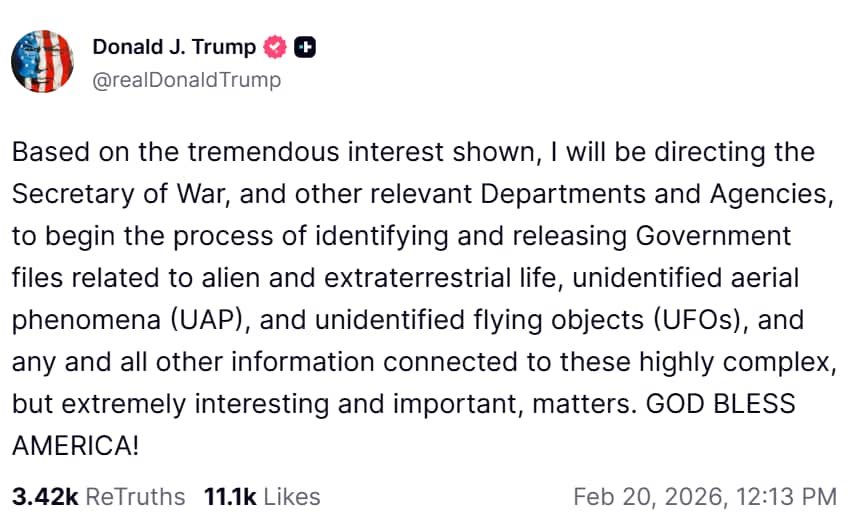
President Donald Trump has announced plans to unveil government documents concerning extraterrestrial life and related phenomena.
In a statement on his Truth Social platform, Trump declared his intention to instruct the Secretary of War, along with other pertinent departments and agencies, to start identifying and making public files related to alien life, unidentified aerial phenomena (UAP), and unidentified flying objects (UFOs).
According to Trump, this decision follows a surge of public curiosity, perhaps sparked by former President Barack Obama’s recent remarks affirming the existence of aliens.
During an appearance on “No Lie,” a podcast by YouTuber Brian Tyler Cohen, Obama was queried about the reality of aliens. He confirmed, “They’re real, but I haven’t encountered them myself.”
Obama further mentioned, “There’s nothing hidden at Area 51 or other secret facilities, unless there’s a massive conspiracy that even I, as president, was kept in the dark about.”
Although the interview with Cohen lasted nearly 50 minutes, Obama’s brief comments on extraterrestrials quickly captured online attention, with a TikTok clip of his response amassing six million views.
Since the interview, he issued a statement clarifying that his answer was in line with “the spirit of the speed round of questions”.
“Statistically, the universe is so vast that the odds are good there’s life out there. But the distances between solar systems are so great that the chances we’ve been visited by aliens is low, and I saw no evidence during my presidency that extraterrestrials have made contact with us. Really!” Obama wrote in a caption alongside the video.
Trump had earlier said Obama had “made a big mistake” in discussing aliens, claiming without evidence he had disclosed classified information.
Asked what he thought of Obama’s comment that aliens are real, Trump said: “Well, I don’t know if they’re real or not, but he gave classified information, he’s not supposed to be doing that.”
He then said he doesn’t have an opinion on aliens, but said “a lot of people believe it”.
“I may get him out of trouble by declassifying.”
It’s unclear when the files will be released.
What do we know about UFOs already?
The first public meeting on UFOs was held just three years ago, where a NASA (National Aeronautics and Space Administration) panel detailed findings — revealing that 5 per cent of sightings they’ve studied remain unexplained.
And the unexplained cases are mainly due to the lack of high quality data, according to its science mission directorate Nicola Fox.
There isn’t enough data that “can be used to make definitive scientific conclusions about the nature and origin of UAP,” she said in September 2023.
The panel detailed the 800 reports they’d received over the past 27 years.
Getting to around 50 to 100 reports a month, many “anomalous” sightings make up only 2 to 5 per cent.
The panel said at the time that there are no signs of extra-terrestrial life.
“We haven’t found life beyond Earth yet, but we’re looking,” said the UAP team chair David Spergel.
Some of the reports noted in the meeting came from Australia, with Spergel calling them confusing.
In 1998, astronomers at the Parkes Observatory in NSW reported infrequent and odd radio signals, called perytons, once or twice a year, that “had a really strange structure,” Spergel said.
“People couldn’t figure out what was going on.”
The signals went unexplained until 2015 when new technology detected they were identical to that of a microwave oven.
The observatory’s microwave was tested, but perytons were not detected when the microwave was operating as usual.
But when the door was opened before the microwave’s time was up, the perytons were there.
“What had happened was that the people in the observatory would heat up their lunch in the microwave,” Spergel said.
“It produced a burst of radio signals that was picked up by sensitive detectors.”
The latest sign of life from NASA was in September 2025, where a sample was collected by their Perseverance Mars rover from an ancient dry riverbed — NASA said it could preserve evidence of ancient microbial life.
Taken from a rock named Cheyava Falls, the sample — called Sapphire Canyon — contains potential bio signatures, according to a paper in the journal Nature.
A potential bio signature is a substance or structure that might have a biological origin but requires more data or further study before a conclusion can be reached about the absence or presence of life.
Since the meeting in 2023, NASA said their investigations will improve with artificial intelligence and technology.