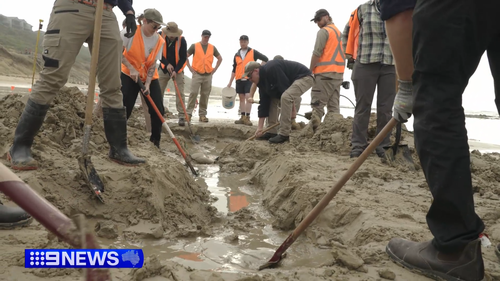

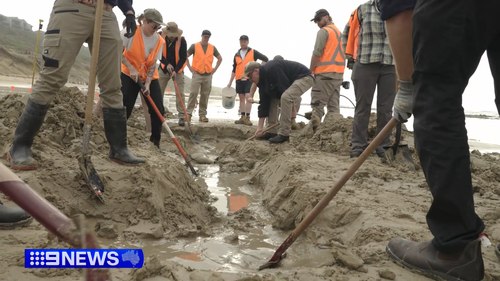
Yesterday, an impressive collaboration between Museums Victoria and Barwon Coast staff led to the successful excavation of a fossil on the shores of Ocean Grove, located on the Bellarine Peninsula. This remarkable find was brought to light thanks to the keen observation of a vacationing family.
The discovery was initially made by the Davidson family, visiting from Cooktown, who stumbled upon the fossil during a December holiday. Kristina Davidson recalled, “I pretty much stumbled over it … we spent some time trying to dig it up and look at it and took some photos.”
Upon receiving a tip-off from the Davidsons, Dr. Erich Fitzgerald, a senior paleontologist at Museums Victoria, took immediate action. “I was actually about to go on leave for Christmas,” Fitzgerald explained. “A member of the public sent an inquiry to the museum’s public enquiry line, saying, ‘we think we’ve found something on the beach at Ocean Grove’.”
On December 19th, Dr. Fitzgerald decided to investigate the site himself. “I went down to scout about, have a bit of a look. Lo and behold, yep, they found something alright,” he confirmed.
The fossil, buried under half a metre of sand, was expertly unearthed by the combined efforts of the museum team and local staff, marking an exciting addition to the paleontological records of the region.
“I pretty much stumbled over it … we spent some time trying to dig it up and look at it and took some photos,” Kristina Davidson said.
”There’s the spine, there’s rib bones, it’s just kind of all there.”
Dozens of helpers raced against a rising tide today to dig away sand and chisel at the one-tonne sandstone block that cocooned the ancient vertebrae.
Heavy machinery was then brought in to move the giant fossil, which was imprinted on a one-tonne block of sandstone, from the beach.
From there it was loaded onto a truck and driven back to Melbourne, where paleontologists will study it.
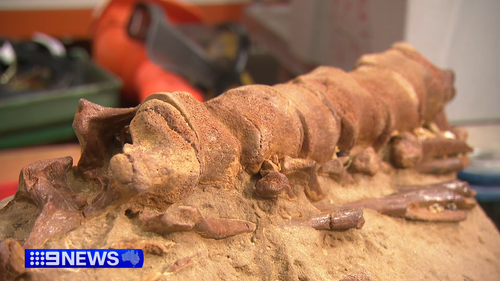
They say it’s one of the biggest whale fossils ever found in Australia.
“Every fossil we find has its own unique significance … it’s rare to find a skeleton where there are many of the bones connected together,” Fitzgerald said.
“There’s one little tooth that we can see exposed on the side of this block, and that tooth suggests that this is from a really quite primitive group of toothed echo-locating whales.”
The fossil could give paleontologists a rare look into a black spot in the history of the mammal.
“These fossils and the rocks that house them at Ocean Grove are from a time in Earth’s history and the evolutionary story of whales, where we have very few fossils worldwide,” Fitzgerald said.
“It’s a critical episode where the Earth’s climate and oceans were changing really dramatically about 21, 23 million years ago.
“This fossil from Ocean Grove doesn’t just have local, state, national significance, it has the real chance to shed light on the global picture of whale evolution through what you might consider the missing years of whale history.”
NEVER MISS A STORY: Get your breaking news and exclusive stories first by following us across all platforms.