
Gain complimentary access to the Editor’s Digest
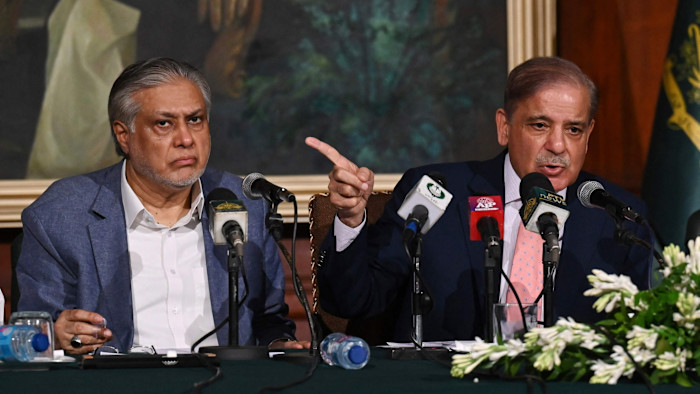
On Tuesday, Pakistan’s foreign minister, Ishaq Dar, stated that he had cautioned his Iranian counterpart against launching any attacks on Saudi Arabia, highlighting a joint defense agreement between Islamabad and Riyadh.
“I communicated the existence of our defense agreement,” remarked Dar, who also serves as Pakistan’s deputy prime minister, referring to his weekend discussion with Iranian foreign minister Abbas Araghchi.
Dar attributed the agreement, established between Islamabad and Riyadh in September, with significantly reducing “missile or drone attacks [on Saudi Arabia],” especially when compared to other Gulf nations.
In response, Tehran sought “guarantees” that Saudi Arabian territory would not be utilized for attacks against Iran, according to Dar.
The defense agreement “declares that any attack on one country will be regarded as an attack on both,” yet neither Islamabad nor Riyadh has activated this clause, despite Pakistan’s engagement in two conflicts with Afghanistan since October.
Dar’s comments to reporters on Tuesday, together with an earlier parliamentary statement, were the first public acknowledgments by a senior official in either Islamabad or Riyadh that the pact may apply to the Iran war.
The Pakistani foreign minister’s statements came the same day Iranian drones damaged the US embassy in Riyadh.
The embassy later warned of imminent missile and drone strikes on the eastern city of Dhahran, where oil company Saudi Aramco is located. The kingdom’s huge oil refinery at Ras Tanura was struck by a drone on Monday.
In a phone call with Saudi leader Crown Prince Mohammed bin Salman on Saturday, Pakistan Prime Minister Shehbaz Sharif said “Pakistan stands in full solidarity with Saudi Arabia” but did not mention the defence pact.
Pakistan has condemned the killing of Iran’s supreme leader Ayatollah Ali Khamenei and the “regional escalation” of the conflict, but its senior officials have refrained from casting blame on the US or President Donald Trump, who they have twice nominated for the Nobel Peace Prize.
Any military engagement by Pakistan against Iran would be fraught with risk, due to widespread support for Tehran among its population, most fervently from its 40mn-strong Shia minority.
A decade ago, Islamabad declined to join air strikes by Saudi and the United Arab Emirates on Iran-backed Houthi rebels in Yemen, sparking a sharp rebuke from Gulf officials.
Pakistan is currently locked in fierce cross-border fighting with the Taliban, its former proxy, in Afghanistan, and, despite bordering Iran, has been spared from its missile and drone salvos.
Yet it still faces significant risks from the Iran war. More than 4mn Pakistanis reside in Gulf states, mostly as migrant labourers, and one citizen was killed when an Iranian missile hit Abu Dhabi on Saturday.
Saudi has sought to remain on the sidelines of the war. Before the US and Israel launched their bombardment of Iran, Riyadh said it would not allow its territory to be used to attack the Islamic republic.
But after the US embassy was hit on Tuesday, Riyadh warned a recurrence of Iran’s “flagrant behaviour” would “push the region toward further escalation”.
“The kingdom reiterated its full right to take all necessary measures to protect its security, territorial integrity, citizens, residents and vital interests, including the option of responding to the aggression,” the Saudi state news agency said.
The UK government is concerned about the risk of escalation in the Middle East and beyond.
A British Foreign Office official said on Tuesday it was “remarkable the extent to which this conflict has already escalated so quickly in its first few days, involving so many Gulf countries, Lebanon, Iraq”.
The official added the UK government noted “the concern of other countries in the region and beyond, including Pakistan”.
British diplomats are in close contact with Riyadh, and are discussing steps the UK could take to bolster the kingdom’s security.
“We need to work to secure de-escalation,” the UK official said.
Additional reporting by Andrew England