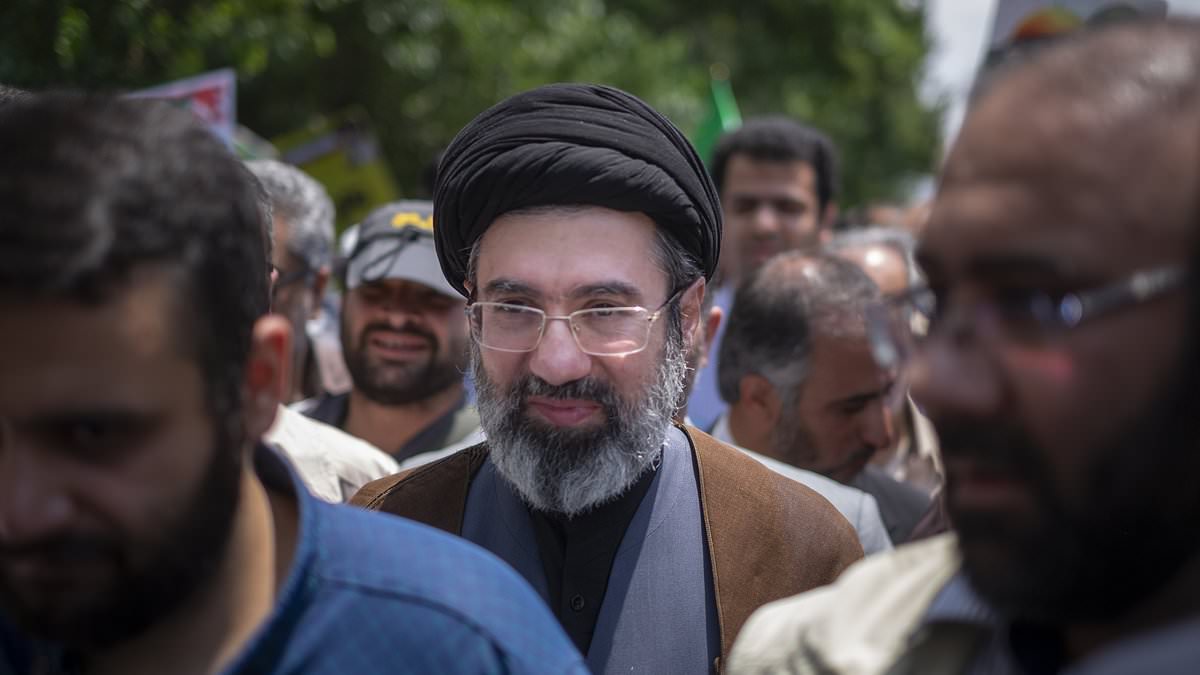

On Wednesday, Israel’s Defense Minister, Israel Katz, issued a stark warning, declaring that any individual chosen to replace Iran’s Supreme Leader, Ayatollah Ali Khamenei—who was reportedly killed in a joint US-Israel assault on Tehran—would face assassination.
This announcement follows reports that Mojtaba Khamenei, the son of the late Ayatollah, is the leading candidate to assume the role of Iran’s new Supreme Leader.
In a social media post, Katz asserted, “Any figure appointed by the Iranian regime of terror to continue the agenda of destroying Israel, threatening the U.S., the free world, and regional nations, while oppressing the Iranian populace, will be marked for assassination, regardless of his identity or location.”
Mojtaba Khamenei, aged 56 and the second oldest son of Ali Khamenei, is known for his close ties with the Iranian Revolutionary Guard Corps (IRGC). According to the opposition news source Iran International, he was selected by Iran’s Assembly of Experts “due to pressure from the Revolutionary Guards.”
Despite not being a high-ranking cleric and lacking any formal governmental position, Mojtaba has never held office within the regime.
Nonetheless, his service in the military during the Iran-Iraq war and his significant influence behind the scenes have positioned him as a potential successor to his father for several years.
However, he was not included in a list of three senior clerics Ali Khamenei reportedly identified last year.
And his father is said to have indicated opposition to his candidacy because it would resemble the hereditary rule enacted by the US-backed Shah monarchy before it was overthrown in the Iranian Revolution in 1979.

Mojtaba Khamenei, the son of Ayatollah Ali Khamenei, is the favourite to become Iran’s new Supreme Leader

Mojtaba (pictured with his father), is not a high-ranking cleric and has no official role in the regime
Father-to-son succession is also viewed negatively in the Shiite Muslim clerical establishment in Iran.
But much of Iran’s top brass has been decimated in the latest conflict and Mojtaba has close ties with the powerful IRGC and the Basij volunteer paramilitary force.
This comes as it was recently revealed that Mojtaba was repeatedly treated for impotency at hospitals in the UK, according to a secret US intelligence document.
According to a classified briefing sent by the State Department to the US Embassy in London in 2008, and later released by WikiLeaks, Mojtaba was placed under pressure by his family to produce heirs.
It required four visits to the Wellington and Cromwell Hospitals, including a final stay lasting two months, and he eventually had a son who was named ‘Ali’ after the baby’s grandfather, the then Supreme Leader.
The intelligence also detailed how ‘within the Supreme Leader’s office, Mojtaba works in his father’s shadow,’ and that he traveled with him in Iran and had a’ fair degree of control over access to his father.’
He was ‘widely viewed within the regime as a capable and forceful leader and manager who may someday succeed to at least a share of national leadership. His father may also see him in that light.’
He was said to be ‘close to and well briefed by’ the senior leaders of the Islamic Revolutionary Guard Corps (IRGC), however was seen as weak in clerical terms.
‘(He) is not expected ever to achieve by his own scholarship the status of ‘mujtahid,’ far less that of ayatollah,’ the report said.
However, in the wake of his father’s death, this may change.
Under Iran’s Islamic guardianship system, the Supreme Leader must be a senior leader with significant political authority.
While Mojtaba has not held senior political roles, he studied under religious conservatives in Islamic seminaries in the Shiite holy city Qom.
Born in 1969 in the holy city of Mashhad, he grew up as his father was helping to lead the opposition to the Shah.
His wife Zahra Adel and his mother, Mansoureh Khojasteh Bagherzadeh, are among the dead from Saturday’s strikes.
The regime’s 88-person assembly is tasked with appointing, supervising and potentially dismissing the supreme leader.
It met on Tuesday in Qom to find a successor to Ali Khamenei, who was killed on Saturday by joint US-Israeli strikes.
Israeli and US strikes flattened the building where the assembly met. There was no information on any potential casualties.
US President Donald Trump said on Tuesday that he fears Iran’s new leader would be ‘as bad as the previous person’.
Commenting on the ‘worst case scenario’ at an Oval Office news conference, Trump said: ‘I guess the worst case would be we do this and then somebody takes over who’s as bad as the previous person, right? That could happen. We don’t want that to happen. It would probably be the worst.’
He added: ‘You go through this and then in five years, you realise you put somebody in who was no better. So we’d like to see somebody in there that’s going to bring it back for the people.’
However, he also expressed confidence on joint US-Israel military capabilities, saying: ‘We have them very much beaten militarily, from the military standpoint. They’re still lobbing some missiles,’ he said.
‘They won’t even be able to do that because we’re hitting all of their carriers. We’re hitting all of their missile stock … and we’re knocking out a lot.’

A primitive Shahed drone evaded high-tech defences over the United Arab Emirates and struck a car park adjacent to the consulate

Smoke rises from an Israeli strike in Beirut on Tuesday
The conflict is now entering its fifth day, with strikes continuing throughout the night.
Israel launched new strikes on military targets in Tehran after an Iranian drone sparked a fire at the US consulate in Dubai.
Iran carried out retaliatory attacks on Middle East Gulf states, targeting US bases including a CIA station at the US Embassy in Saudi Arabia, while the US Consulate in Dubai was also rocked by a drone strike.
The Lebanese capital Beirut was rocked by explosions shortly after midnight as Israel and Hezbollah traded strikes and rocket fire.
Lebanese state media later said Israeli strikes had hit a hotel in the Beirut suburb of Hazmieh, as well as a four-storey building in the eastern city of Baalbek, where five people were reportedly killed.
Meanwhile, Iran’s Revolutionary Guards have today declared they have ‘complete control’ of the crucial Strait of Hormuz
Iranian forces say any vessels seeking to pass the strait – a vital route for world oil and gas supplies – risked damage from missiles or stray drones.
It comes as US President Donald Trump said yesterday the US Navy was ready to escort oil tankers through the crucial Gulf passage
The Guards said they had also launched more than 40 missiles at US and Israeli targets in a new wave of strikes