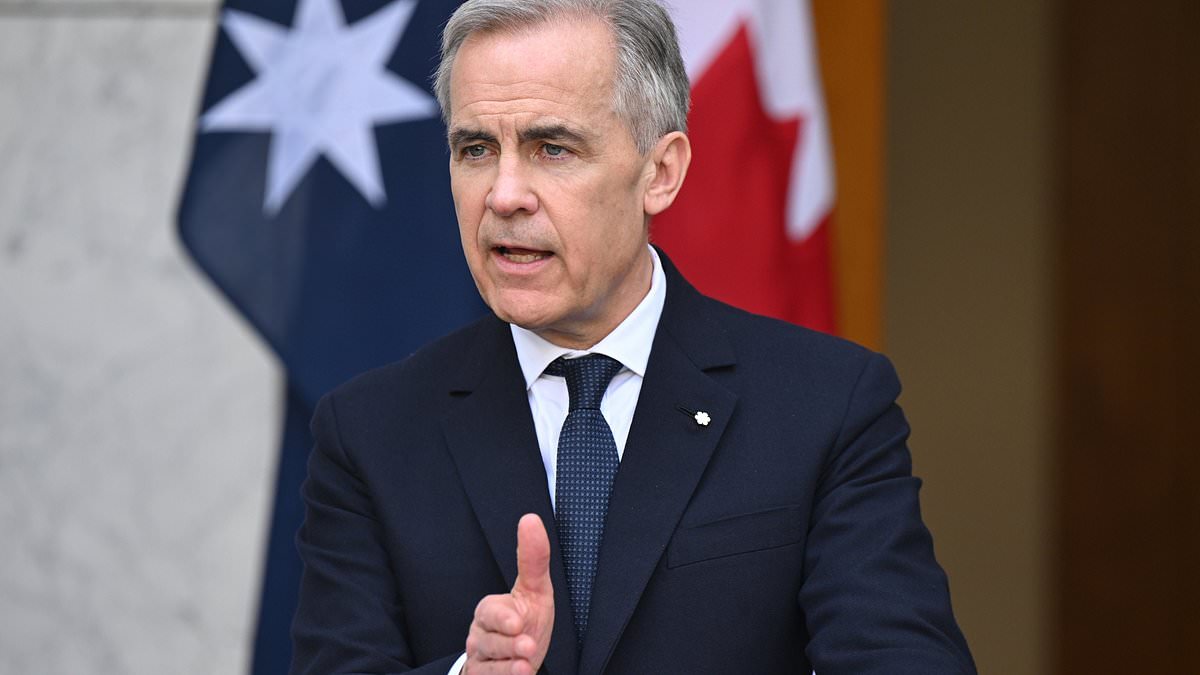


Canadian Prime Minister Mark Carney recently delivered a compelling address to the Australian parliament, urging nations like Canada and Australia to forge new alliances in the face of a fragmented global landscape. Carney emphasized the need for middle powers to collaborate beyond the traditional reliance on the United States. “In a world redefined by disruption, countries that are trusted and can cooperate will respond more swiftly, shape outcomes more effectively, and ultimately enjoy greater security and prosperity,” he stated. Carney challenged middle powers, such as Japan, Australia, Canada, and South Korea, to either uphold existing rules, create new ones for their security and prosperity, or risk allowing major powers like China and the US to dictate global outcomes.
Why middle powers need to work together

Carney’s call for middle power coalitions presents a challenging scenario for Australia, as it prompts a reevaluation of its key ally, the United States. Australia’s defense strategy heavily relies on the US military’s presence and capabilities in the Indo-Pacific region, with much of Australia’s military equipment dependent on US support. Completely severing ties with the US is not feasible, as evidenced by Canberra’s endorsement of recent US and Israeli actions in Tehran, even without direct involvement. Nonetheless, Australia is encouraged to cultivate stronger relationships with other nations, reducing dependence on a potentially unpredictable US. This can be achieved through collaboration in trade, conflict prevention, and international law. As great powers increasingly flout international norms, middle powers bear the responsibility to uphold global institutions and attempt to moderate the actions of the major powers when necessary.
What would middle power alliances look like?

It is important to approach the concept of “middle powers” with a clear perspective. The term typically refers to nations that, while not superpowers, wield significant influence through diplomacy or economic and military strength. This category can include countries whose values might not align with Australia’s, such as Iran. Therefore, Australia should engage with other middle and smaller powers with a focus on common priorities. These include resisting coercion by larger powers, shaping global cooperation frameworks, and holding major powers accountable as “responsible stakeholders” of the international order. In practical terms, Carney, in his Canberra speech, advocated for creating a “dense web of connections” among middle powers. He described this as “variable geometry,” forming diverse coalitions tailored to specific issues based on shared values and interests.
Australia’s international ties

Of course, Australia has a strong alliance with New Zealand. Beyond this, Canberra has signed a number of ‘comprehensive strategic partnerships’ in recent years with countries in the region, including the ASEAN bloc of Southeast Asian countries, India, Indonesia, Singapore, Papua New Guinea, Malaysia, South Korea, and most recently, Vietnam. These agreements can deepen cooperation in a range of areas of mutual concern, including security. Australia also signed a new defence agreement with Japan in 2023 that allows for each country’s forces to operate in the other. This is a big deal – it was Japan’s first defence treaty with an international partner since 1960. More recently, Australia has agreed to bilateral defence agreements with Papua New Guinea, Indonesia and Timor-Leste. These pacts appear focused on ‘strategic denial’ – preventing potential adversaries from achieving a foothold in our immediate region.

These bilateral agreements are regionally focused. A key question for Australia is whether it can also cooperate with countries like Canada, the UK, Germany and France in the Indo-Pacific region. This relies in part on their appetite to engage more here. As Carney mentioned in Canberra, one potential area of cooperation is the Critical Minerals Production Alliance – an initiative launched by Canada to expand critical minerals production and processing capacity and diversify supply chains. Australia also has small coalitions in the region that allow for more flexible models of security cooperation. Coalitions, rather than alliances with firm defence commitments, are more likely to flourish in a region as geo-strategically, economically and politically complex as the Indo-Pacific. Australia’s key ‘minilateral’ partnerships include: the Quad (Australia, US, Japan, India) and emerging ‘Squad’ (Australia, Japan, Philippines, US). AUKUS (Australia, UK, US). The Trilateral Security Dialogue (Australia, Japan, US). Five Eyes (Australia, Canada, New Zealand, UK, US). These all centre on US participation for a reason. Strategic minilateralism has long been Canberra’s way of anchoring Washington to the Indo-Pacific to provide a counterweight to China’s regional influence.

It is important to note that many middle powers hedging their bets by not aligning with either the US or China – such as Indonesia – still have strategies that rely on the US not withdrawing from the region. The challenge now is how to cultivate new small-group arrangements for an uncertain future. Two new groupings that make a lot of sense are: Japan, South Korea and Australia: These three US allies have been growing closer in recent years. Now, it makes even more sense for them to collaborate in ways that may not involve the US, including in economic security, maritime security and supporting international rules. Australia, Japan and the Philippines: Like Japan, Australia is increasing its defence cooperation with the Philippines, another US ally. The Philippines is at the coalface of a number of security challenges involving China. Australia can also deepen relationships with larger groupings in areas other than security. In fact, there’s already a successful group of middle and small powers in the region that doesn’t include either the US or China: the Comprehensive and Progressive Agreement for Trans-Pacific Partnership (or CPTPP).

This is a free-trade agreement originally for Pacific Rim countries, comprising Australia, Brunei, Canada, Chile, Japan, Malaysia, Mexico, New Zealand, Peru, Singapore and Vietnam. (Trump pulled the US out in 2017.) The United Kingdom became the first non-Pacific nation to join in 2024; others like Uruguay, Costa Rica, the United Arab Emirates, Indonesia and the Philippines are interested in joining next. The CPTPP has been successful in eliminating most tariffs among member countries, while also providing a platform for economic cooperation more broadly. This agreement could expand even further to include the European Union, South Korea, Norway and Switzerland. Carney wants to ‘broker a bridge’ between the EU and the CPTPP to ‘create a trading bloc of 1.5 billion people, grounded in common standards and shared values’.
The ‘rupture’ in the global order

We need to avoid simplistic narratives about the state of the international order. Multilateralism isn’t dead. Global institutions still matter. And people risk misunderstanding Carney’s call if they use it to suggest we need to funnel all of our efforts and resources into military deterrence alone. Middle and small powers play important roles in preserving international norms and creating new ones. This is more pressing in the current security environment. And though the US is less interested in multilateralism at the moment, there is still a place – and a need – to encourage the great powers to cooperate on a wide range of issues, from trade to climate change to AI governance.