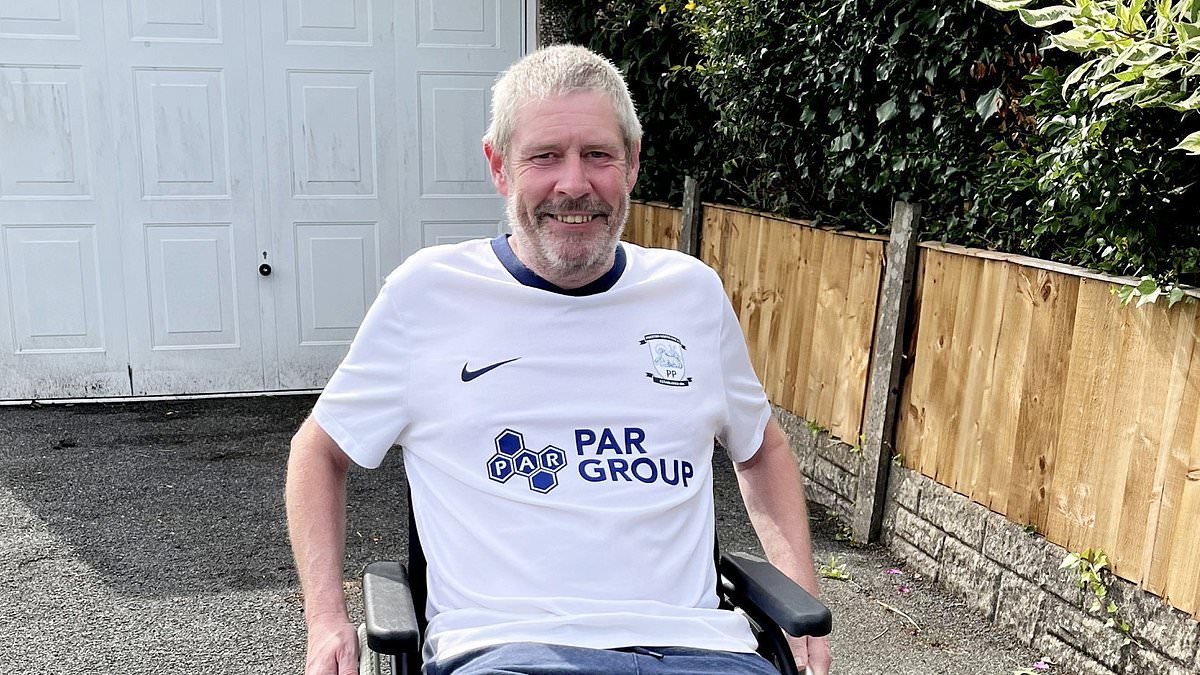

A man who initially attributed the stiffness in his legs and frequent falls to aging was ultimately diagnosed with motor neurone disease, a severe illness that deteriorates the nerves responsible for movement.
Andrew Chadwick, aged 53, first experienced leg stiffness in January 2025, resulting in a fall that caused him to trip over a curb and fracture a rib. Not long after, he experienced another fall.
His wife, Joanna Chadwick, explained, “He kept having trouble walking, but we assumed it was just due to his age, or perhaps a pinched nerve.”
“He visited a physiotherapist, who insisted on an urgent hospital referral. Andrew spent two weeks undergoing tests, but nobody was providing us with any information,” she continued.
Hailing from Lancashire, Mr. Chadwick received a diagnosis of motor neurone disease (MND) in June 2025. This debilitating condition leads to muscle weakening and can severely impact breathing and eating.
“When Andrew received the diagnosis, I was heartbroken,” Mrs. Chadwick shared. “I buried my face in my hands, and Andrew began to cry. It left me speechless. Nothing can truly prepare you for such news.”
MND affects up to 5,000 adults in the UK at any one time. There is a one in 300 lifetime risk of developing the disease and, while it can affect adults of any age, it is more common in people over 50.
The disease affects the nerves known as motor neurons, which are found in the brain and spinal cord. Symptoms include stiffness, difficulty walking and muscle cramps, and the condition is usually life-shortening.

Andrew Chadwick, 53, was diagnosed with MND – a condition that causes muscle weakness and can lead to problems with breathing and eating – in June 2025

Andrew is picture with his wife, Joanna Chadwick, who has supported him throughout his diagnosis and recovery
Mr Chadwick had to give up his job as an engineer as he no longer had the strength to continue working.
His wife explained: ‘Since the diagnosis, Andrew’s condition has worsened. He now can’t walk anywhere without a walking aid, even in the house.
‘He’s missed his walker a few times and fallen on the floor. He looked so helpless with tears in his eyes – he couldn’t get up again.
‘It takes him half an hour to get dressed; his legs are so stiff, so I put his socks on for him.
‘I have to make his lunch before I go to work because he can’t cut meat up or butter bread.’
There is currently no cure for MND, with treatments instead focusing on easing symptoms and improving quality of life.
Mr Chadwick takes two medications: Baclofen to relax his muscles and help with stiffness in his legs, and Riluzole, which can slow the progression of the disease.
In November 2025, his feet gave way as he was getting out of the car, leaving his head covered in cuts and requiring a trip to A&E.
However, the couple are not letting the diagnosis get them down and has decided to focus their time on raising money for MND charities and increasing awareness of the disease.
They have organised charity nights and a sponsored walk on MND Awareness Day, with Mrs Chadwick determined to get her husband to the finish line. In May, Mr Chadwick will also be taking part in a sponsored skydive.
Mrs Chadwick said: ‘We want to raise awareness for people with MND and show that even though you’ve got this horrible, cruel disease, you can still value life.
‘We’re raising money for the MND Association and Andrew is doing a sponsored skydive in May.
‘We just want to give back and help other people.’