
The United States’ comprehensive military engagement in Iran has likely incurred billions of dollars in expenses for American taxpayers in a matter of just one week.
On February 28, the US, in coordination with Israeli forces, launched a series of strikes, prompting Iran to retaliate with attacks on US military installations throughout the Middle East. The ensuing conflict has tragically resulted in a death toll reaching into the thousands.
Iran’s ambassador to the United Nations has reported that the casualty count has exceeded 1,300 lives. Additionally, over 200 individuals have lost their lives in Lebanon, along with at least 11 fatalities in Israel.
In a particularly devastating incident, six US service members were killed during an Iranian airstrike on a base in Kuwait on Sunday. President Donald Trump traveled to Delaware on Saturday to attend the dignified transfer ceremony for the fallen soldiers.
The conflict’s impact has extended beyond the battlefield, causing significant disruptions in travel as Middle Eastern airspace was temporarily closed. This closure has left thousands of American travelers stranded abroad.
Amidst the ongoing turmoil, the Trump administration has faced persistent inquiries regarding the financial burden of these military operations.
The Department of War provided a breakdown of assets and targets from the first 72 hours of Operation Epic Fury; however, government officials have not disclosed the exact cost of the military activity.
The Center for Strategic and International Studies, a bipartisan research institution in Washington, analyzed DOW fact sheets, Congressional Budget Office estimates, and statements from government officials to provide an estimate of wartime costs for the operation thus far.

A recent study has estimated that the US has already spent billions on the first 100 hours of military operations in Iran. President Donald Trump and Secretary of War Pete Hegseth, pictured above, have vigorously defended the efforts

Military operations in the region are now entering its second week. Pictured above is the aftermath of strikes in Tehran on Friday

The military strikes were initiated last Saturday by Israel and the US. Iran has retaliated against US military bases across the Middle East. Pictured above is an explosion in Tehran on Saturday
The study concluded that the US has spent around $3.7 billion, or $891.4 million a day, on wartime efforts in the first 100 hours of Operation Epic Fury.
The most significant expense comes from munitions. CSIS estimated that the US spent $3.1 billion on munitions alone, none of which were budgeted for.
Combat losses and infrastructure damage totaled $359 million, which was not previously budgeted for by the DOW.
Lastly, operations and support costs totaled $196.3 million, including $18.3 million that was already included in the DOW’s budget.
These estimates indicate that the DOW spent approximately $3.54 billion in unbudgeted funds during the first 100 hours of the war in Iran. Congress passed a $900 billion defense budget last year.
Below is a breakdown of military expenses for air, naval, and ground operations:
Air operations – $125 million

A new study has estimated that air operations alone have already cost US taxpayers $125 million. Pictured above is a US navy fleet in 2024
CSIS estimates that air operations in the first 100 hours of Operation Epic Fury cost $125 million and are increasing by $30 million per day.
The institution cited an update from the US Central Command on Tuesday stating that more than 200 fighter aircraft were conducting operations.
CSIS estimated the following costs for the most expensive aircraft assets per day:
- Tanker and cargo: $9 million
- Carrier air wing: $5 million
- Non-stealth fighter: $5 million
- Stealth fighter: $5 million

The US has authorized millions of dollars worth of military equipment in the region. Pictured above is an Iranian fighter jets being before US troops destroyed it
Naval operations – $64 million
CSIS estimates that naval operations cost $64 million during the first 100 hours, of which $5.9 million is unbudgeted, and increase by about $15 million per day.
The US has consistently sent warships to the Middle East since the October 7 attack, but naval forces surged in the region for Operation Epic Fury.
Two US Navy carriers, 14 destroyers, and three littoral combat ships are currently in the Arabian Sea, Persian Gulf, and the eastern Mediterranean.
CSIS estimated the following costs for the most expensive naval assets per day:
- Aircraft carrier: $6 million
- Destroyer: $5 million

Naval operations are estimated to have cost $64 million. Pictured above is the missile destroyer USS Frank E. Petersen Jr in the Arabian Sea on February 18

The US has shot down numerous Iranian fighter jets. Pictured above is a US armanent destroying an Iranian ballistic missile on March 2

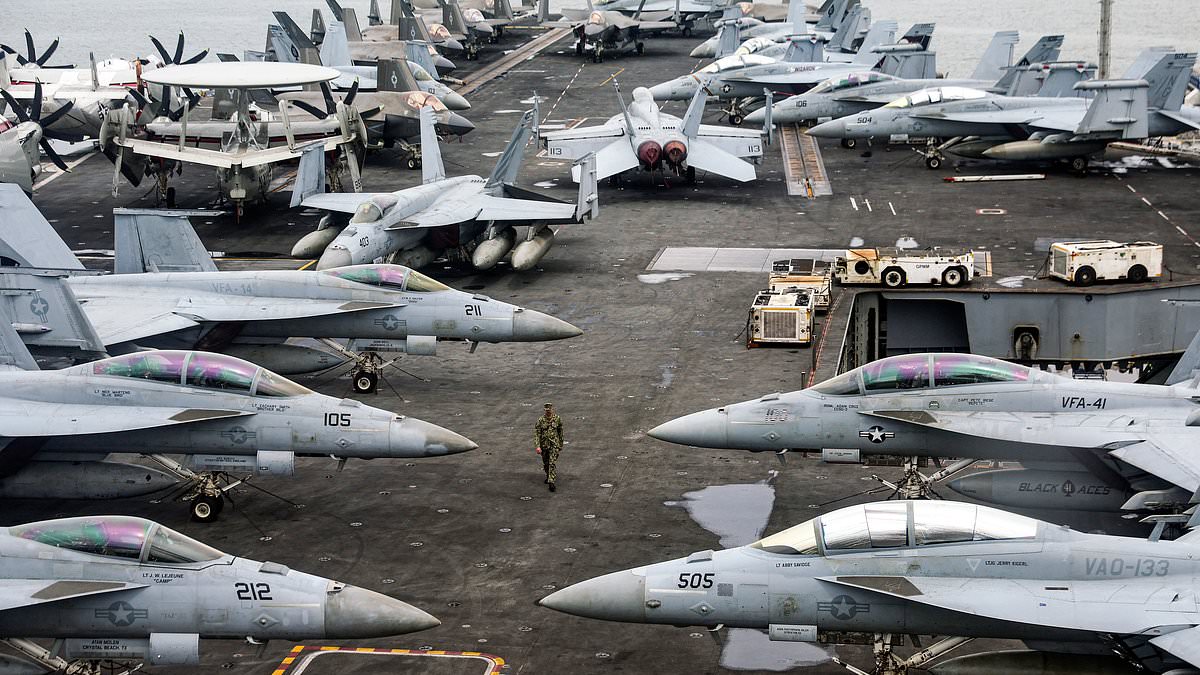
Aircraft carriers and destroyers have been sent to the Middle East amid ongoing military operations. Pictured above are fighter jets parked on a flight deck on Thursday
Ground operations – $7 million
The US has yet to initiate a ground invasion of Iran, but there are almost 600 US soldiers stationed at military bases across the Middle East as of December, according to the Defense Manpower Data Center.
Artillery units have also been known to operate in the region, and the National Guard battalion was activated.
CSIS estimated the following costs for the most expensive ground assets per day:
- Artillery brigade: $1 million
- National Guard battalion: less than $1 million

Two Iranian fighter jets were destroyed on March 2, pictured above. The war has already cost US taxpayers an estimated $3 billion
Munition expenditures
Using past US air campaigns, CSIS estimated that it will cost $3.1 billion to replenish the US munitions inventory used in the first 100 hours of Operation Epic Fury, with costs increasing by $758.1 million a day.
The US has sent over 2,000 munitions of various types to Iran in just the first few days of the operation, according to US Central Command.
‘Though expensive and scarce, the long-range missiles allow U.S. forces to strike from a distance,’ CSCIS wrote.
‘In the initial, surprise attack, they would have been used to destroy Iranian air defenses and other counter-air capabilities and create permissive conditions for follow-on attacks.’
The institution also estimated a cost of approximately $359 million in equipment losses and infrastructure damage.
The extent of damage to US military bases in Gulf countries is unclear, but videos of the attacks have shown explosions at facilities in Kuwait and Qatar.

Pictured above is a map of damaged US military bases across the Middle East
Continued costs
Costs in the initial days of a war are typically the most expensive. The Trump administration has not provided a timeline for how long military operations will continue in Iran.
DOW Secretary Pete Hegseth told reporters on Wednesday that US forces would be ‘accelerating.’
‘We are just getting started,’ he said.
Kent Smetters, a researcher at the University of Pennsylvania’s Penn Wharton Budget Model, told CNN that even a two-month war could cost up to $95 billion.
The Iraq War cost American taxpayers $3 trillion. The massive price tag was significantly higher than the Bush administration’s 2003 estimate of $60 billion.
The Pentagon told the Daily Mail that it did not have the exact costs on wartime efforts to provide.