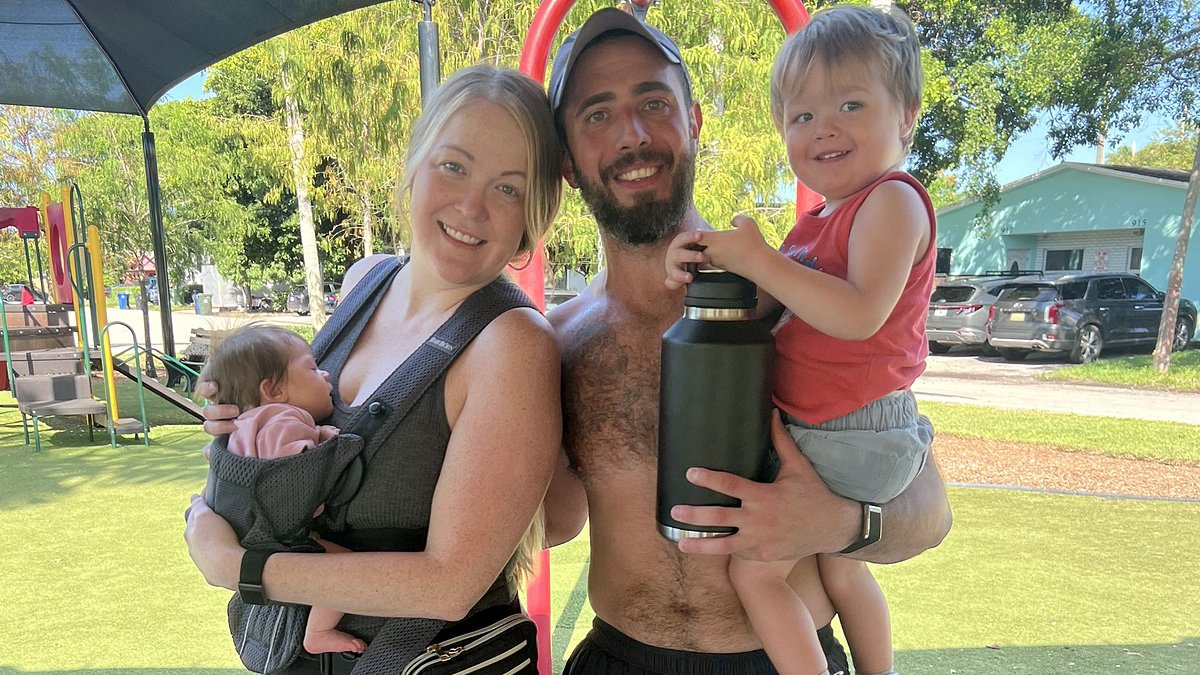

A Florida father initially attributed his unexpected chest pain to a meal of spicy food, only to discover that he was in the throes of a life-threatening heart attack.
Mario Ciccarello, a 34-year-old dedicated fitness enthusiast and warehouse employee, had just wrapped up a workout session in the park this past February when he experienced sudden, intense pain in his chest.
The discomfort soon spread to his shoulder and left arm, symptoms he recognized as classic indicators of a heart attack.
Despite being an ultra-marathon runner, Ciccarello dismissed the possibility of cardiac issues due to his age and fitness level, instead chalking up the pain to the spicy Mexican food he’d consumed the previous night.
Upon returning home around midday, he informed his partner, Stephanie James, that he needed to lie down, telling her he felt as though his heart was “shutting down.”
James, who was in the midst of recording a social media video, lightheartedly asked, “Are you dying?” to which Ciccarello responded, “I might be.”
‘I had this overwhelming sense of dread that I can’t fully describe. Something was awry inside,’ he said.
When Ciccarello went to lie down, his resting heartbeat raced to 112 beats per minute, nearly twice his normal rate, a sign of increased strain on the heart.

Mario Ciccarello, a 34-year-old fitness fanatic and warehouse worker, thought he was having chest pain from eating spicy food. It was a heart attack. He is pictured above with his partner, Stephanie James, and their two children
‘Then the pain came back like a tidal wave. It was ten times worse than in the park,’ he said. ‘My whole left side felt like it was detaching from my body.
‘I looked at my son sleeping and wondered if it was the last time I was going to see him.
‘That’s when I went into the living room and I told [James] it isn’t a joke now and I think I’m having symptoms of a heart attack.’
Ciccarello and James rushed to the hospital, where doctors found he had suffered a 95 percent blockage in his left anterior descending (LAD) artery, which supplies more than half of the heart’s blood.
The blockage causes a ‘widow-maker’ heart attack, a name that refers to the high mortality rate.
Doctors estimate only 12 percent of patients survive because blocking the LAD artery immediately causes massive damage to the heart’s pumping chamber.
Widow-maker heart attacks are more common in men, especially in their 40s, though women over 50 can also be at an increased risk.

Pictured above is a scan showing Ciccarello’s blocked left anterior descending artery
About 800,000 Americans suffer a heart attack every year.
Much like other forms of heart attack, the risk of developing a widow-maker event increases from lifestyle habits such as obesity, a lack of exercise and a diet high in saturated fats.
But Ciccarello is part of a growing number of young, fit Americans suffering heart attacks for no clear reason.
In 2019, 0.3 percent of adults in this age group had experienced a heart attack. By 2023, that figure increased to 0.5 percent—a rise of over 66 percent in just four years.
It means that one in five heart attack patients are now younger than 40.
The causes are unclear, but recent research has honed in on stress, delayed screenings and potential environmental contaminants such as pollution.
In Ciccarello’s cases, doctors suspect he may have a genetic condition that made him more susceptible to a heart attack, but it’s currently unclear which condition it may be, so his team is still running tests.

Ciccarello, pictured above with his son Luciano, is part of a growing number of fit Americans suffering heart attacks

Ciccarello, pictured above, is now educating other young people about the signs of a heart attack
Despite low odds, doctors were able to save Ciccarello’s life by inserting two stents – mesh tubes that restore blood flow through blocked arteries – into his heart.
Ciccarello, who is now on blood thinners while he undergoes genetic testing, is using social media to educate other young, fit people about the signs of a heart attack, which include chest pain, shortness of breath, dizziness, an upset stomach, fatigue and lightheadedness.
‘I could have died and we should have gone to the hospital sooner but we did not think for a second I was having a heart attack,’ he said.
‘When I look back I wish I’d have gone earlier because they say every minute you wait it does more damage to your heart.’


