
For many years, the idea of cryopreservation has been a staple of science fiction, often used as a creative device to propel characters into the distant future.
One of the most formidable challenges in this field has been the ability to freeze complex biological tissues, especially the brain, without inflicting severe and irreversible damage.
However, a recent groundbreaking study has made substantial progress in this area, successfully reviving functional activity in previously frozen brain tissue. This achievement brings previously far-fetched futuristic concepts closer to reality.
The main challenge in preserving brains through cryopreservation has been the formation of ice crystals.
When water within the delicate cellular structures freezes, it expands into ice crystals. This expansion can puncture cell membranes, disrupt the intricate network of neurons, and ultimately sever the connections vital for thought, memory, and consciousness.
Such damage results in thawed tissue that is unable to perform any meaningful functions.
However, a team of neurologists at the University of Erlangen–Nuremberg in Germany circumvented this problem by turning to a technique known as vitrification.
This process cools tissue so rapidly that it prevents ice from forming altogether, and Instead of crystallizing, the liquids inside and around the cells transform into an amorphous, glass-like state, preserving the tissue’s structure with all molecular motion effectively halted.

In the film Passengers, cryosleep is the central tragedy: Jim Preston wakes 90 years too early from his hibernation pod, forcing him to grapple with unbearable isolation and the devastating choice of whether to doom another passenger to the same fate
The team applied this method to thin slices of mouse hippocampus, a region critical for learning and memory, cooling them to -196 degrees Celsius (about -321 degrees Fahrenheit) with liquid nitrogen.
The samples were then stored in this glass-like state for periods ranging from ten minutes to a full week.
The true test came with rewarming. The researchers meticulously thawed the brain slices, then probed them to see if any indication of life remained. Microscopic analysis revealed that the delicate neuronal and synaptic membranes had survived the process intact.
Further tests showed that the mitochondria, the tiny energy sources within the cells responsible for metabolism, were functioning without signs of damage, according to the latest study, published in Proceedings of the National Academy of Sciences (PNAS).
The team was able to record electrical activity from the neurons. The cells responded to electrical stimuli in a way that was near normal, though with some moderate deviations from unfrozen control samples.
Most importantly, the researchers observed evidence of long-term potentiation (LTP), a process involving the strengthening of synapses that is considered a cellular basis for learning and memory.
This finding suggested that not only were the individual neurons alive, but some of the complex, functional circuitry underlying cognition was also intact.
To achieve this breakthrough, the German research team started with thin slices of mouse hippocampus, a region critical for memory.

The movie Aliens involves cryosleep that has devastating consequences. Ripley awakens after 57 years to learn her daughter grew old and died without her
These were immersed in a potent cocktail of cryoprotective agents (CPAs) introduced in steps to prevent shock.
Once fully loaded, the slices were plunged onto a copper cylinder cooled by liquid nitrogen. In this state, all molecular movement stopped completely for up to a week.
Rewarming was just as critical as the freezing. To prevent ice from forming as the tissue transitioned back to a liquid state, the slices were warmed incredibly fast, at a rate of 80 degrees C (176 degrees F) per second in a warm solution.
Once thawed, the potent chemical cocktail was carefully washed out in a way that prevented the cells from absorbing water too quickly and bursting.
The team then attempted to turn an entire mouse brain into a glass-like state. A major hurdle was the blood–brain barrier, the brain’s natural defense system. It lets water pass through easily but blocks the large molecules of the CPAs.
The researchers’ solution was to alternate perfusing the brain’s blood vessels with the protective chemicals and a carrier solution.
This approach loaded the tissue evenly without causing catastrophic dehydration or, later, fatal swelling.
After rewarming, the team put the tissue through a rigorous battery of tests to see if it had survived.
They measured oxygen consumption to confirm the cells’ powerhouses, the mitochondria, were still working.
They used powerful electron microscopes to check if the delicate connections between neurons, called synapses, remained intact. And crucially, they inserted tiny electrodes to stimulate the cells and listen for a response.

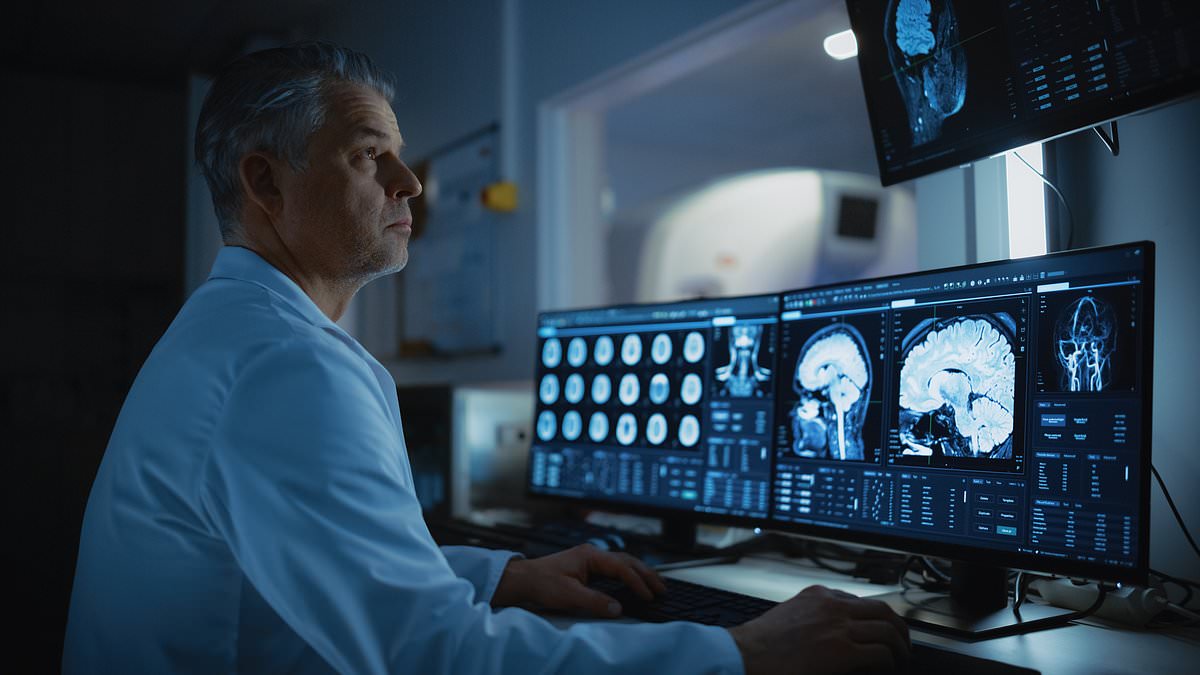
A team of neurologists at the University of Erlangen–Nuremberg in Germany froze the brain tissue using a technique known as vitrification (stock image)

In normal tissue (black) and tissue exposed only to the protective chemicals but not frozen (blue), the responses get stronger with each pulse, a sign of healthy short-term plasticity. But in tissue that went through the full freeze-thaw process (red), this strengthening is muted. This confirms the change comes from vitrification itself, not just chemical exposure
Remarkably, not only could individual neurons fire in response to stimulation but the complex circuits underlying learning and memory were still operational.
The observations were limited to a few hours, as the brain slices naturally degrade after thawing and the work was done on thin tissue sections not a whole, living brain.
Mrityunjay Kothari, a mechanical engineer specializing in cryobiology, told Nature: ‘This kind of progress is what gradually turns science fiction into scientific possibility.’
However, he added that applications such as the long-term banking of large organs or mammals remain ‘far beyond the capabilities of the study.’
Nevertheless, the implications for health and medicine are notable. This research opens new avenues for protecting the brain after severe injury or during disease, where inducing a protective, suspended state could buy precious time for treatment.
It also suggests that researchers could potentially allow for the long-term storage of donor brains for research or, more realistically, other complex organs for transplantation.
This study provides the most compelling evidence yet that its foundational science may be slowly building.


