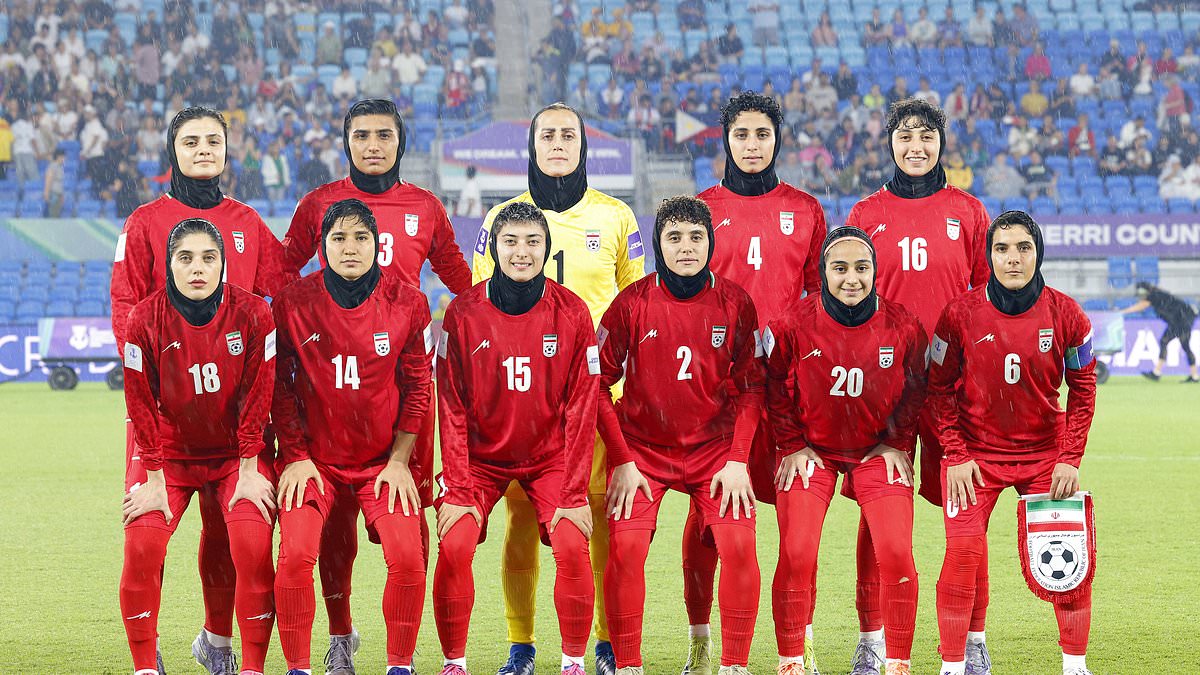

A member of Iran’s women’s national football team has become the fifth individual from the delegation to withdraw her asylum request and depart from Australia overnight. This sudden change comes amid concerns that the athletes faced coercion, possibly through threats aimed at their families back in Iran.
Initially, seven members of the visiting women’s football delegation, comprising six players and one backroom staff, sought asylum in Australia. Their actions followed accusations of being ‘traitors’ in Iran after they refused to sing the national anthem during the ongoing conflict involving Iran, the United States, and its ally Israel.
Despite the initial asylum requests, the situation shifted dramatically. One player quickly decided to return to Iran shortly after accepting asylum in Australia.
The situation further escalated when Home Affairs Minister Tony Burke revealed that three more individuals from the delegation had retracted their asylum requests and departed for Iran on Saturday night.
Iran’s state broadcaster reported that “two players and a member of the technical staff of the women’s national football team” had abandoned their asylum applications in Australia and were on their way to Malaysia.
Adding to the developments, the government confirmed the departure of another player, Captain Zahra Ghanbari. As the national team’s top goalscorer and a prominent striker, her return leaves only two members of the delegation still in Australia.
Iranian media reports praised her move, with IRNA saying she was ‘returning to the embrace of the homeland’, and the Mehr news agency describing it as a ‘patriotic decision’.

A fifth Iranian women’s footballer has withdrawn her asylum claim and left Australia overnight. Seven were granted protection, but five have now returned home, leaving just two players remaining in Australia
Officials from Home Affairs gave the trio repeated opportunities to change their minds before honouring their request to go home.
‘While the Australian government can ensure that opportunities are provided and communicated, we cannot remove the context in which the players are making these incredibly difficult decisions,’ Burke said.
‘The Australian government has done everything we could to make sure these women were provided with the chance for a safe future in Australia.’
The first player who changed her mind over the asylum application exposed the location of the other asylum seekers when she contacted Iran’s embassy in Australia.
They were then forced to change the safe house where they were living.
A former player and a Persian-language TV channel based outside Iran said the players had been pressured to reverse their stance through threats against families back home. But Iranian authorities have in turn accused Australia of pressuring the players to stay.
The opposition broadcaster Iran International said it had been told family members were threatened, with Ghanbari’s mother called in by the Guards’ intelligence arm before her daughter was informed of the questioning.
Shiva Amini, a former Iranian national futsal player who now lives in exile, said she had heard information that Iran’s Football Federation, working with the Revolutionary Guards, ‘placed intense and systematic pressure on the players’ families in Iran’.

Captain Zahra Ghanbari, a striker and the national team’s top goalscorer has returned to Iran
Amini, who left Iran following a hijab controversy, claimed this ‘shows the level of cruelty and desperation they are willing to use to force these athletes to comply’.
Lawyer Kambiz Razmara, vice-president of the Australian Iranian Society of Victoria, told Daily Mail there was no doubt the Islamic Revolutionary Guard Corps ‘would have got to them’ despite the women being held in a safe house.
‘The pressure on the family back home, perhaps via the players who have already left, the usual routine by this regime to intimidate, frighten and coerce into action anyone who defies it,’ he said.
‘And it’s not just threats on their families. It’s also the social stigma for them back in Iran.
‘Only 11 per cent of the country is pro-Ayatollah, but they have status and they would be using propaganda such as the US bombing of the school to try and turn people around.’
Mr Razmara claimed there would be ‘enormous pressure’ for the remaining players to return home.
‘That kind of feeling, the dread, is just awful. It’s akin to waiting to know whether cancer is going to kill you,’ he said.
Mr Razmara said the women’s soccer players, if they stayed, would be subject ‘to the pressure of watching things unfold from afar’.

Concerns have been raised that covert Iranian agents could have played a role in convincing them to return home
‘It can be that the IRGC can go and arrest family members, or make businesses suffer or just harass someone as they walk down the street,’ he said.
‘We understand it will be difficult for them. We are in solidarity with them.’
Tina Kordrostami, a councillor for the Australian city of Ryde, claimed the players were being ‘heavily intimidated’ by Tehran, suggesting their families were being used as leverage to get them back home.
‘I know families have even been detained. I know family members are missing,’ Kordrostami told Fox News.
‘One thing I really would like for people in the West to understand is that Iranians within the country have in many ways given up on the West, and they are only relying on one another to survive this regime,’ she added.
‘We are very worried about them. We know for a fact that they will not be safe,’ she said, referencing claims that the women face severe consequences once they return back home.
Conflict in the Middle East continues to widen, with intensified attacks on Iran and retaliatory strikes targeting multiple Gulf countries.