
This week, as our government officials received a warm welcome in the United States, it’s tempting to interpret this as a reflection of the positive regard for Ireland and its people. However, it’s important not to let this reception inflate our sense of self-importance.
President Catherine Connolly’s recent statements regarding Ireland’s ‘unique’ role in global matters serve as a timely reminder of this. Her remarks, while perhaps well-intentioned, were inaccurate, somewhat embarrassing, and ultimately unnecessary.
During her St. Patrick’s Day address, Connolly reiterated comments she made earlier for International Women’s Day. She stated, “As a neutral, independent country, a post-colonial society, and a people marked by famine and forced migration, we are uniquely placed to offer a valuable perspective on the challenges facing our world, not least war and displacement.”
But is Ireland truly unique in this regard? Every nation and every individual has their own unique story. The idea of uniqueness does not inherently bestow a special status. Some in Ireland, led by our President, seem to believe it grants us a sort of moral superiority. This perspective is misguided.
On International Women’s Day, Connolly labeled the bombings in the Middle East as “deliberate assaults on international law,” referring to these actions as violations of the international norms that have underpinned global peace for decades. She urged for these acts to be called out unequivocally.
Interestingly, she refrained from naming the countries involved, despite the fact that many understood her implication. Perhaps she feared further straining relations with the government, but naming the US and Israel might have lent her words more weight.
She also pointed to Ireland’s history of colonisation, famine and the peaceful resolution of conflict in the North, which she said ‘oblige us to speak plainly’.
The President said Ireland is ‘uniquely positioned’ to do that, pointing to the State’s peacekeeping history and commitment to disarmament and non-proliferation, which she said stand as ‘testament to the disproportionate influence a small, neutral state can wield when it acts with integrity and purpose’.
Really? Does the President really think that when Ireland speaks the whole world listens, believing that we have some ‘unique’ authority and standing that is not found elsewhere?
Nobody would dispute the validity of her message in her first St Patrick’s Day message since taking office that ‘the normalisation of war can never be accepted.
Now, more than ever, we must renew our commitment to peace and diplomacy in line with the principles of international law as set out in the United Nations Charter’.
Leaving aside the ‘now more than ever’ cliché that has become so overused in recent times – since the Second World War there have been many crises of the kind we are seeing now – we should be humble enough to realise that many other countries, both aligned and non-aligned to military groups, have also put in very significant shifts in UN peace-keeping.
We are no more virtuous than them.
How many peace agreements have been brokered by Ireland?
How many people actually turn to us for advice or help?
How many others have a perception of us that mirrors our self-regard?

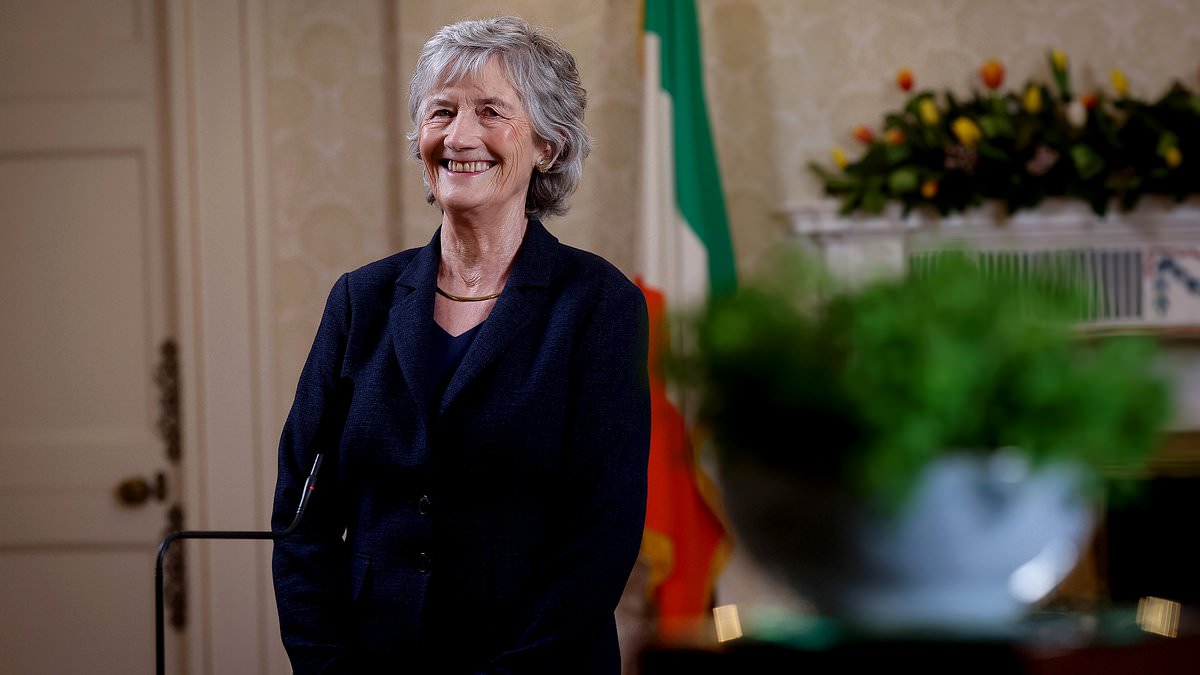
The President, seen here with husband Brian, is right to be concerned, to voice concerns on our behalf, but might be more thoughtful in her assessment of our role in sorting the world out
Many other countries have experienced colonisation and famine – and far more recently than we have.
There are other countries that realise that armament is a necessity for defence and that to be without defensive weapons in the face of threats from aggressors – of whom there are many – is often hopelessly naïve.
The idea that Russia and Israel, for example, can be talked down from their aggression is almost nonsensical… and now, unfortunately, the US has returned to that list of rogue international actors.
The President is right to be concerned, and to voice concerns on our behalf, but might be more thoughtful in her assessment of our role in sorting the world out.
Best to keep Trump in Doonbeg during his Irish visit
If, as is likely, Donald Trump comes to Ireland in September it will likely be to Dublin as well as Doonbeg, even if the Government would quietly prefer it if he stuck to the Clare venue.
Keeping him at the golf would be easier from a security and political point of view.
Holding protesters at more than arm’s length would be made easier by the remote location of the golf course.
Politically he wouldn’t quite be out of sight and out of mind, but there would be fewer opportunities for embarrassment to the host country, especially if it could be portrayed as a private visit.
However, there are concerns in Government circles that Trump might want a detour to Dublin as part of any visit, and there is a reason for this.

Donald Trump in Doonbeg… There are concerns in Government circles that Trump might want a detour to Dublin as part of any visit he might make later this year for the Irish Open golf
The US government has bought a significant plot of land in Dublin as the location for its new embassy in the city, over four acres of prime real estate.
Congress was informed by the State department of a $171million purchase and of a plan to spend another $510million on design, construction and fit-out.
The old landmark Jury’s Hotel in Dublin 4 was demolished over a year ago and, rather than leaving a large hole in the ground, the site has been resurfaced with tarmac (although no parking is allowed behind the fences that have been erected there, which is something of a waste).
There is speculation in Government circles that Trump, as a keen property developer, might be interested in overseeing a ceremony breaking ground for the new embassy.
His good mate and golfing buddy, Ambassador Ed Walsh, might see it as a way to entertain his sponsor. He could tell him stories about what Seán Dunne wanted to do on the extended site two decades ago, to create a mini-Manhattan. Trump would surely enjoy that. He might even want the new embassy to be named after him.
A ceremony would be a major security problem, however, especially as residents in the highly expensive apartments nearby overlooking the empty site might be required to move out.
It would also be a choke point at which protesters might congregate, but at least it would give the gardaí practice for the Israeli soccer international that is due to take place at the nearby Aviva stadium in early October (which, as an aside, must be becoming more unlikely to take place).
The idea of bringing the US president to Ballsbridge might make some sense, to the Americans at least, but if Trump were in Dublin there would be pressure to have him hosted at Government Buildings too, elevating the status of the visit. It would be rude not to invite him if he was in town.
In that case there would be pressure to go the whole hog and allow him to address the Houses of the Oireachtas, an honour afforded previously to presidents John F Kennedy, Bill Clinton and Joe Biden (but not to Barack Obama who instead, in 2011, addressed a large crowd at College Green in the capital).
There would be some political resistance to that, to put it mildly. The TDs who sat on their hands instead of applauding when Ukrainian president Volodymyr Zelensky visited might be far more vocal in opposing Trump. For those reasons, take it as an unlikely development.
However, if their president is in Dublin, the Americans would expect that a visit to Áras an Uachtaráin would be in order, even if it might surprise Trump to find that the incumbent, Catherine Connolly, is a woman and not, as he assumed last Tuesday, a man.
The conversations between the pair, both public and private, could be very difficult, given that the Irish President would be most unlikely to show the restraint displayed by Micheál Martin last Tuesday and might cut loose in condemning Trump’s love of war and bullying.
At least she wouldn’t want to play golf with him.
Data centres should pay household rates for electricity
The price of electricity is going up sharply. That is inevitable. Even if the war in the Gulf is ended soonish – which seems unlikely – the disruption will take a long time to rectify.
Even though not all electricity is generated from fossil fuels, the price of electricity in this part of the world is tied to the price of gas, which has soared since the American and Israeli bombardment of Iran started. Without effective regulation, suppliers are poised to exploit this with rampant profiteering.
Already over 300,000 households are in arrears on their bills. It has been pointed out that electricity and gas prices are well below the peak they reached in 2022 and 2023 but it’s all relative. Prices did not fall back to where they were in 2021 before the crisis caused by Russia’s invasion of Ukraine.
People have been spending more of their monthly income on electricity, especially now that the Government has phased out the cost-of-living supports that helped mitigate the bills. The increase in prices may not be as sharp as three or four years ago but they will be sizeable still and will come on top of an already elevated level.
In the budget last October the Government not only removed the last supports but didn’t give people any income tax improvements either. Voters were told essentially to maintain their living standards by negotiating inflation-matching pay increases with their employers. But inflation is now likely to tick up sharply again.
The Government also made it clear that it wants to wean people off income supports However, it is going to have to make things a little easier for motorists, especially those who need their cars or lorries for work and who cannot depend on public transport. As the Government benefits from the increases in the prices of petrol and diesel – taking 60% in taxes – it has to reduce excise duties to bring prices back down.
But it seems set to resist attempts to reinstate electricity credits, arguing that they should be targeted at those who need them, not everyone. That’s fair enough in theory, but anyone who doesn’t get the income supports – even if they don’t really need them – is going to be angry about others who do get them. That’s human nature.
We have made strides in increasing our wind and solar capacity (although not by nearly enough because of the failure to put in new off-shore wind farms for over two decades, depending instead on taking power from onshore wind farms).
The problem is that all the new supply going onto the grid is not enough to meet ever increasing demand. This is where data centres come in. They eat about 22% of all the electricity produced. That figure might increase to 30% by the end of the decade.
We need data centres for the major employers in the country – the tech giants, financial companies and more – and to protect the corporation tax revenues they provide, but there is a substantial cost to the State in doing that.
Big consumers of electricity get big discounts from suppliers to reward them for the volumes they purchase consistently. But another way of seeing discounts is as subsidies.
It has been estimated some data centres and large industrial customers may pay as little as half as much per unit of electricity as domestic consumers.
The Government should compel the electricity suppliers to sell each unit of electricity to industrial or commercial purchasers at the same price it charges households.
While this might not directly lower household bills, it would end the unfairness of domestic users subsidising big tech. At least the profits of electricity suppliers are taxable, and the extra money they would make from increasing prices to big customers could be spent on improving the grid’s capacity.
Planners of electric bus fleet lack a bit of spark
You might think that if you were to order a fleet of electric buses you would simultaneously arrange the installation of a charging point and a supply of electricity.
After all, it would take time for the buses to arrive from their supplier – enough time, surely, to have everything ready for their delivery.
Apparently we have 132 new double-decker battery-electric buses in Dublin, Galway and Limerick – each costing not far short of €500,000 – sitting in garages and unable to be put in service because of a lack of charging infrastructure.
That is crazy.
The National Transport Authority (NTA) this week informed the Oireachtas Public Accounts Committee that ‘the time between the placing of an order and actual delivery for battery-electric buses is typically in the order of 12 to 24 months’.
‘In addition, there can be up to a year between the delivery of the first bus and the last bus under a single order.
‘As a consequence, it is virtually impossible to fully align charger installations and bus manufacturing schedules.
‘This has also been the experience internationally with virtually all bus operators,’ the NTA said.
Falling back on what allegedly happens elsewhere is not a good enough excuse.
But more pertinently, one might have thought that timetabling would be a standard competence of the NTA. Apparently not.