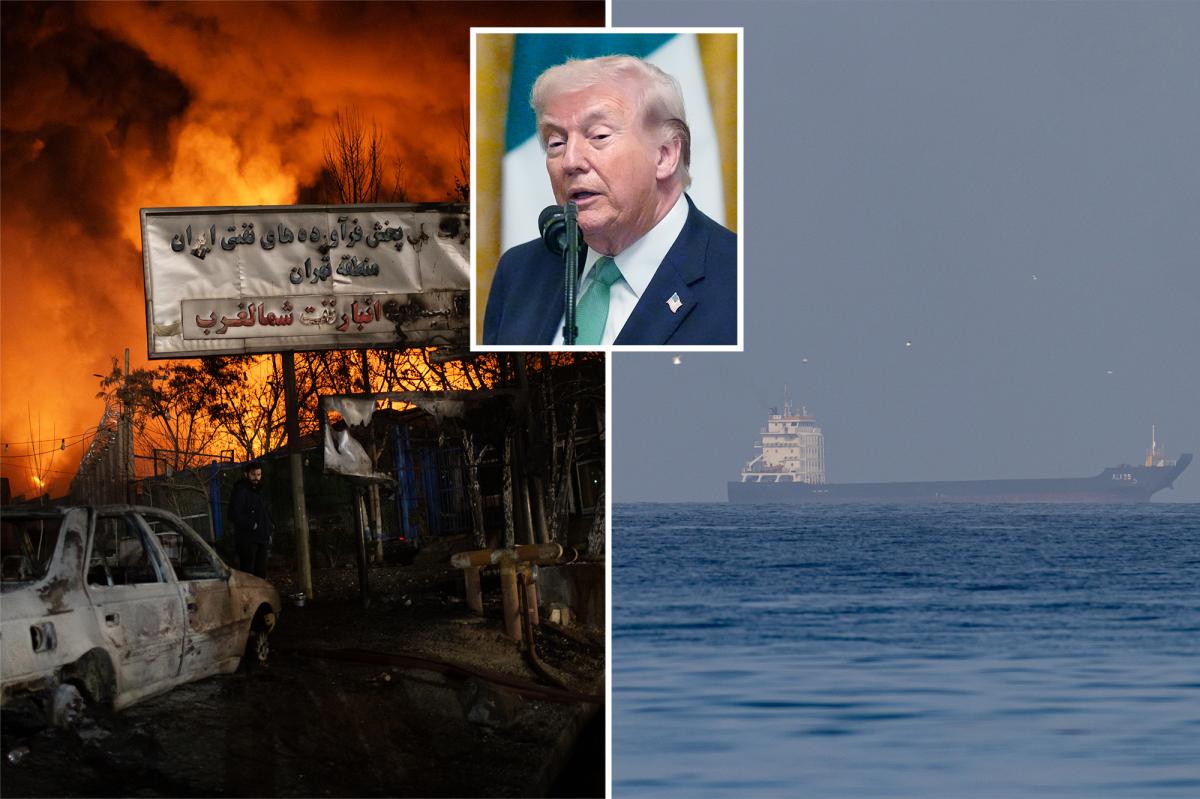

In a bold declaration, Iran has promised to adopt a strategy of “zero restraint,” targeting energy infrastructure throughout the Persian Gulf along with financial institutions involved with the US. This comes in direct response to President Trump’s threat to “obliterate” Tehran’s power plants.
On Sunday, Iran stood firm against the US following Trump’s stern ultimatum. The US President demanded that Iran cease its aggressive actions in the Strait of Hormuz, a critical passageway responsible for 20% of the global oil supply.
Trump’s ultimatum included a 48-hour deadline, set to expire around 8 p.m. ET on Monday.
Iranian Parliament Speaker Mohammad Baqher Qalibaf declared unequivocally that Iran would not yield to such demands. He warned of an extensive retaliatory strike that could significantly escalate global energy prices if Trump proceeded with his threat.
Qalibaf asserted, “Should our power plants and infrastructure be targeted, we will consider critical infrastructure, energy networks, and oil facilities throughout the region as legitimate targets for irreversible destruction, leading to prolonged high oil prices.”
Adding to the tension, Iranian Foreign Minister Abbas Araghchi emphasized that any US attack would elicit a response far more severe than previous assaults on Middle Eastern oil and gas facilities.
“The ONLY reason for restraint was respect for requested de-escalation. ZERO restraint if our infrastructures are struck again,” Araghchi said.
Iran’s armed forces echoed the warnings, saying any attack on Tehran’s power plants would result in the full closure of the Strait of Hormuz and attacks on energy and communications infrastructure linked to the US.
The Islamic Republic claims that the Straight of Hormuz is not closed — and that only ships belonging to “enemy” nations are being threatened.
However, few oil tankers are passing through the straight — as shipping companies, insurers and crews hesitate to pilot tankers laden with 4 million barrels of crude oil through contested waters.
“Power plants of regional countries hosting US bases will be legitimate targets for us,” Iran’s military said, threatening to further escalate the war.
Iran has made good on its retaliatory attacks before, with an Israeli attack on its gas facility last week resulting in the bombardment of similar sites in Qatar, Saudi Arabia, Kuwait and the United Arab Emirates.
The war, strikes on energy facilities, and the closure of the Strait of Hormuz have come together to cause the price of oil to skyrocket.
Brent crude, the global benchmark, soared above $112 a barrel on Friday, with US crude reaching $98 per barrel.
Treasury Secretary Scott Bessent defended the president’s stance on Sunday, saying that escalation could be the best way to de-escalate the conflict.
With the national average cost of gasoline rising to $3.925 a gallon, Bessent argued that “50 days of temporary, elevated prices” was worth “50 years of peace in the Middle East.”
Despite the hypothetical, Bessent admitted that he did not know when gas prices would come back down as fears rise about prolonged costs from the war.
“I don’t know whether it’s going to be 30 days, I don’t know whether it’s going to be 50 days, I don’t know whether it’s going to be 100 days,” he told NBC’s “Meet the Press.”
Mike Waltz, the US ambassador to the United Nations, said Iran needed to take Trump’s ultimatum seriously.
“The president is not messing around,” Waltz told Fox’s “Sunday Morning Futures.”
“He stands on his red lines, and he’s not going to allow this genocidal regime to hold the world’s energy supplies or economies hostage,” Waltz added.
Waltz warned that the Trump administration would start by blowing up “one of Iran’s largest power plants,” without stating which one he was referring to.
Iran’s largest power plant is its Damavand facility, located southeast of Tehran and capable of producing 2,900 megawatts, according to Iran International.
Trump issued his ultimatum on his Truth Social platform on Saturday at 7:44 p.m., making Iran’s deadline Monday at the same time.