
Donald Trump is reportedly seeking an alliance with Mohammed-Baqer Qalibaf, a prominent Iranian figure closely associated with Qasem Soleimani, the Iranian general Trump ordered assassinated in 2020. This move comes as Washington urgently seeks a cooperative leader to helm Iran.
Qalibaf, who currently serves as the speaker of Iran’s parliament, has a notorious reputation. Dubbed the ‘rooftop killer,’ he gained infamy in the late 1990s for his brutal actions during student protests, which included throwing students from buildings, ordering the shooting of demonstrators, and boasting about beating others with batons. His path of violence eventually led him to become the mayor of Tehran.
A resident of Isfahan, whose family still resides there, expressed skepticism about Qalibaf’s potential leadership, stating, “He is just as ruthless as the others. Iran will see no change with him in charge. He’s been part of the regime’s brutal actions for nearly 47 years.”
There is a growing concern that Trump might replicate the errors of Jimmy Carter, who inadvertently facilitated the rise of hardline mullahs following the 1979 Iranian revolution by supporting them after the Shah’s downfall.
Speaking to the Daily Mail, a young Iranian warned, “Trump is deceiving the world yet again. No one in the current regime is a viable choice. If he pursues this, it surpasses the foolishness of Carter’s support for Ayatollah Ruhollah Khomeini.”
‘Not a single member of the regime is an option. If they do this, it is just another level of stupidity after the Carter administration supported Ayatollah Ruhollah Khomeini.’
Trump is under pressure to wrap up the war quickly as Iran strangles the Strait of Hormuz, driving up global oil prices, and launches strikes against US bases and America’s allies across the region.
‘He’s looking for an off-ramp right now that will affect the most change,’ a White House staffer told the Daily Mail.


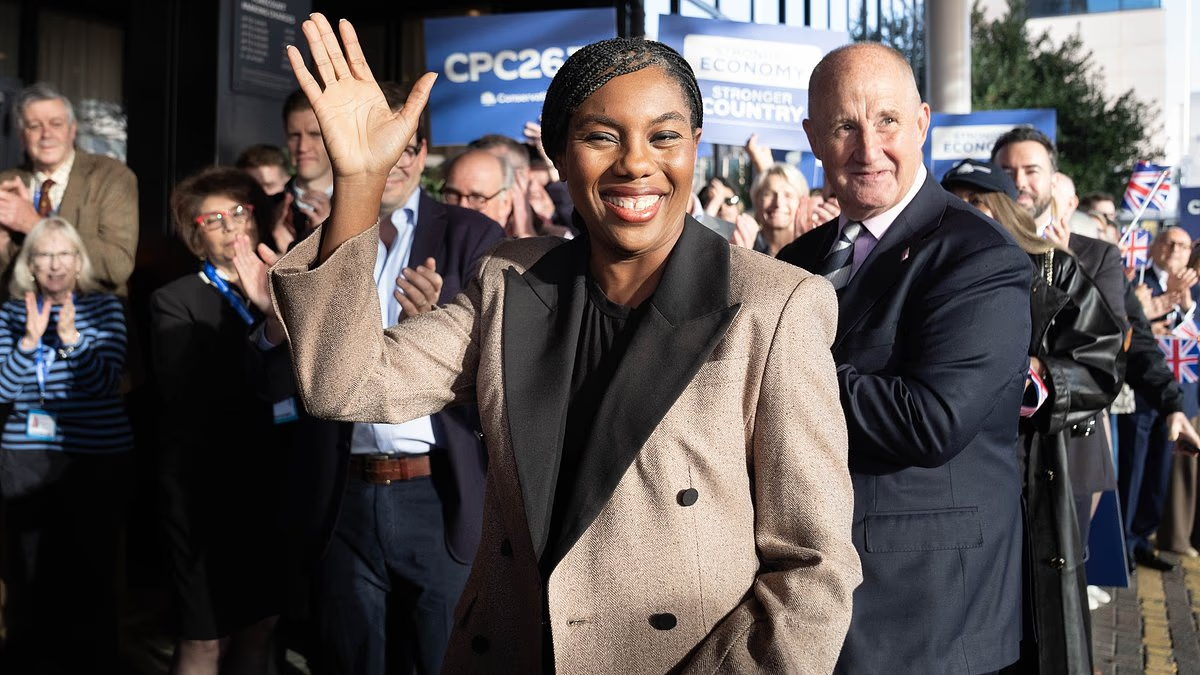
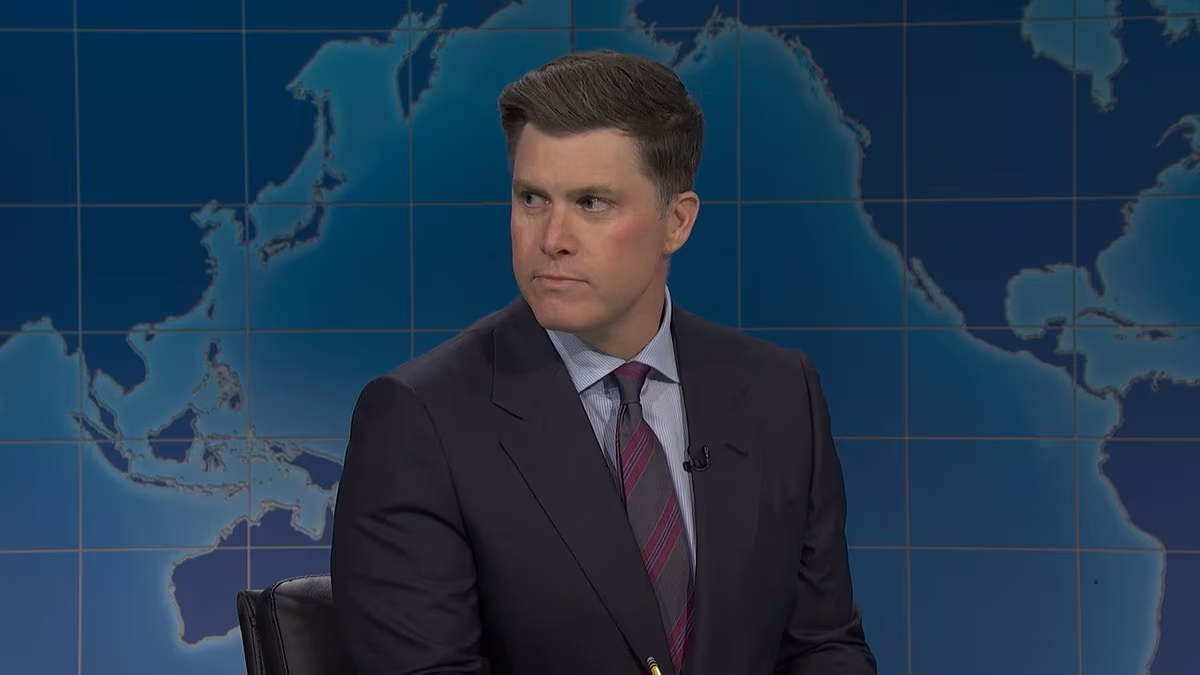
Donald Trump (left) is courting Mohammed-Baqer Qalibaf (right) as Washington scrambles for a pliable new leader to run Tehran

Mohammad Bagher Qalibaf waves to residents as visit the site of Thursday’s Israeli airstrike, in Beirut, Lebanon, Saturday, Oct. 12, 2024
Trump has said he believes the 64-year-old leader will be amenable, telling reporters in the Oval Office on Tuesday: ‘They’re going to make a deal.’
But a young Iranian told the Daily Mail that Trump’s pick was ‘a joke … a murderer.’
During the 2000 pro-democracy student uprisings, Ayatollah Ali Khamenei appointed Qalibaf as the head of the national police.
The move followed Qalibaf’s involvement in a letter by IRGC commanders to President Mohammad Khatami explicitly threatening military action if the unrest was not suppressed.
His subsequent leadership of the police force was characterized by aggressive crackdowns on both demonstrators and members of the press.
Qalibaf has bragged in the past that he is ‘proud’ to have beaten protesters with batons and subject them to violence during anti-regime demonstrations.
There are also reports that he personally obtained permission to shoot at students during the social uprisings of 2003.
‘Look closely at the 1999 Iranian student protests. He was in charge of killing and arresting students at this time. His reward was the mayoral position of Tehran,’ the young Iranian added.
Qalibaf has denied any talks with Washington, publicly taunting Trump as he maintains his strongman persona.
‘No negotiations have been held with the US, and fake news is used to manipulate the financial and oil markets and escape the quagmire in which the US and Israel are trapped,’ he wrote Monday on X.
An Iranian activist who fled to Armenia told the Daily Mail that the talks with Qalibaf might even be a ruse to draw him out into the open and assassinate another member of the leadership.
‘I am sure they want him to leave his rat house, and then Israel can hunt him down,’ he said.

Smoke and flames rise at the site of airstrikes on an oil depot in Tehran on March 7

Qalibaf sits at center as they wear the Revolutionary Guard’s uniform in a session of parliament, in Tehran, Iran, Sunday, February 1

People visit Behesht-e Zahra cemetery to honor their deceased relatives on the last day of Eid al-Fitr in Tehran, Iran on March 22

Iranians set fire to flags of the United States and Israel as they gather to commemorate those killed from the Dena naval vessel, at Enghelab Square on March 17
The Trump administration sees Qalibaf as a ‘hot option,’ officials told Politico, though they cautioned that they were not ‘rushing into’ selecting the new leader.
Officials are using the framework provided by Delcy Rodriguez in Venezuela, Nicolas Maduro’s deputy who has agreed to provide oil to the US under constant threat of another military intervention.
An administration official explained the Iranian proposal, as ‘we’re going to keep you there. We’re not going to take you out. You’re going to work with us. You’re going to give us a good deal, a first deal on the oil.’
Trump’s envoys Steve Witkoff and Jared Kushner have been engaging with ‘very solid’ figures within the Iranian government, Trump said.
The President stopped short of naming specific figures but maintained that Tehran and Washington had agreed on several key points, including no nuclear weapons.
‘We are dealing with a man who I believe is the most respected,’ Trump noted, though he clarified it was ‘not the Supreme Leader.’
Trump said nobody had heard from Mojtaba Khamenei since the US-Israeli airstrikes on February 28 that killed his father, Ayatollah Ali Khamenei.
Trump’s diplomats were in touch with Qalibaf, one unnamed Israeli official told Axios, while another said Qalibaf led the conversations, the Jerusalem Post reported.
His history with the Khamenei family goes back decades, with a leaked 2008 US diplomatic cable describing Mojtaba as the ‘backbone’ of Qalibaf’s campaigns, acting as advisor, financier and senior-level political patron.
More recent reports on Qalibaf’s role describe him as one of ‘Mojtaba’s men.’
Any lingering proximity to the former regime is viewed with extreme caution by Iranians inside the country.
‘He is a murderer. A maniac,’ a fourth Iranian told the Daily Mail, arguing that hardline security chief Ali Larjiani – killed in an Israeli strike on March 17 – represented a better option.

People gather near where rescue workers using heavy machinery clear debris from a destroyed residential building on March 23, in northern Tehran, Iran

Iran’s domestically built missiles and satellite carriers are displayed in a permanent exhibition at a recreational area in northern Tehran, Iran, Tuesday, March 24

Iran’s parliament speaker Mohammad Bagher Qalibaf speaks in his campaign gathering in Tehran, Iran, on June 26, 2024

People visit Behesht-e Zahra cemetery to honor their deceased relatives on the last day of Eid al-Fitr in Tehran, Iran on March 22
‘He is way more radical than a lot of officials we see. With this guy, they will have to come back in a couple months and start a war,’ he added.
Nazee Moinian, an Associate Fellow at the Middle East Institute, said Qalibaf belongs to the same worldview as his predecessors.
‘There’s no partner for peace right now in Iran and unfortunately, I think as hard as messengers Witkoff and Kushner have worked, the Islamic Republic has remained beyond Americans’ comprehension,’ she said.
Moinian also added that the Islamic Revolutionary Guard Corps’ ‘ideology backed by guns’ has so far proven effective.
‘This war has clearly shown us that the narrow base of the regime’s support is much more invested in the regime’s survival than we thought,’ she added.
‘We have to pass the sniff test on whether this is acceptable to America, but more importantly, if it is acceptable to Iranians themselves.’
Qalibaf’s ascension would mark a political coup as he has carefully stalked the halls of power for decades.
He ran for president unsuccessfully starting in 2005 and lost on three subsequent occasions.
White House Press Secretary Karoline Leavitt told the Daily Mail: ‘These are sensitive diplomatic discussions and the United States will not negotiate through the news media.’