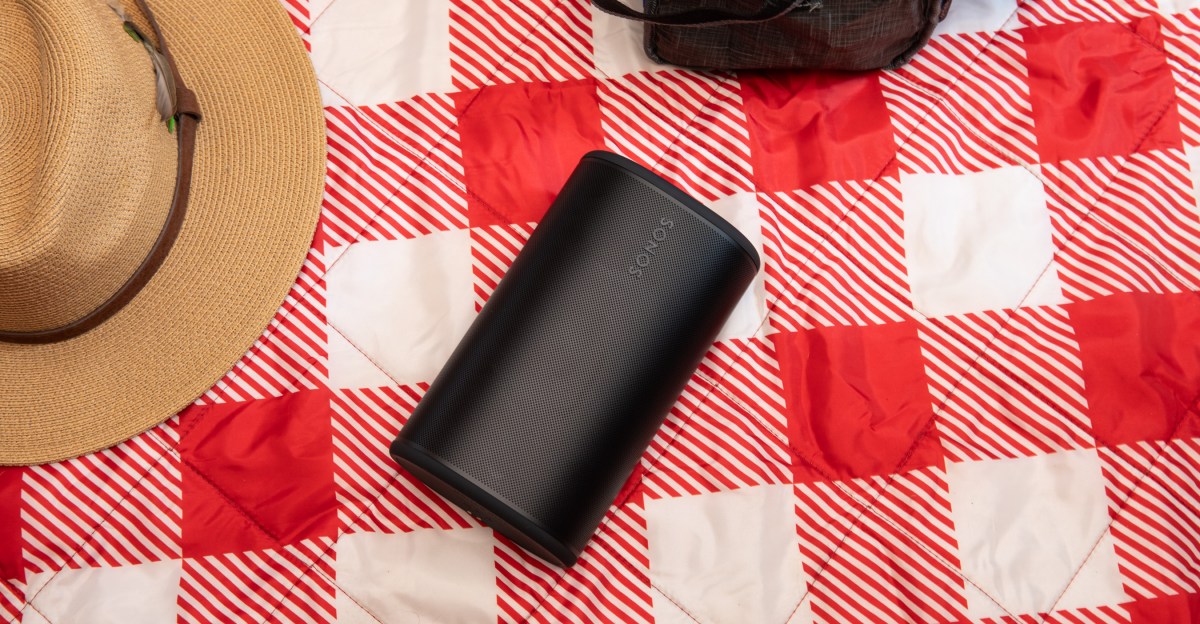

After nearly 18 months without launching a new consumer product, Sonos has introduced the $299 Sonos Play, a fresh addition to its lineup of portable speakers. Unlike its predecessors, the Arc Ultra and Sub 4, which were updates to existing models, the Sonos Play is an entirely new offering. This versatile speaker can seamlessly integrate into an existing Sonos setup or serve as an enticing entry point for newcomers. When connected to Wi-Fi, it performs like any other Sonos speaker with features such as Auto Trueplay, AirPlay 2, and stereo pairing. Additionally, it functions as a water-resistant Bluetooth speaker, perfect for on-the-go use.
Positioned in the middle of Sonos’s portable speaker range, the Play offers more than double the battery life of the Roam 2, although it isn’t as easily portable. It excels at filling larger spaces with sound, offering a better grab-and-go experience compared to the heavier and larger Move 2. The Play combines the home-friendly attributes of the Move 2 with the portability of the Roam 2, establishing itself as the most adaptable speaker in Sonos’s lineup.


$299
The Good
- Easily portable
- Integrates into the Sonos ecosystem
- Bluetooth capable
The Bad
- Doesn’t include wall adapter
- Sound is a little shouty
The Play’s design resembles a compressed version of the Era 100, featuring four buttons on the top for play/pause, volume adjustments, and voice service control. The back houses a Bluetooth button, microphone switch, power button, and USB-C port. Similar to the Move 2, it comes with a charging base equipped with a hard-wired USB-C cable but lacks a wall adapter. To power it, you’ll need a minimum of an 18W charger, which can be purchased from Sonos for $29, or sourced more economically elsewhere. The USB-C port also allows for charging on the go, serves as a power bank for other devices, and, with a $19 line-in adapter, connects to a wired 3.5mm audio source.
Incorporating technology from the Era 100 and Move 2, the Play includes two angled tweeters with waveguides aimed at providing stereo separation, though achieving a stereo effect from a single speaker is challenging. It also features a front-firing midwoofer for midrange and bass, complemented by two force-cancelling passive radiators situated on each side.

The Play is noted for its clear vocal delivery, making voices like those of Chris Cornell and Ella Fitzgerald stand out, and it highlights solo instruments such as Miles Davis’s trumpet. However, its sound profile tends to emphasize the midrange and treble more than the Era 100, which offers a smoother midrange and stronger bass. On tracks like Fleetwood Mac’s “Second Hand News,” the guitar and cymbals might come across as overly pronounced. Songs with high-pitched elements, such as Soul Coughing’s “Super Bon Bon,” can sound harsh at higher volumes. The Play can reach impressive volume levels, especially with rock and pop tracks, where the volume setting often remains at 50 out of 100 or lower for optimal sound quality.
Dimensions (H x W x D, in.): 7.57 x 4.43 x 3.02
Dust/water resistance: IP67
Smart assistants: Sonos Voice Control, Amazon Alexa
Connectivity Wi-Fi 6, Bluetooth 5.3, USB-C, AirPlay 2
Bluetooth codecs: SBC, AAC
As long as you keep the mic turned on, you can enable Auto Trueplay, which allows the speaker to constantly listen and adjust the tuning based on the environment it’s in. In my days with the speaker, I kept this on as I moved it around to different rooms, or out to the front yard, and it kept the sound tuning consistent. Which also means that in all of those situations, it still kept the slightly pushed upper frequencies. There’s an EQ in the Sonos app, but it’s limited to just bass and treble. There’s no way to back off the shouty upper mids, but I found that boosting the bass by a couple ticks gave me the low-end response I was looking for without needing to pump the volume up, and doing so gives more depth to the strings during the opening theme of Rachmaninoff’s second piano concerto.
As with other Sonos speakers, you can use the Sonos app to connect two Plays into a stereo pair, which allows you to have a much wider soundstage and stereo separation. This is only available on Wi-Fi, though. Even if you take both with you, they won’t maintain that stereo connection on Bluetooth. If you do take only one, the Play will act as a Bluetooth speaker while away from Wi-Fi and reconnect as a part of the stereo pair when returned and the Bluetooth connection is turned off. If you want to use one Play on its own around the house, turning off the other one will temporarily disable the stereo pair so you aren’t carrying around just the left or right channel.
The stereo pairing is a nice feature, but if I were going to make a stereo pair with Sonos speakers, I’d do it with an Era 100 and the new Era 100 SL. They sound better, they’re cheaper, and since they need to be plugged in, you know they’re staying put.
The Play shines as a portable speaker. It weighs 2.87 pounds (less than half the 6.6 pounds of the Move 2), has a built-in durable rubber carrying loop, and is IP67 rated to keep it dust-tight and protected from being dunked in water. Sonos claims the battery lasts up to 24 hours, which is consistent with my testing, and in the future when it no longer holds a charge, you can replace it yourself using Sonos’ battery replacement kit.


When you’re out and no longer on Wi-Fi, you can connect to the Play via Bluetooth. And you can group multiple Play or Move 2 speakers using a proprietary speaker-to-speaker grouping technology with no audible lag (it’s like party modes on other portable speakers). The pairing process is quick, and the added speakers have an impressive range. I was able to carry a second Play speaker around 200 feet away before losing the connection. This isn’t the same as the stereo pairing you can do on Wi-Fi. In this mode, each speaker is getting the same signal, not split between left and right channels. And since you’re on Bluetooth and not Wi-Fi, you can’t share what’s playing on the rest of your Sonos system.
When you pick up the Play, it’s best to get into the habit of grabbing for the loop instead of the speaker body. Its size and shape are great for grabbing it by its side, but on a few occasions when I did that, one of my fingers would accidentally press either the Bluetooth button or the power button, stopping my music playback.
In the app you can choose between Sonos Voice Control or Alexa (still no Google Assistant). The Sonos voice assistant can complete Sonos system tasks well — stopping and starting music, changing volume, moving your music to other speakers — but can have trouble with more specific requests, such as searching for songs.
My experience with the Sonos Play speakers was smooth, except for an issue I ran into with one of my two review samples, which stopped working or charging after a short while. Sonos was quick to send out a replacement, and this would be covered by the one-year warranty, or the 30-day return policy.

The Sonos Play speaker is a highly capable portable Bluetooth speaker with great, albeit mid- and high-end focused, sound that’s rugged and can easily expand with other Sonos speakers. If you’re just looking for a portable Bluetooth speaker, though, there are lots of less expensive options with similar performance, like the Bose SoundLink Plus, JBL Charge 6, or Ultimate Ears Megaboom 4 — although all of them have flaws in their sound profiles (for instance, the Bose can get a little distorted at higher volumes, and the Megaboom doesn’t get too loud).
But the Play isn’t just a portable Bluetooth speaker, it’s a way to build — or start — a Sonos home system. If you want to be able to easily, and temporarily, bring your Sonos system into a room that doesn’t have a speaker — for a relaxation playlist while taking a bath, perhaps — the Play is the best way to do that. The Move 2 has better sound, but is much bulkier, less water-resistant, and $100 more expensive; the Roam 2 is $160 cheaper, and a lot smaller, but with a corresponding decrease in sound quality and volume.
An Era 100 — or a pair, with an Era 100 SL — is still a better choice for a stationary setup. It’s cheaper and it sounds better. But if you were thinking of buying something like the Era 100, and you also want a speaker you can carry around, the Play is a great choice for both existing Sonos users looking to expand or someone that’s been waiting to try out the system. It’s the most flexible Sonos speaker, with the fewest compromises yet.
Photography by John Higgins / The Verge