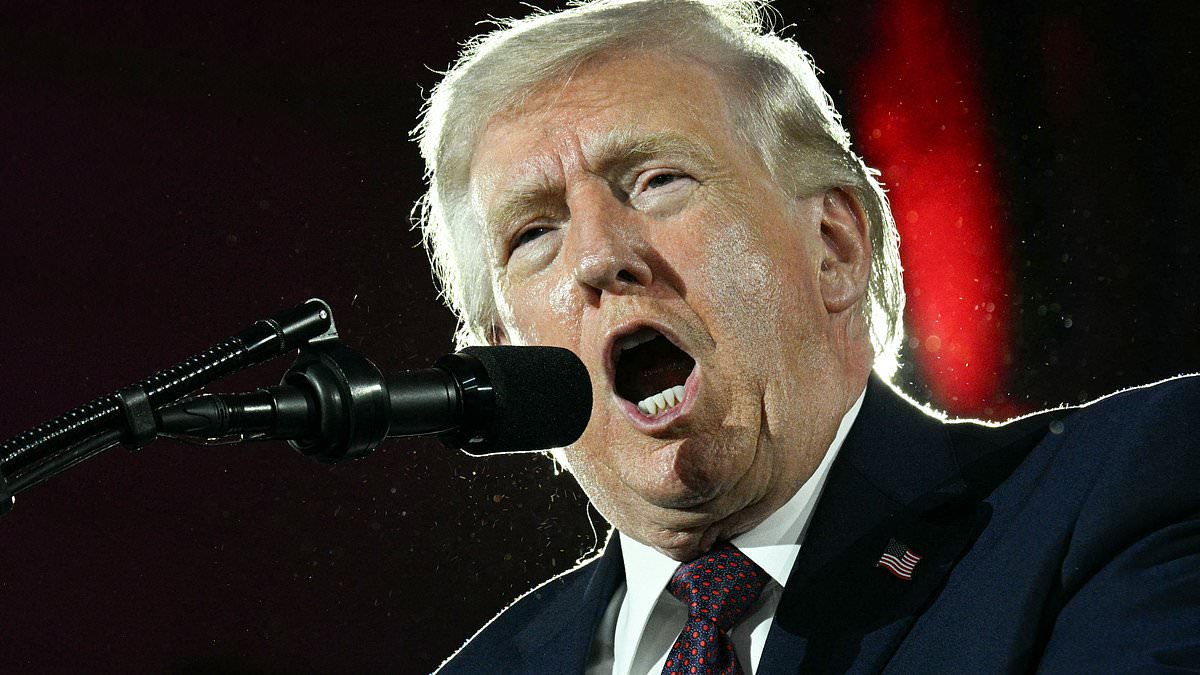


On Thursday, former President Donald Trump issued a stern warning to Iranian negotiators, urging them to get serious about reaching a deal with the United States. Taking to his platform, Truth Social, Trump remarked that Iran had been “obliterated” militarily and had no chance of recovery. He described the Iranian negotiators as “very different and strange,” and accused them of only outwardly considering U.S. proposals despite their desperate need for a deal. Trump’s message was unequivocal: “They better get serious soon, before it is too late, because once that happens, there is NO TURNING BACK, and it won’t be pretty!”
Trump Renews Criticism of NATO Allies

In a separate post earlier today, Trump criticized NATO, claiming the alliance has done little to address the situation with Iran, which he described as a “lunatic nation” now militarily weakened. Trump reaffirmed that the U.S. does not require NATO’s assistance but urged the public to “never forget” the perceived lack of support. This criticism follows Trump’s previous denunciations of NATO during the conflict, particularly after member nations declined his requests to aid in escorting ships through the Strait of Hormuz. Last week, Trump labeled U.S. allies as “cowards” for complaining about high oil prices while refusing to assist in reopening the strategic waterway.
Pentagon Weighs ‘Final Blow’ Options Against Iran

Trump’s remarks coincide with reports that the Pentagon is contemplating military strategies to deliver a decisive blow to Iran, potentially involving ground forces and extensive bombing. Sources indicate that unless diplomatic talks progress or the Strait of Hormuz is reopened, a significant military escalation is increasingly likely. U.S. officials suggest that another display of military strength could bolster Trump’s position, either enabling him to claim victory or strengthening his negotiating power for a peace settlement. Options reportedly under consideration include invading or blockading Kharg Island, Iran’s primary oil export hub, taking control of Larak Island to curtail Tehran’s influence over the Strait of Hormuz, and seizing ships exporting Iranian oil from the strait’s eastern side.

It comes as oil prices climbed again today as markets reacted to Iran dismissing a US proposal to end the war despite Donald Trump insisting leaders in Tehran ‘badly’ want a deal to stop the conflict. Meanwhile, Iranian outlets have reported that the parliament is seeking to approve a bill which would levy tolls for passage through the Strait of Hormuz. The BBC reported that the head of the parliament’s construction committee said a ‘draft has been prepared but has not reached the stage of a full bill’ and the aim is to ‘provide security for vessels passing’. It has not yet specified how much the possible tolls will be.

Iranian Foreign Minister Abbas Araghchi said last night in a televised interview on state TV that Iran has so far accepted requests of vessels passing by countries such as ‘China, Russia, Pakistan, Iraq, and India’. He said Hormuz, from Iran’s perspective, ‘is not completely closed but closed to enemies’. Trump yesterday told his fellow Republicans that the US and Israel ‘cut out the cancer’ of Iran’s nuclear program as insiders claim he’s privately seeking to end the war within weeks. The president declared victory over Iran’s nuclear threat while speaking to the National Republican Congressional Committee Wednesday and said the US military was ready to deliver the knockout blow.

‘It’s short term. What we had to do is get rid of the cancer. We had to cut out the cancer. The cancer was Iran with a nuclear weapon,’ he said. ‘We’ve cut it out. Now we’re going to finish it off.’ Meanwhile, Trump privately told allies and cabinet members that he doesn’t want the war to be drawn out much longer. Trump had initially outlined a four to six-week timeline at the beginning of the war and he wants to stick to that goal. The US President has said the US is ‘in negotiations right now’ and that the participants include special envoy Steve Witkoff, Trump’s son-in-law Jared Kushner, Secretary of State Marco Rubio and Vice President JD Vance.

Trump has not identified anyone from Iran taking part. A 15-point peace plan, modeled on Trump’s Gaza deal, was confirmed by two officials briefed on the talks, the New York Times reported. It includes Iran dismantling all of its nuclear and long-range missile capabilities, as well as opening the Strait of Hormuz, and abandoning its ties to proxy terror groups across the Middle East. The proposal outlines reciprocal benefits for Iran, including assistance with advancing its civilian nuclear program, as well as lifting all sanctions imposed by the international community. Meanwhile, Iran issued its own plan via state TV, that includes a halt to killings of its officials, safeguards against future attacks on Iran, reparations for the war, the end of hostilities and Iran’s ‘exercise of sovereignty over the Strait of Hormuz.’

Those measures, particularly reparations and its continued chokehold over the Strait of Hormuz, likely will be unacceptable to the White House. ‘No negotiations have happened with the enemy until now, and we do not plan on any negotiations,’ Iran’s foreign minister Abbas Araghchi later told state TV. The war in the Middle East continues to rage on, with the death toll rising to more than 1,500 people in Iran, nearly 1,100 people in Lebanon, 20 in Israel and 13 US military members, as well as a number of civilians on land and sea in the Gulf region. Millions of people in Lebanon and Iran have been displaced. Activists in Iran reported heavy strikes early on Thursday morning around Isfahan, a city 205 miles south of capital Tehran.

Isfahan is home to a major Iranian air base and other military sites, as well as one of the nuclear sites bombed by the United States during the 12-day war between Israel and Iran in June. The semi-official Fars news agency, which is close to the paramilitary Revolutionary Guard, described the attacks as targeting ‘two residential areas’, without elaborating. Earlier, Israel’s military said it had completed ‘a wide-scale wave of strikes’ across Iran, including in Isfahan. A missile alert sounded on mobile phones in Dubai on Thursday morning. Saudi Arabia’s Defence Ministry said it intercepted multiple drones over its oil-rich Eastern Province on Thursday morning, while Kuwait reported it was working to intercept incoming Iranian fire and Bahrain sounded its missile alert sirens.