
Alison Cheperdak found herself in a precarious situation, fully aware of the stakes involved.
In 2020, during a naturalization ceremony led by Donald Trump, the former president struggled with the pronunciations of complex names that Cheperdak had prepared for him. This moment was set to have a significant impact on her career.
As Cheperdak was responsible for ensuring Trump had the correct pronunciations and phonetic spellings, the oversight became a pivotal moment for her professional trajectory.
In front of the entire audience, Trump pointed out the mishap, remarking that his staff ‘didn’t prepare him well enough.’
Now 35, Cheperdak hasn’t let this experience fade from memory. Instead, she’s transformed her most challenging professional experiences into a thriving business, launching an etiquette consultancy that now helps White House interns make a positive impression.
During the final year of Trump’s first term, Cheperdak served as a vital adviser in the West Wing, working within the Office of the Staff Secretary.
Her goal was simple but daunting: brief and ready the President for every speech, memo, Air Force One flight and event on his packed schedule.
‘Something that really stuck out about him, was his work ethic … and how he really cared what a lot of people thought,’ she told the Daily Mail.

Alison Cheperdak served as a key advisor in the West Wing during the final year of the Trump administration


Her goal was simple but daunting: brief and ready the President for every speech, memo, Air Force One flight and event on his packed schedule

Alison Cheperdak (second from left) in the Oval Office with Donald Trump during the President’s first term
Far from insular, she said, he was constantly seeking outside perspectives. ‘He would ask questions of pretty much anybody, and he really likes to take the pulse of what people are thinking,’ Cheperdak said.
She said the historic ceremonies she attended were powerful enough to ‘bring me to tears,’ while also providing some of her most nerve-wracking professional moments.
After leaving the White House at the end of the first term, Cheperdak traded the ‘insane’ hours of the West Wing for a new mission.
Getting certified in British and North American etiquette, she launched a consultancy called Elevate Etiquette, teaching the next generation the art of good manners.
Her own training involved improvisation. She recalled the ‘nerves of steel’ needed to look polished while doing frantic ‘creative housework’ – including the time she shoved discarded speech drafts into a decorative vase seconds before Trump walked in.
‘Luckily, he only saw the final version he needed,’ Cheperdak said.
The Staff Secretary’s office acts as the ultimate filter for the Resolute Desk, with everything from daily briefings to executive orders passing through this ‘command central.’
‘You want to be presenting the President the final document that’s ready for his eyes, and you don’t want him to look down like, ‘Well, this was draft one, and this was draft two,” Cheperdak explains. ‘His time is too important to drive through the weeds of every revision that happened in a document.’

Cheperdak prepares to board Air Force One during her time in the White House

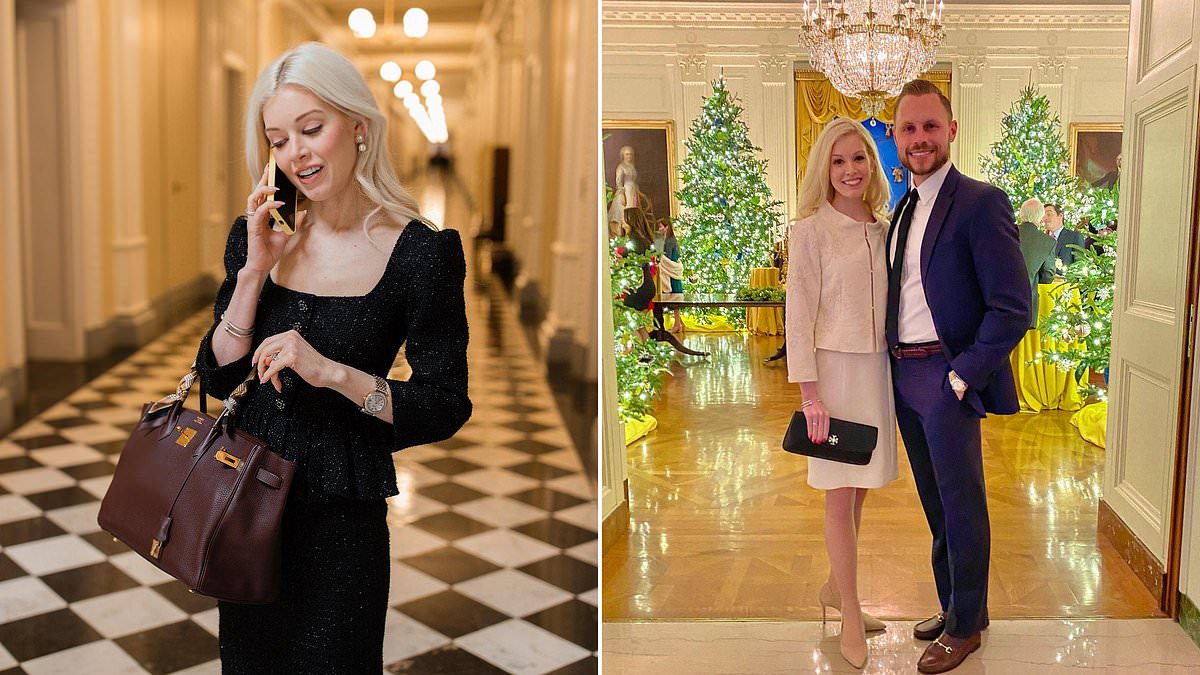
Alison Cheperdak and her husband are pictured at a White House event

Now, as she shapes the next generation of leaders, Cheperdak is certain that a little bit of etiquette goes a long way. In the world’s most powerful office, and everywhere else, the ability to ‘read the room’ is the ultimate power move
Even the most rigorous prep, though, couldn’t always account for every human mistake, and ‘awkward conversations’ followed.
Cheperdak admits that even the most powerful man in the world can be tripped up by a tricky proper noun. It was her job to ensure the phonetics in the President’s speeches were ‘just right’.
‘No person ever can pronounce everything correctly all of the time,’ she said. ‘There were times that I would mess that up, or I would miss something … and the President wouldn’t pronounce something right, and it would be my fault.’
One specific instance stands out: the word ‘plasma.’
‘The President pronounced it incorrectly, and it was 100 percent my fault,’ she admitted. ‘I didn’t flag it as a word that we should be paying special attention to… I didn’t give him the speech early enough.’
She braced for the fallout. ‘Okay, my days are done here. I’m going to pack up my things and go home,’ she remembers thinking. To her surprise, ‘the next day, it was like nobody cared.’
Overall, working for Trump meant keeping up with a ‘pretty insane’ pace.
Publicly, Trump was cast as an impulsive leader who preferred gut instinct over his inner circle and a reputation for tuning out experts became a fixture of the news cycle.

What started as a personal quest for growth – getting certified in British and North American etiquette – has turned into a thriving consultancy called Elevate Etiquette

Her number–one rule for anyone entering a high–stakes room? Don’t treat things like a ‘field trip’
But Cheperdak said that narrative bore little resemblance to life inside the West Wing.
‘You didn’t need any sort of fancy credential for him to appreciate your opinion,’ she recalled.
Her new book, Was It Something I Said?, is a guide for anyone from interns to executives looking to master the ‘soft skills’ she believes actually run the world.
‘I wrote this book for people who think that they’re doing the right thing and they don’t realize how they’re coming across,’ she said.
‘Whether it’s knowing when to send a thank-you note or understanding that just because something isn’t classified doesn’t mean that it’s not sensitive.’
Success in the West Wing, and in life, comes down to a simple philosophy, Cheperdak said: ‘Do the job that you’re assigned really well before you ask to do the cool things. Do them with grace and poise.’
The lesson of the West Wing, she said, is simple: etiquette is not soft. The ability to ‘read the room’ is the ultimate power move.