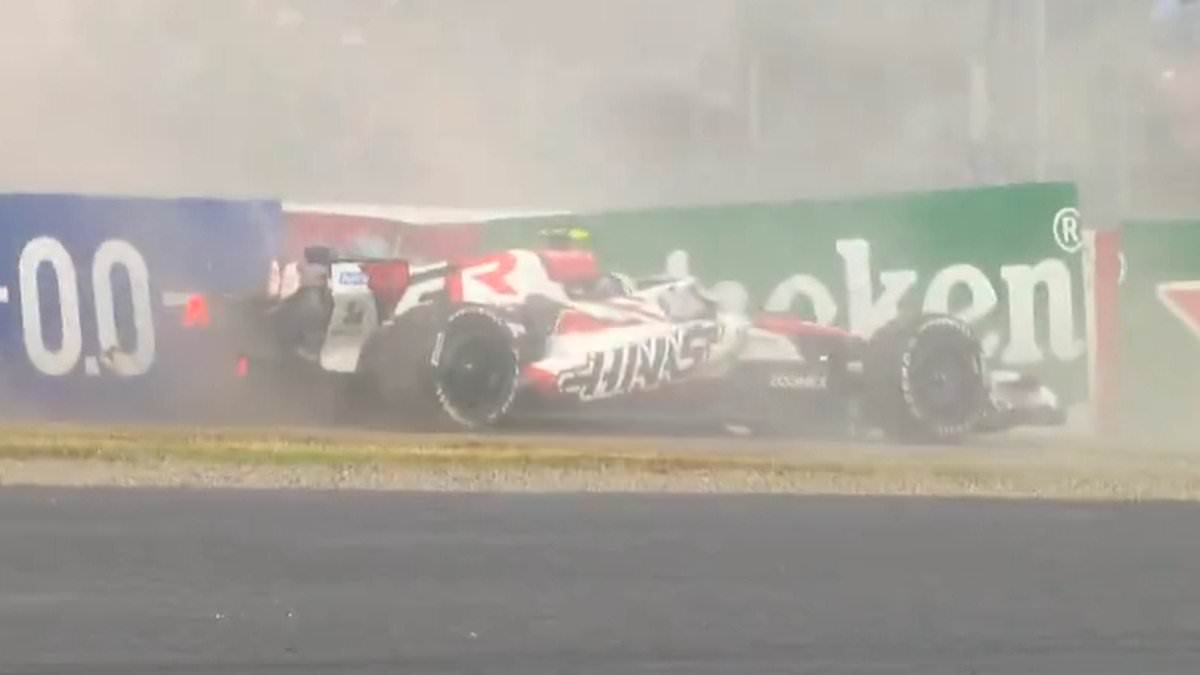

British Formula One driver Ollie Bearman narrowly avoided serious injury in a high-speed crash at the Japanese Grand Prix, sparking discussions about the safety measures under the sport’s new regulations.
The 20-year-old from Essex, currently in his sophomore year in F1, lost control of his vehicle at Suzuka’s renowned Spoon Curve, resulting in a collision with the barriers at an alarming speed of 191 mph and enduring a force of 50G.
Bearman managed to exit his Haas car but soon collapsed as track marshals rushed to assist him. He was visibly bruised and struggled to bear weight on his right leg.
Reflecting on the incident after the race, which was claimed by Mercedes driver Kimi Antonelli, Bearman remarked, “It was a terrifying moment, but thankfully, I’m alright, and that’s what’s most important.”
“As the adrenaline fades, I realize it’s going to be a long journey home,” he added.
Bearman acknowledged the damage to his car, stating, “The vehicle is in pretty bad shape, but we have a month to regroup before the Miami Grand Prix on May 3. I can only apologize to my team.”

Ollie Bearman limped away from a serious 191mph accident at the Japanese Grand Prix
This season’s use of half-electric engines produce huge disparities in speeds at various points during a lap. And, in this case, Bearman deployed a new gimmicky boost button that made him some 30mph faster than the car he was pursuing, that of Alpine’s Franco Colapinto.
‘There was a massive overspeed, which is a part of these rules, and we have to get used to it, but I felt I wasn’t given much space, given the huge excess speed I was carrying,’ said Bearman.
Apparently addressing the governing FIA and the sport’s owners Formula One Management (FOM), the Ferrari academy graduate added: ‘We need to be a bit more lenient and a bit more prepared, as unfortunately this was the result of a massive speed differential we’ve not seen in Formula One before.’
The sport’s rulers have already tweaked the regulations in the last few weeks and will meet again to see how they can iron out potentially dangerous elements.
The accident followed world champion Lando Norris’s warning earlier this month that ‘somebody will end up over the fence’ with the complicated and unpredictable deployment of electric power at certain moments.
It is understood Colapinto was not slowing down to charge his battery at the time of the accident. So, it seems, the Argentine did not contribute to the problem.
It was more a case of over-exuberance from Bearman, albeit a situation complicated by the bamboozling regulations.

Bearman suffered no fractures and was later seen walking down the pit-lane after his crash
Bearman shimmied to the left at the apex of the left-hander and ran on to the grass. He then banged through at least one polystyrene distance marker board, pirouetted right around, and bashed sideways into the outside of Spoon, sending up a spray of gravel.
He was still ‘alert and communicating’ throughout, confirmed a Haas spokesman.
Asked if Bearman had a lucky escape, the boss of the American-owned Haas team Ayao Komatsu said: ‘Yes. He is just very disappointed in himself. He is not making excuses.
‘He was really beating himself up. I told him that ‘yes’ his accident cost us points today but told him that he has done so many good things.
‘He is hard on himself. I am sure he will bounce back.’
Williams driver Carlos Sainz, a critic of the battery-era, said: ‘I’m excited to see what the FIA and FOM come up with for the new regulations, hopefully for Miami.
‘We’ve been warning them about this kind of thing happening with these closing speeds. It was always going to happen.
‘Here we were lucky there was an escape road. Now imagine going to Baku or going to Singapore or going to Vegas and having crashes next to the walls.
‘I hope it serves as an example and the teams listen to the drivers. This racing is not OK.’
The FIA issued a statement, saying: ‘A number of meetings are scheduled for April to assess the operation of the new regulations and to determine whether any refinements are required.’


