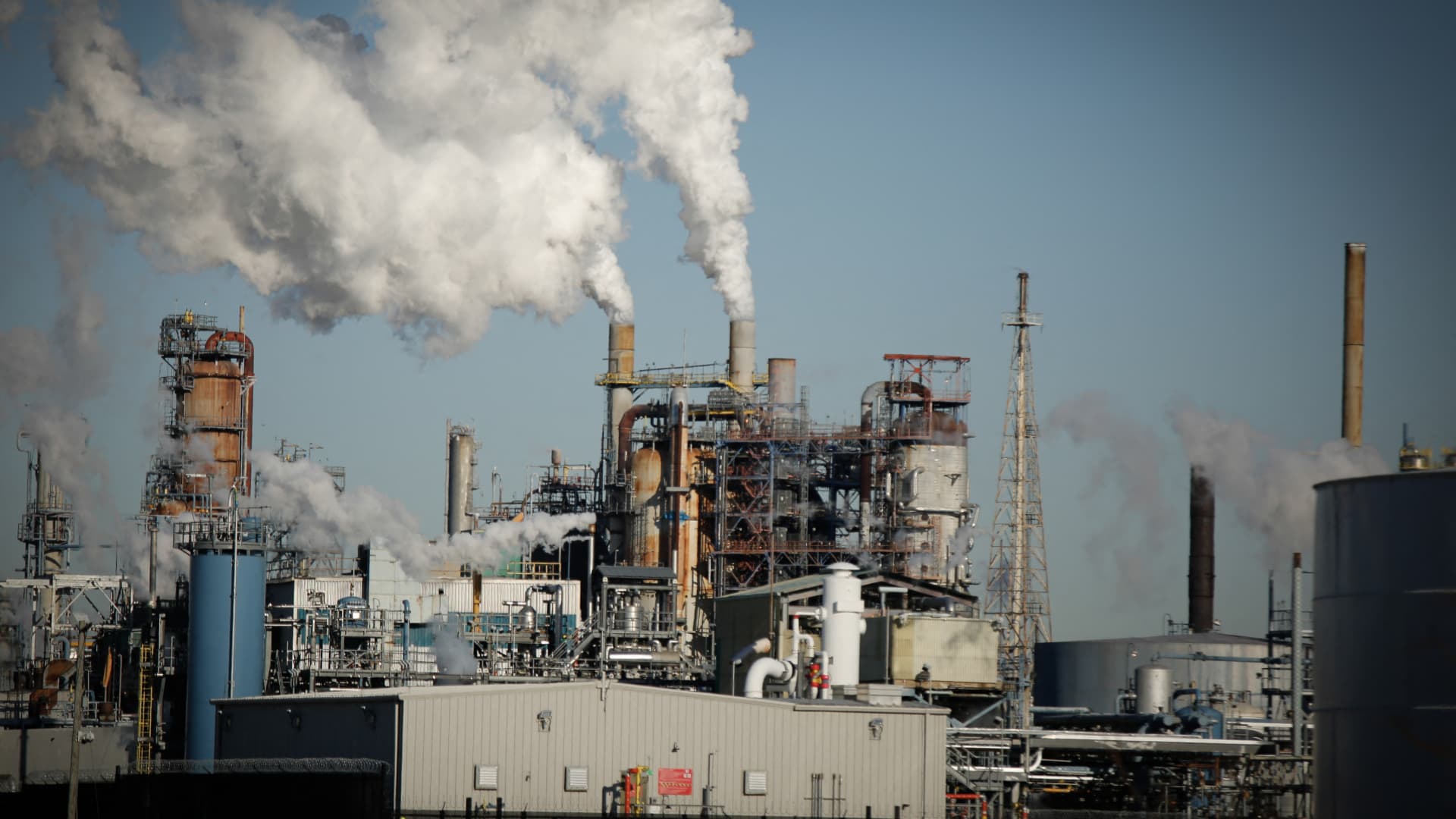

On March 18, 2026, a plume of smoke billows from refinery chimneys in Linden, New Jersey, painting a dramatic picture.
Photo by Kena Betancur | AFP | Getty Images
Monday saw a surge in oil prices as tensions escalated in the Middle East. Yemen’s Houthi rebels, supported by Iran, launched missiles toward Israel, while reports emerged that U.S. President Donald Trump expressed a desire to seize Iranian oil, stoking fears about potential disruptions in the region’s energy supply.
Brent crude futures, set for May delivery, jumped by 2.5%, reaching $115.45 a barrel. Meanwhile, May delivery contracts for U.S. West Texas Intermediate climbed 1.5%, settling at $101.17 per barrel.
Brent crude’s value has skyrocketed over 55% this March, positioning it for the most significant monthly increase ever recorded.
During an interview with the Financial Times on Sunday, Trump revealed that his preferred course of action concerning Iran involves “taking the oil,” drawing parallels to the U.S. maneuver in Venezuela, where it gained influence over the nation’s oil industry following the detention of leader Nicolás Maduro.
His remarks come as the conflict between U.S.-Israel and Iran has entered its fifth week, with attacks spreading across the region, heightening risks to energy infrastructure and driving a sharp rally in crude prices.

Oil prices since the start of the year
Yemen’s Houthis said Saturday they had launched missiles at Israel, marking their first direct involvement in the U.S.- Israel war against Iran.
In a post on X, spokesperson Yahya Saree said the group fired a barrage of ballistic missiles at what it called sensitive Israeli military targets, in support of Iran and Hezbollah forces in Lebanon.
The attack marks a further escalation in the conflict, which began with U.S. and Israeli strikes on Iran on Feb. 28.
Michael Haigh, global head of fixed income and commodities research at Societe Generale, said the potential for further disruption through the Bab el-Mandeb Strait, a key shipping channel linking the Gulf of Aden to the Red Sea, could push prices even higher.
“We’re talking between four and five million barrels per day going through there,” Haigh told CNBC’s “Squawk Box Europe” on Monday, referring to the Bab el-Mandeb Strait.
“Moving into April now, we’re going to see lots of adjustments going on but if we have another four million barrels taken out of the Red Sea, on top of what we already have, then this leg’s oil price is much, much higher,” he added.
In a note published earlier in the month, analysts at Societe Generale said prolonged supply disruption in the Middle East could push prices as high as $150 per barrel in April.
Analysts have told CNBC that the Houthis could attempt to choke off maritime traffic through the Bab el-Mandeb Strait, separating the Arabian Peninsula and the Horn of Africa — through which ships must pass to reach the Red Sea and the Suez Canal — adding to pressure on global trade.
Higher for longer oil prices?
Ed Yardeni, president of Yardeni Research, said global equities were beginning to reflect a scenario of “higher-for-longer” oil prices and interest rates, as the risk of a prolonged conflict grows.
He warned that the continued blockade of the Strait of Hormuz could deepen the market pullback and raise recession risks, with uncertainty around the conflict, including the possibility of greater U.S. involvement, likely to keep volatility elevated until oil flows normalize.
“The speed and magnitude of the move underscore how quickly energy markets are repricing geopolitical risk, challenging earlier efforts to keep both oil and bond markets anchored, and reinforcing the risk of sustained disruption in the Strait,” Yardeni wrote in a note published Monday.
David Roche, strategist at Quantum Strategy, said markets were increasingly pricing in a more aggressive U.S. response, including the possibility of “boots on the ground” and a move to seize Iran’s key export hub at Kharg Island, through which roughly 90% of the country’s oil flows.
Such a step, he warned, would effectively choke off Iran’s dollar revenues but risk triggering full-scale escalation, with Tehran likely to retaliate by targeting critical infrastructure across the Gulf.
That escalation could fast spill into global supply routes. Roche pointed to the vulnerability of Saudi Arabia’s East-West pipeline, which carries around 5 million barrels per day to the Red Sea, warning that any disruption at the Bab al-Mandeb chokepoint — where Yemen’s Houthis operate — could severely constrain exports.
Even under alternative routes via the Suez Canal, capacity would be sharply reduced, potentially taking 4 to 5 million barrels per day off the market, he added.
— CNBC’s Azhar Sukri & Anniek Bao contributed to this report.


