
Until January 2020, Paddy Murphy led an active lifestyle, making his regular trips to the local pub for a pint. However, that routine was disrupted one day when he donned his coat and headed out.
“I walked a few hundred yards and suddenly found myself struggling to breathe, which was quite unusual for me,” Paddy recalls. “I had to sit on a wall for a bit, felt somewhat better, but as soon as I continued, the breathlessness returned.”
Concerned, Paddy contacted his GP, who, alarmed by his symptoms, referred him to the Mater Hospital.
The following day, he was hit with unexpected news: his heart was the culprit, and he urgently needed bypass surgery. “I must admit, that was not easy news to digest,” Paddy shares. “I had always been healthy, never had any illnesses. Suddenly, I found myself preparing for a quadruple bypass at the Mater the very next day.”
Post-surgery, Paddy’s health seemed to improve until he faced another hurdle—a recurrence of skin cancer on his head.

Paddy Murphy has been given a new lease of life by the Mater Private cardiac specialists
“There was a tiny bump on the side of my head,” Paddy explains. “My consultant, Dylan Murray, noticed it and was concerned. Upon investigation, it turned out to be a tumor.”
A plan was made to operate and remove the tumour but Paddy had a heart attack on the operating table.
What had happened was that Paddy’s bypass was no longer working the way it should have been but he was lucky to have been in the Mater Private where two consultants are leading a specialist team that is offering hope to heart patients when others believe they have done all they can.
Dr Colm Hanratty is a Consultant Cardiologist and Director of Cath Lab at the Mater Private Hospital, Dublin and Dr JJ Coughlan is a consultant Cardiologist and they lead the Complex Percutaneous Coronary Intervention (PCI) team at the Mater Private, helping patients with challenging heart issues who may have been previously told there is no hope.
‘There are lots of people out there who have got complex coronary disease which they’ve been told can’t be treated or they have not been offered a treatment,’ says Dr Hanratty.
‘One of the reasons that maybe these patients aren’t offered treatment is that because of the pattern of disease that they have, or maybe because of their age, they’re considered high risk or people might think that it’s too risky to offer them treatment.
‘Or the disease is very complex and other doctors might not be able to offer them treatment, it might not be within their skill set to be able to perform these kinds of procedures. And we see that particularly when people have had arteries that have been blocked for a very long time, and which is regarded as more challenging to treat.

Consultant cardiologists Dr JJ Coughlan and Dr Colm Hanratty
And so because of that, and because these patients are maybe limited by symptoms, but they’re out in the community, they’re just left to kind of trundle along and perhaps their quality of life isn’t that good and they aren’t able to do much.
‘But at the same time they’re not in the hospital and their doctor might think they are out in the community and doing OK but their quality of life might not be great.
‘A common story that we would encounter is people who’ve really been living for a long time with very significant symptoms that are really limiting what they can do in their daily lives.’
The Complex PCI team take their patients and first of all look at what’s going on with the arteries that supply their heart, where the problems are.
‘We try to see if there is a way that we can offer them some sort of a solution that can improve the blood supply to the heart,’ says Dr Hanratty.
‘And generally by doing that, we find that a lot of the patients we treat feel a lot better, they’re able to do a lot more, and they’re able to enjoy life a lot more. A lot of what we do is actually about improving people’s quality of life. And so for us, the massive thing is that if a patient is having significant symptoms and they have a problem with the arteries of their heart, we try to improve that.’
For Paddy, the fact that he was referred to the Complex PCI team was a life-saver.
‘Unbeknownst to the doctors who were doing the operation, he actually had been having significant chest pain for months,’ says Dr Coughlan. ‘He was barely able to leave the house and he hadn’t told anybody. And he had previously had bypass surgery many years ago, but some of the grafts that had been done as part of the operation had begun to fail. So primarily a lot of his heart’s blood supply was reliant on one of his grafts.’
Paddy was in a difficult situation.
‘His own arteries had completely blocked off and all he had was this graft and it was clearly a problem. So that’s an example of a situation where he’s a patient who doesn’t really have many options. There wasn’t a surgical option for him to be treated. Medicines clearly weren’t weren’t suitable for him, and he was in a very challenging situation. And the only option was to open his native blood vessels which had been blocked for a long time.’
Paddy got the procedure done by Dr Hanratty – percutaneous coronary intervention is a minimally invasive procedure that opens the arteries.
A catheter with a small balloon is inserted through a small incision in the wrist or groin and guided to the blockage, where the balloon inflates to widen the artery, placing a stent there to keep it open.
‘When I saw him back in clinic, his life was really completely transformed,’ says Dr Coughlan.
‘Before he had been barely able to leave the house. He wasn’t able to play golf and he’s back now playing 18 holes of golf.
‘He can walk as far as he wants without issue, and he’s back going out singing. And I think it’s an example of somebody who was really just getting on with symptoms and very limited for a long period of time, who underwent what was certainly a high risk and complex procedure, but one that was performed by an individual with expertise in treating these kinds of cases. And it’s really made a massive difference to his life. So he’s gone from really being very limited to effectively having no limitations at all.’
Dr Hanratty says if you have been diagnosed with a heart issue and you feel that the treatment you have been receiving hasn’t been working for you, then it is worth asking for a second opinion, particularly if your quality of life has been badly affected.
‘The fact that you can’t play golf isn’t necessarily a big thing in the minds of a doctor or GP,’ says Dr Hanratty. ‘The fact that you’re not in hospital, the fact that you’re still out and about, doctors might feel that patient’s quality of life is fine.’
Age is also a factor in patients being told there is nothing more that can be done but at the very least Dr Hanratty says his team can offer a second opinion.
‘We’ve set aside what we would describe as a complex list. Where we have got a team who are specialised in dealing with these patients.’

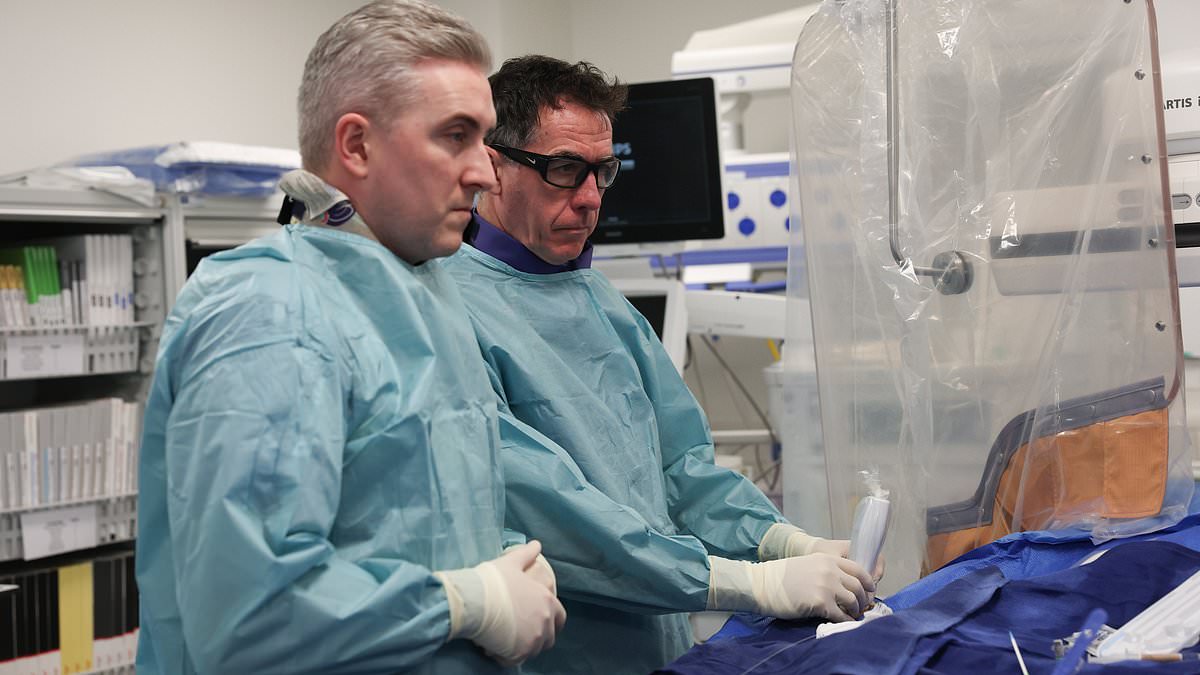
Dr Colm Hanratty and Dr JJ Coughlan with the Complex PCI team at the Mater Private Hospital
As cardiac consultants their daily work sees them dealing with cardiac patients of all kinds.
‘But the service also acts as a referral service so other cardiologists can refer patients to us if they’ve had challenges. Sometimes patients who’ve had complications or difficulties in other places and are still having issues, they may come for a second opinion. But the main idea is that by having a dedicated complex list with two consultant operators working alongside a specialist team, we’re able to do more of these cases and also do them in a more safe manner.
‘We have a lot of experience in managing the types of situations that commonly come up. And this means that we can offer these high risk procedures with a very low complication rate. One of the reasons that people are maybe less inclined to offer some of these patients treatment is that they’re concerned about the potential for complications, the potential for risk. But we would say that complex procedures can be performed and high risk procedures can be with low risk to the patient if they’re done by individuals who specialise in that area and a team that’s focused on that area all the time,’ Dr Hanratty continued.
‘It’s a satisfying job to see patients like Patrick (Paddy) whose life greatly improved after the treatment.
‘Patrick happened to be in the hospital and came to us because he was in our hospital,’ says Dr Hanratty.
‘A lot of the other patients we deal with have come as second opinion, either through their GP or direct referrals. That is a very common pathway. The patients are definitely out there and we’re now in a position to treat a larger number of these patients.
‘Both JJ and I are salaried by the hospital, so we’re not fee for service doctors, so we don’t gain any additional revenue by doing these procedures. It’s taken us five years to get to this point, but I think what the hospital has seen is that the benefit to patients is clear.’
And for Paddy it has been life-changing. Despite the fact that he was also diagnosed with prostate cancer which was subsequently treated and is waiting for another skin cancer operation, the PCI procedure has given him a new lease of life.
He can walk to the pub, he’s golfing and he is back travelling too. The Dubliner, 80, is full of thanks for the treatment he received from Dr Hanratty and Dr Coughlan and he has been signed off their list now.
‘I’m back playing golf,’ Paddy says. ‘I said to them before the operation, “Will I be able to play golf after the operation?”. And he said, of course you will.”
‘I am back doing all those things now. It has been fantastic as I have my confidence back.’
For more information about the Complex PCI team see materprivate.ie or ask your GP.


