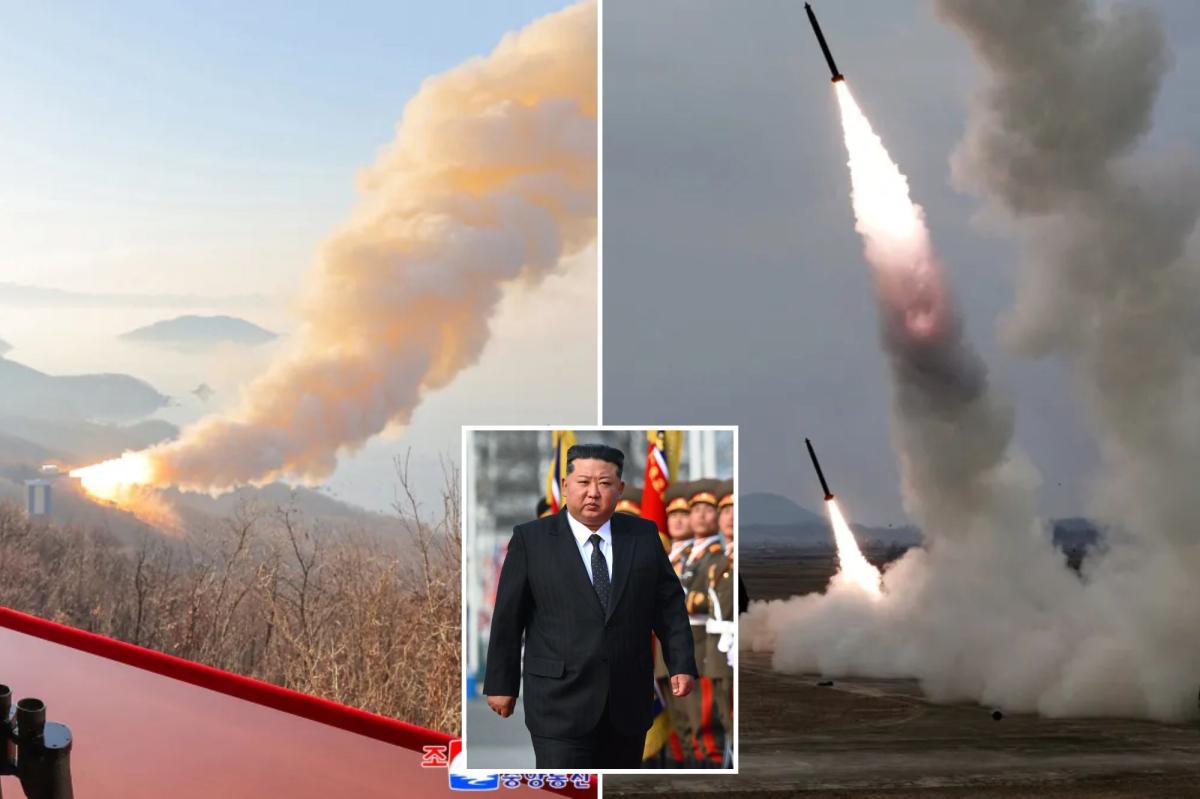


In a show of defiance, North Korea launched multiple short-range ballistic missiles into the sea on Wednesday. This marked the second round of missile tests in as many days, as reported by South Korea’s military. These military maneuvers closely followed a North Korean official’s harsh rebuke of South Korea’s aspirations for improved inter-Korean relations.
The missiles were reported by South Korea’s Joint Chiefs of Staff to have been fired from the eastern coastal region of Wonsan in North Korea. Each missile traveled approximately 150 miles towards the eastern waters of North Korea. In response to these provocations, South Korea emphasized its state of readiness, underpinned by a robust military alliance with the United States, to counter any threats posed by the North.
Following these launches, South Korea announced that North Korea had fired an additional ballistic missile towards its eastern waters, although further specifics were not disclosed.
On the previous day, South Korean military forces detected the launch of another projectile from the vicinity of North Korea’s capital. While South Korean and U.S. intelligence agencies continue to analyze this event, reports from South Korean media suggest that the projectile, likely another ballistic missile, vanished from radar due to an abnormal trajectory soon after its launch. These reports imply that the launch may have been unsuccessful.
The consecutive missile tests underscore North Korea’s intention to maintain a hardline stance, dismissing South Korea’s persistent attempts to rekindle dialogue. The South Korean government, despite these challenges, has remained committed to its diplomatic efforts to rejuvenate stalled discussions between the two Koreas.
The back-to-back launches came after North Korea made it clear that it has no intentions of improving ties with South Korea, whose liberal government has steadfastly expressed its hopes to restore long-dormant dialogue.
On Tuesday night, Jang Kum Chol, first vice minister at Pyongyang’s Foreign Ministry, said South Korea would always remain the North’s “most hostile enemy state.” He derided South Korea as “world-startling fools” engaged in wishful thinking over a recent statement by Kim Yo Jong, the influential sister of North Korean leader Kim Jong Un.
After South Korean President Lee Jae Myung expressed regret over alleged civilian drone flights into North Korea, Kim Yo Jong late Monday praised him for what she called honesty and courage, but reiterated a threat to retaliate if such flights recur.
South Korean officials responded by describing Kim Yo Jong’s statement as meaningful progress in relations.
Jang said her statement was intended as a warning. He cited Kim Yo Jong as calling South Korea “the dogs affected by mange that blindly bark to the tune of neighboring dogs” as she criticized it for recently co-sponsoring of a UN human rights resolution on the North’s purported human rights violations.
North Korea has refused to return to talks with South Korea and the US and pushed to expand its nuclear arsenal since Kim Jong Un’s diplomacy with US President Donald Trump collapsed in 2019.
In a ruling Workers’ Party congress in February, Kim Jong Un threatened to destroy South Korea, if provoked. He left open the door for dialogue with Trump but urged Washington to drop demands for the North’s nuclear disarmament as a precondition for talks.
Earlier this week, North Korea said Kim Jong Un had observed a test of an upgraded solid-fuel engine for weapons and called it a significant development boosting his country’s strategic military arsenal.
Missiles with built-in solid propellants are easier to move and conceal their launches than liquid-fuel weapons, which in general must be fueled before liftoffs and cannot last long.
South Korea’s spy agency told lawmakers Monday the engine test was likely related to an effort to build a more powerful solid-fuel intercontinental ballistic missile that can carry multiple nuclear warheads, according to lawmakers who attended the meeting.
Experts say North Korea needs multi-warhead missiles to penetrate through U.S. missile defenses, but doubts the country has mastered a technology needed to acquire such a weapon.