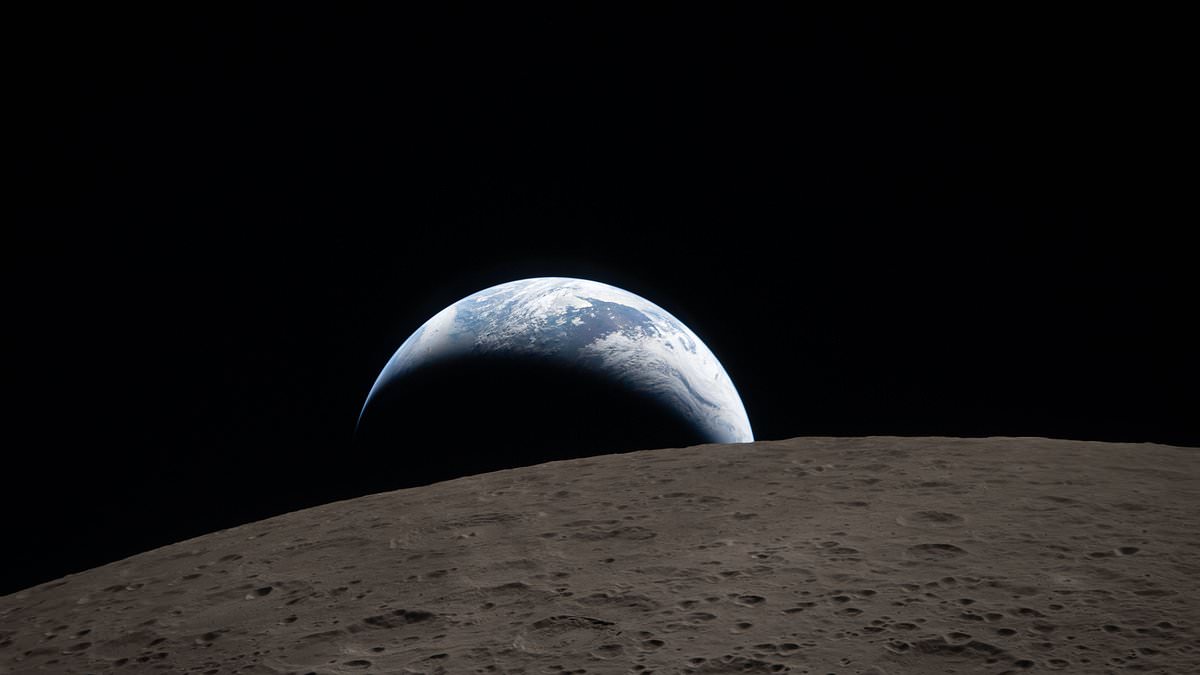

Among the captivating images captured by NASA’s Artemis II team, the striking ‘Earthset’ photograph has emerged as particularly mesmerizing.
This remarkable image depicts our vibrant blue planet seemingly descending behind the moon’s surface, as the lunar body partially conceals Earth from view.
Reid Wiseman, Victor Glover, Christina Koch, and Jeremy Hansen, the astronauts of the Artemis II mission, snapped this photograph during the initial phase of their six-hour flyby around the moon.
Although it appears as though Earth is setting, this illusion is the result of the Orion crew capsule maneuvering over the moon’s far side, temporarily obscuring Earth from sight.
As the capsule circled the moon, the four astronauts alternated between capturing photographs of the lunar landscape, making sketches, and recording audio narratives of their observations.
Many of the lunar features they documented had not been observed by humans since the conclusion of the Apollo missions over five decades ago.
The Earthset image reveals swirling clouds over Oceania and Australia, the peaks of ancient craters, and the wreckage of meteor impacts.
Here are 10 things that you might not have known about NASA’s new ‘Earthset’ photo.

This image, titled ‘Earthset’, was taken from the far side of the moon and shows the Earth dipping beyond the lunar horizon. Here are 10 things you might not have spotted

The Artemis II crew trained to spot and photograph important regions of the moon. During their six–hour flyby, they took over 10,000 images. Pictured: Canadian astronaut Jeremy Hansen practices photographing the moon
1. Taken on an £800 commercial camera
While you might expect NASA to use the latest cutting–edge cameras, this image was actually captured using a decade–old piece of equipment.
According to NASA’s Flickr post, this incredible image was captured using a Nikon D5.
This is a commercially available DSLR launched in 2016 that was quite poorly reviewed upon launch.
However, the camera’s rugged construction, reliable mechanisms, and extremely high light sensitivity make it perfectly suited to space photography.
And, while it cost over £5,000 when first released, you can now pick up one of these high–end cameras for a little over £800.
2. A nod to the Apollo missions
The Artemis II Earthset image is actually a nod back to NASA’s earliest moon missions, mirroring the iconic ‘Earthrise’ photo.

The Earthset image is a nod to the iconic ‘Earthrise’ photo taken by NASA astronaut Bill Anders during the Apollo 8 mission in 1968
This earlier image, showing a distant Earth rising over the moon’s horizon, was taken by the crew of the Apollo 8 mission.
In 1968, Apollo 8 became the first crewed spacecraft to leave Earth’s gravitational influence and the first time that humans had reached the moon.
Just like the Artemis II mission, the crew of Apollo 8 travelled around the moon and back to Earth, paving the way for future lunar landings.
During their trip, Apollo 8 astronaut Bill Anders managed to snap an image of the Earth just as their craft emerged from behind the moon.
However, Apollo 8 had a much easier time getting this stunning shot since they orbited the moon 10 times before returning home, while Artemis II only had one opportunity.
3. Taken from a record–breaking distance
The Earthset photo was taken while the Artemis II crew made its record–breaking lunar flyby.
The Orion crew capsule travelled at a height of 41,072 miles (66,098 km) above the lunar surface.

The image of the Earth setting behind the moon was taken just three minutes before the Orion crew capsule lost connection to Mission Control during a planned radio blackout
From this distance, the moon looked about as large as a basketball held at arm’s length, so the crew had to use zoom lenses to capture this unique photo.
This flyby also carried the crew to a staggering 252,756 miles (406,771 km) from Earth.
This surpassed the distance achieved by the Apollo missions, meaning the crew of Artemis II reached the furthest from Earth any human has ever been.
4. Lucky timing – three minutes before Orion slipped behind the moon
This photo was taken at 18:41 EDT (23:41 BST) on Monday, April 6.
This was only three minutes before the Orion crew capsule slipped behind the bulk of the moon, entering a planned communications blackout.
With the moon blocking any radio signals from Earth, the astronauts continued along their pre–programmed flight path without real–time guidance from Mission Control, relying entirely on onboard systems.
After 40 minutes of nerve–wracking silence, Christina Koch reestablished contact with Earth and confirmed that all was well.

From this unique perspective, the daytime side of the Earth appears as a thin crescent silhouetted against the blackness of space. What these pictures don’t show is that only 20 per cent of the moon was illuminated at this time
This meant that the stunning image captured by the Artemis II crew could only be sent back to Earth after they had passed all the way around the moon.
5. A crescent Earth alongside a crescent moon
In the image, you can see that the Earth is covered by a curved shadow, with half the planet experiencing day and the other half night.
What is harder to see in this image is that the Artemis II crew were also seeing a crescent moon.
As they passed around the moon’s far side, only 20 per cent of the lunar surface was illuminated by the sun.
This meant that large parts of the moon were still hidden from view and extremely difficult for the astronauts to observe.
6. The 38–mile–wide Ohm crater
Without any atmosphere to protect it, the moon is constantly battered by a bombardment of meteor impacts.

In the Earthset image, you can see the Ohm crater (pictured). This is a 38–mile–wide (62 km) depression formed by an ancient meteorite impact
This is a massive boon for geologists since, without any wind to erode them, these craters record a detailed history of the moon’s evolution.
In the Earthrise image, you can see the 38–mile–wide (62 km) Ohm crater.
This crater features distinctive terraced edges and a central peak, formed by a meteor impact that melted the surface, causing it to splash and rebound.
The image is so clear that you can even make out the system of ‘ray’ impacts stretching out from the Ohm crater.
These rays are straight lines of smaller craters, created by enormous chunks of moon rock shot out over the surface by the original impact.
7. Earth’s smooth horizon contrasted with the moon’s bumpy horizon
In this image, you can see the smooth, clean edge of the Earth’s horizon silhouetted against the darkness of space.
By contrast, if you look closely, you can see that the moon’s horizon is bumpy, jagged, and irregular.
What you are seeing here is actually the rims of thousands of craters that pockmark the far side of the moon more densely than the near side.
These range from small, simple impact craters no more than six to nine miles (10 to 15 km) in diameter, to vast basins over 186 miles (300 km) across formed by catastrophic collisions.
Seen from the low angle of the Orion crew capsule, these overlapping depressions give the moon’s horizon a distinctive serrated appearance.
8. A view of Australia and Oceania
As well as giving a wonderful view of the moon, this photo also offers a fantastic perspective on our own planet.
In the daylight portion of Earth, you can see swirling clouds of Australia and Oceania.
9. Earth lit up thanks to its clouds and oceans
It might be surprising that the Earth appears to be so much brighter than the moon, even though the crew were much closer to the lunar surface.
This is because the Earth reflects a lot more light than the moon does, bouncing back about three times more sunlight.
The majority of that light is reflected by clouds and oceans, which the moon lacks, making the Earth seem far brighter in comparison.
10. Earthset is just one of thousands of photos
While the Earthset photo is certainly impressive, it is actually just one of the more than 10,000 photos taken by the Artemis II crew.
Working in shifts and using 17 different handheld cameras, the crew worked to gather as much detail as possible about the moon’s far side.
During their training, each member of the team was specifically trained to identify and photograph specific lunar features such as craters and patches of cooled lava.
These images will reveal details that satellite cameras might have missed in stunning levels of detail.
That will help scientists build better maps of the lunar surface and gain a greater understanding of lunar geology.
With NASA planning to establish a permanent lunar outpost by 2030, this information could prove extremely valuable in the coming years.
During their lunar flyby, the Artemis II crew were even able to observe several features that had never before been seen by humans.
This included the vast Mare Orientale basin, a 577-mile-wide (930 km) impact basin in the Moon’s southern hemisphere.
Because this crater is so large, previous Apollo missions weren’t able to see the structure in its entirety from their low lunar orbit.
Additionally, the Artemis II crew spotted a number of new craters formed by meteors that had hit the lunar surface since the end of the Apollo programme.
Christina Koch told the NASA control room: ‘All the really bright, new craters, some of them are super tiny, most of them are pretty small, there’s a couple that really stand out, obviously, and what it really looks like is a lampshade with tiny pinprick holes and the light shining through.’
Canadian astronaut Jeremy Hansen made a special request to NASA mission control to name two of these new craters that they had ‘observed, both with our naked eye and with our long lens’.
The first he asked to name Integrity, after the name the astronauts have given to their Orion crew capsule, and the other Carroll, to commemorate Reid Wiseman’s late wife, who died of cancer in 2020.

The crew embraced each other after deciding to name a new crater Carroll, to commemorate Reid Wiseman’s late wife, who died of cancer in 2020.
Mr Hansen said in an emotional tribute: ‘A number of years ago we started this journey… and we lost a loved one and there’s a feature on a really neat place on the moon… at certain times of the Moon’s transit around Earth we will be able to see this from Earth.’
The announcement prompted the astronauts to embrace, while mission control in Houston fell silent in a rare moment of reflection.
Having passed the moon, the Orion crew capsule will now ride the tug of Earth’s gravity back home over the coming days, with splashdown expected on Friday.
Their final ordeal will be a blazing re–entry into the planet’s atmosphere, as the capsule hits the atmosphere at around 25,000 miles per hour (40,200 km/h) before deploying its parachutes and landing in the Pacific Ocean.
Thankfully, the latest weather predictions suggest that Artemis II will have favourable conditions for reentry.
According to AccuWeather, the southern coast of California will see winds of only seven to 14 miles per hour (11 to 22 km/h) and waves no larger than five feet.
John Feerick, AccuWeather Senior Meteorologist, says: ‘Mission controllers and recovery crews at sea will be watching conditions closely up to splashdown.
‘NASA says there can be no rain or thunderstorms within 30 nautical miles of the recovery site. Waves should be under six feet, and winds need to stay below 25 knots for the recovery boats.’