Share this @internewscast.com
Donald Trump has always been surrounded by individuals who are more than willing to bolster his self-image. From devout followers who see him as divinely appointed to international leaders offering their admiration, Trump’s ego has often been well-fed by those around him.
Recently, however, the lines of comparison have taken a more religious turn, with suggestions likening Trump to Jesus or other saintly figures. This shift in rhetoric has sparked considerable attention and debate.
In a recent incident, Trump sparked controversy by sharing an AI-generated image depicting himself in a Jesus-like manner. Although he later removed the image and claimed it actually showed him as a Red Cross worker, the initial post raised eyebrows and fueled discussions about its appropriateness.
Just weeks earlier, at a White House Easter event, Trump’s spiritual adviser, Paula White-Cain, took the opportunity to draw parallels between the former president’s legal ordeals and attempted assassination plots with the trials faced by Jesus. This comparison was made in a public setting, further amplifying its impact.
“You were betrayed and arrested and falsely accused. It’s a familiar pattern that our Lord and Savior showed us,” White-Cain remarked as Trump stood nearby, a statement that extended beyond the usual praise offered by his religious supporters.
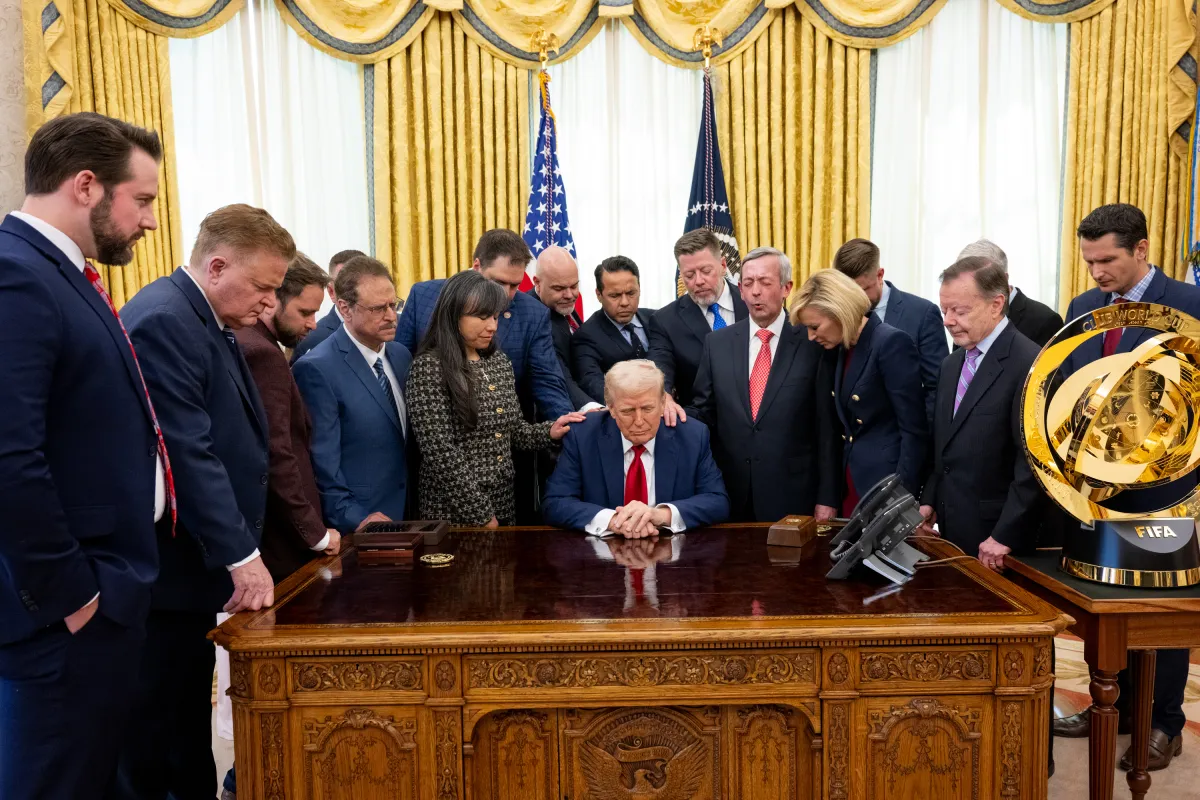
The narrative being crafted around Trump by his ardent followers and advisers seems to be reaching new heights, pushing the boundaries of religious metaphor and sparking dialogue on the appropriateness of such comparisons.
Previously, the rhetoric compared Trump to a “chosen” one. When he survived an assassination attempt in 2024, his evangelical backers framed it as “divine intervention” and said he’d been “blessed by God”.
But has such rhetoric buoyed the president into thinking he’s in some way close to divine?
“I think that he has some sort of vague belief that he is favoured by a higher power,” Shaun Blanchard, a senior lecturer in theology at the University of Notre Dame, told SBS News.
“He has some sort of quasi-spiritual understanding of his own destiny, and I think he does think of himself as a kind of saviour figure for everyone that will sort of submit to his authority.”
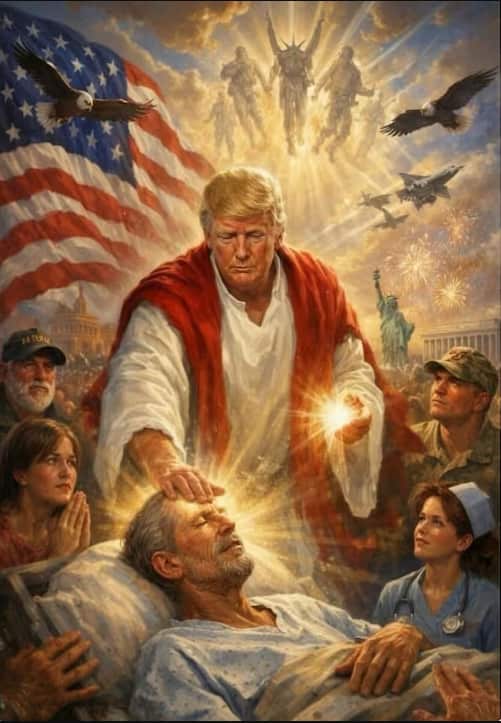
Trump deleted the AI image following a backlash, but not before some MAGA figures started asking a different question: Is Trump the Antichrist?
“It’s more than blasphemy. It’s an Antichrist spirit,” said former congresswoman Marjorie Taylor Greene.
Christian influencer Mandy Arthur wrote: “God, we might have made a mistake and accidentally elected the Antichrist.”
Blanchard said Trump’s post had brought this new debate in such circles.
“He has deceived tens of millions of people. I mean, there’s many, many, many people who are otherwise good and kind and decent people who are under his way,” he said.
‘Don’t take the picture literally’
However David Smith, an associate professor at the University of Sydney United States Studies Centre, said he doesn’t think Trump himself is a particularly religious figure, and people should not take the message literally.
“I don’t think he’s got such strong religious convictions that he himself would believe that he is divine in some way,” he told SBS News.
Smith said it’s clear Trump did not know what peoples’ boundaries were with the AI image.
“Even though he’s got a lot of Christian followers, he is not very religiously-literate himself, and he will post just about anything that glorifies himself,” Smith said.
“He didn’t realise that really posting something that depicts him as pretty unmistakably Jesus Christ was going to be a step too far.
“He doesn’t know the difference between claiming that Jesus is looking after him and actually sort of likening himself to Jesus in some way.”
Why did Trump attack the pope?
Trump posted the AI image as he began an extraordinary attack on Pope Leo XIV, describing the pontiff as “weak on crime” and “terrible for foreign policy”.
Pope Leo has been critical of the war in the Middle East, denouncing the “delusion of omnipotence” that was fuelling the US-Israel war in Iran.
“Enough of the idolatry of self and money!” Leo said during a prayer vigil in Rome this week. “Enough of the display of power! Enough of war!”
Trump has refused to apologise, explaining that his remarks about the pope were regarding the head of the Roman Catholic Church’s criticisms of violence in the Middle East war. “He was very much against what I’m doing with regard to Iran, and you cannot have a nuclear Iran. Pope Leo would not be happy with the end result.”
But does Trump consider Pope Leo as some kind of political adversary?
Blanchard explained that the pope held “immense” moral and spiritual authority and he’s not someone Trump can win over through his usual methods.
“[Trump is] used to being able to either buy someone like, buy their allegiance, do some sort of transactional deal, or just bully them into silence,” Blanchard said.
“And he can’t do that with the pope. And I think it adds insult to injury for Trump that the pope’s an American.”
Monday’s AI image post is not the first time the president has sparked outrage with a religious depiction of himself.
Last year, he posted an AI-generated image of himself as the pope, which was reposted by the official White House account, leading Catholics to warn: “Do not mock us”.
Blanchard said he believes Trump has taken the Vatican’s declining an offer to join the Gaza “Board of Peace” and Pope Leo’s rejection of an offer to visit the US for Fourth of July celebrations, as “unacceptable rebukes from the pope”.
The war in the Middle East as a ‘religious war’
The Jesus-like imagery and the attacks on the pope come amid concerns that the US-Israel conflict with Iran is being framed as a “holy war”.
US defence secretary Pete Hegseth, an evangelical Christian, has called on the American people to pray for victory “in the name of Jesus Christ”.
Last month, he used a worship service at the Pentagon to pray for “overwhelming violence of action against those who deserve no mercy”.
This comes amid reports that US soldiers have lodged more than 100 complaints with the Military Religious Freedom Foundation, claiming that commanders were using extremist language around the war.
One complainant said a commander “urged us to tell our troops that this was ‘all part of God’s divine plan’ and he specifically referenced numerous citations out of the Book of Revelation referring to Armageddon and the imminent return of Jesus Christ”.
The complaint further claimed that superiors had said that Trump was “anointed by Jesus to light the signal fire in Iran to cause Armageddon and mark his return to Earth,” according to the Guardian.
Armageddon is sometimes depicted as a final battle between the forces of good and evil.
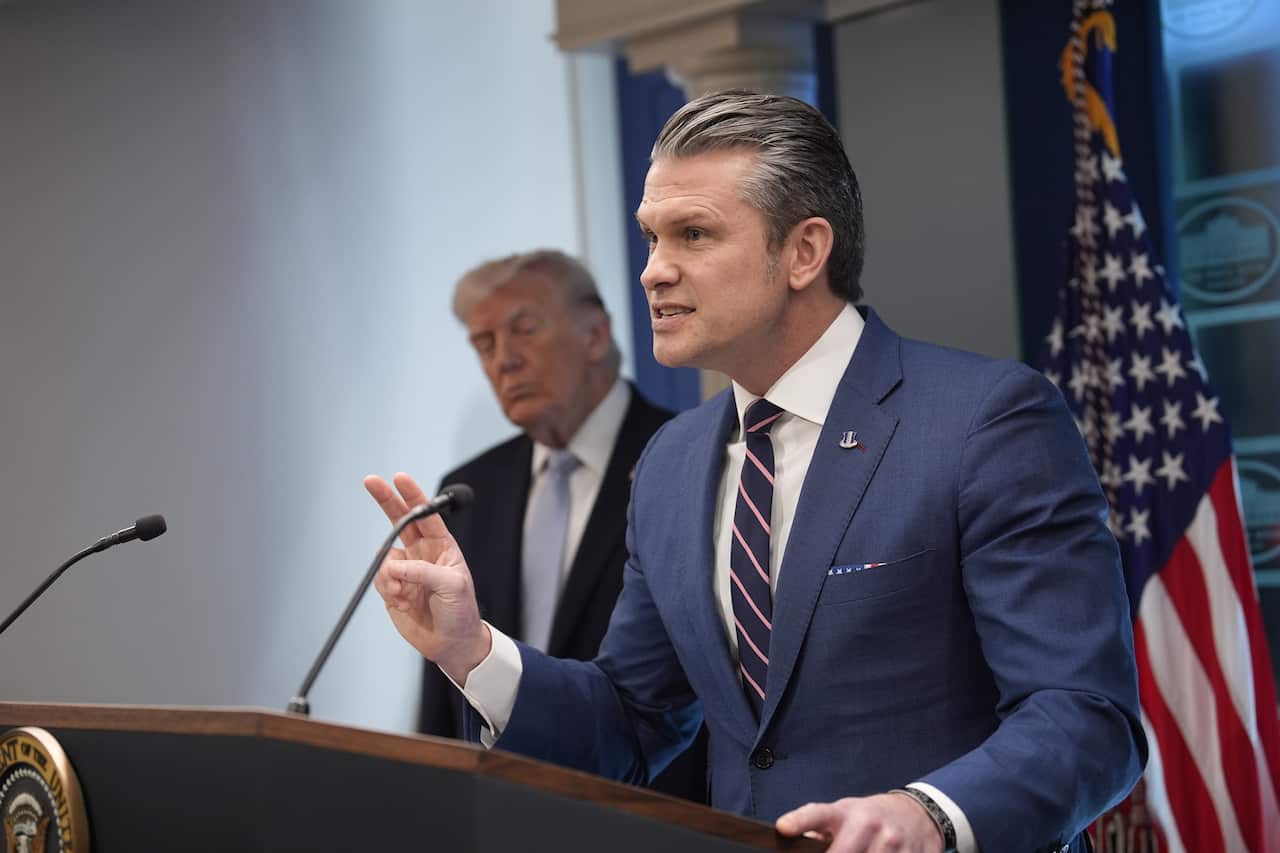
Smith is sceptical about whether the framing of it as a religious war was having any effect on the American people.
He said many were struggling with just the political justifications for the war.
“It’s not good to be setting this up as a war between Christianity and Islam for all kinds of reasons, but I just think Americans aren’t even buying that rhetoric at all.
“Americans are really sick of war. They’re really sick of war in the Middle East. And I think for most Americans, they’re just really puzzled as to why the United States has gone back to war with Iran now.”
Smith said many in the US are “quite disturbed” by the kind of religious rhetoric that is being used.
There is a long tradition in military chaplaincy of prayers calling for the protection of US troops or an end to war.
“That’s the way that people are used to thinking about war in religious terms,” he said,
“They’re not used to hearing somebody who’s just renamed himself the Secretary of War praying for violence against the enemy — that really goes against the tenets of Christianity.”
For the latest from SBS News, download our app and subscribe to our newsletter.