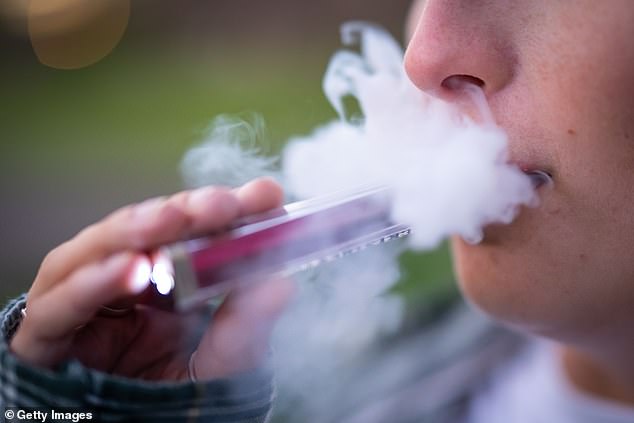

Research indicates that vaping can potentially lead to cancer, although it remains less harmful than traditional cigarette smoking.
Currently, over 5.5 million people in the UK use e-cigarettes, which have been considered a safer alternative to tobacco.
The health service has previously endorsed these devices as part of a larger initiative to reduce smoking rates.
In 2023, the Conservative government even committed to distributing vapes to more than a million citizens.
However, emerging studies suggest that these vividly colored and sweet-flavored vapes might not be as harmless as previously believed.
A recent analysis by researchers at the University of Canterbury in New Zealand has revealed that vaping could increase the risk of several types of cancer, including those affecting the nose and lungs.
Analysing chemicals produced when vape liquid is heated, as well as their effect on the body, the team found that ‘vaping presents an unquantifiable cancer risk’.
As cancers can take 15 years or more to develop after exposure to cancer-causing chemicals, however, they added that it could take ‘many years’ to determine just how large that risk is.

Vaping is likely to cause cancer but not as much as cigarettes, researchers have claimed
While vapes do not contain tar, carbon monoxide or many of the other potentially hazardous chemicals found in cigarettes, studies have found low levels of toxic chemicals, including formaldehyde, which has been linked to cancer, as well as small metal particles, in the devices.
Studies have also shown that people who vape are more likely than non-vapers to develop chronic obstructive pulmonary disease, or COPD – a chronic lung condition that which can trigger organ failure.
Vaping is still safer than smoking cigarettes, and can be an effective tool for giving up smoking, concluded the authors of the recent paper, published in the New Zealand Medical Journal.
However, they added, it’s ‘difficult to identify any benefit of vaping for its own sake’.
Ian Shaw, a professor in physical and chemical sciences at the University of Canterbury and the study’s lead author, said: ‘Vaping for its own sake adds to life’s cancer risks and is therefore unacceptable’.
He added: ‘It will take many years to collect clinical data to determine whether vaping causes cancer because it takes at least 15-years for cancers to develop after exposure to cancer-causing chemicals.
‘In our paper, we used knowledge of the chemistry of the vaping process to determine the chemical composition of ‘vape smoke’ and then assessed the carcinogenic risk of each of the ‘vape smoke’ chemicals from published animal and other toxicity studies.
‘From this, we predicted the cancer risk to vapers based on the published levels of these chemicals in ‘vape smoke’ and concluded that vaping presents a cancer risk.
‘However, it is likely that the vaping cancer risk is lower than the cigarette smoking cancer risk.
‘Therefore, using vaping for smoking cessation is acceptable because this will lower the overall cancer risk, but vaping for its own sake adds to life’s cancer risks and is therefore unacceptable.’
Around 5.4 million Britons aged over 16 are believed to currently vape – more than the number who now smoke cigarettes.
The NHS say vaping is ‘less harmful’ than smoking and is ‘also one of the most effective tools for quitting smoking’.
However, they add: ‘Vaping is not completely harmless and we don’t know yet what the long-term effects may be.’
The study compared levels of harmful chemicals inhaled from cigarette smoke and vapes.
It found cigarettes usually produce much higher amounts of acrolein – a toxic irritant linked to lung and heart damage – and acetaldehyde, a chemical associated with cancer risk, meaning smokers are exposed to larger doses of these substances.
Formaldehyde, a known cancer-causing chemical, was found at similar levels between cigarettes and vaping, while propionaldehyde was also found at similar levels.
Overall, the findings suggest vaping may expose users to lower levels of some toxic chemicals than smoking, but it does not remove exposure completely.
Experts commenting on the findings said the research was important in highlighting that vaping is not risk-free.
Andrew Waa, co-director of ASPIRE Aotearoa tobacco control research centre at the University of Otago, said: ‘For people who smoke, vapes may help them to quit their nicotine addiction completely or at least switch to vapes.
‘However, simply because vapes are available, a proportion of those who ‘switch’ might have otherwise quit their addiction. In this case they may be exposed to more harm.’
George Laking, assicuate professor at Te Aka Mātauranga Matepukupu Centre for Cancer Research, University of Auckland, called the report was ‘refreshing’.
He added: ‘The main problem with vaping nicotine in my view is that it is addictive and this in turn is allowed to be profitable. I worry that physical hazards of vaping can be a distraction from the underlying cycle of addiction and profit.
‘Any work that puts hazards of vaping into context will raise the level of the public conversation.
‘I became interested in vaping because of my work as an oncologist for lung cancer, that remains overwhelmingly caused by smoking cigarettes, that are still many times more dangerous than vaping.’
The new research comes just weeks after researchers in Sydney, Australia, found that vaping was linked to mouth and lung cancer.
After analysing the available literature into the potential harms of vaping that were published between 2017 and 2025, they concluded that vaping is not risk free.
The most concerning studies, they noted, are the ones that show that vaping can cause changes to a user’s DNA, increasing the risk of cell malfunction linked to cancer.
They said vapes cause tissue damage to the respiratory tract, which has been linked to the development of lung cancer, and it also causes changes to the oral microbiome. This drives inflammation and increases the risk of oral cancer.
The risks, they found, are highest for those who smoke both traditional cigarettes and use vapes, approximately half of the smoking population; the toxic combination increases their risk of lung cancer four-fold.