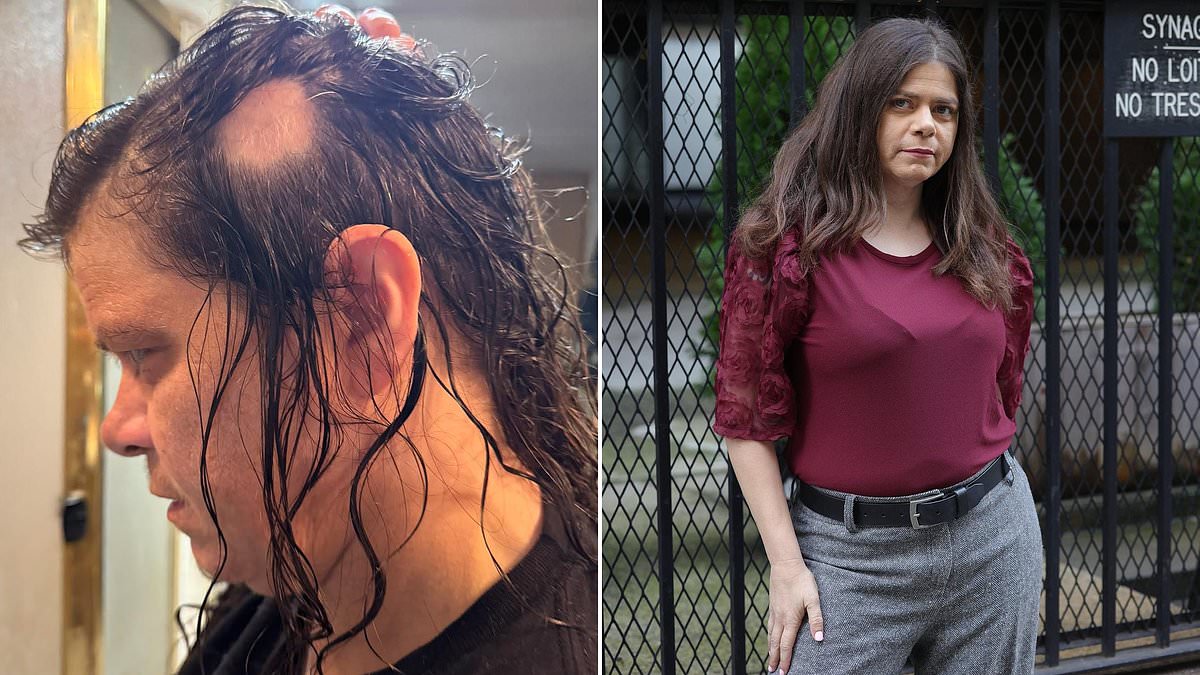
Darrelle Radcliff felt an unfamiliar sensation as she ran her fingers through her hair, prompting her to stop.
Amidst her typically thick and lush brown hair, she discovered a small patch of skin that was remarkably smooth and soft. It was a moment of disbelief.
Shortly after, at the age of 43, Radcliff found herself gazing at a photograph her boyfriend had taken, revealing a bald area the size of an orange, just behind her hairline.
“Suddenly, I’m just looking,” she recounted to the Daily Mail, “and I think, ‘Oh my gosh, there’s a bald spot.'”
When this happened in February 2025, Radcliff was struck with the fear that she might follow the same path as her sister, who had lost all her hair around the same age.
At 44, Radcliff began wearing a beanie everywhere she went, while friends and family, with the best intentions, suggested costly treatments and medications to address her hair loss.
She pushed their advice away, being terrified of needles and the potential side effects of drugs. She was at a loss as to what she should do.
That was when a friend suggested she try rosemary shampoo. Radcliff purchased the roughly one-dollar per use bottle and, within a month, said her hair had started to grow back.

Darrelle Radcliff, 44, said that rosemary shampoo helped to reverse a bald patch on her head
About 80 percent of men and up to half of women suffer from some form of hair loss.
Standard treatments are relatively well established for men, with options like minoxidil, also known as Rogaine, and finasteride commonly prescribed.
For women, however, the choices are more limited – finasteride, for example, is generally not recommended for women due to potential risks in pregnancy and limited safety data, particularly in women of childbearing age – leaving many to rely on fewer clinically proven solutions.
As a result, a growing number of people are turning to rosemary – typically used as an oil – as a natural remedy for hair loss. The trend is fueled in part by viral social media videos that showcase dramatic transformations allegedly due to the supplement.
The interest stems back to a 2015 study by Iranian scientists involving 100 people, which suggested rosemary oil was as effective as minoxidil, which works by improving blood circulation to the scalp.
Experts caution that there are no rigorous, large-scale clinical trials that prove rosemary reverses hair loss.
They warn that rubbing the oil into the scalp – the application method recommended when using it for hair loss – could cause scalp irritation, dryness, itching and even hair shedding.
However doctors suggest the method may also increase blood flow to the scalp – similar to minoxidil, although likely to a lesser degree – which boosts the oxygen and nutrient supply, potentially stimulating hair growth.
Radcliff started to use the shampoo every other day to help reverse her hair loss.
She applied it in the shower, massaging it into her scalp for 30 seconds and then waiting two minutes – to ensure the oil was absorbed – before washing it off.
She used Tgideras rosemary shampoo, which is available on Amazon for $22.90 per bottle. Each bottle contains 7.4fl oz, equivalent to about 20 washes.

Shown above is the orange-shaped bald patch that emerged on Radcliff’s scalp. She opted for the shampoo after it was recommended by a friend
At the same time, she also started to take Nature’s Bounty Advanced Hair, Skin & Nails supplements, which cost $7.96 for a bottle of 80 – roughly ten cents per gummy.
These contain biotin, which experts say can help with hair regrowth by boosting keratin production, an essential component for new hair.
Within a month of starting her regimen, Radcliff said hairs began to regrow on her bald patch.
They appeared as small, blonde hairs initially, which Radcliff said was odd because she had brown hair and had not been blonde since her pre-teen years.
The hairs continued to grow and, within a year, had taken on a darker color, blending back in with her original hair.
Radcliff kept using the rosemary shampoo throughout, and still uses it now, saying that she is convinced it helped to restore her lost hair.
It was not clear what caused her hair loss. She may have suffered from alopecia areata, an autoimmune disorder that causes hair to fall out or small, oval patches to suddenly appear on the scalp.
Alopecia areata happens because the immune system mistakenly attacks hair follicles, causing inflammation and hair loss.
In approximately 50 to 80 percent of mild alopecia areata cases, hair grows back spontaneously within one year, even without treatment.
Nearly seven percent of people in the US live with the condition.
Dr Abraham Armani, a hair transplant surgeon in Texas, told the Daily Mail there was no clear evidence that rosemary could reverse hair loss.
He said he has a number of patients who swear by rosemary oil, saying it has helped them to regain lost hair. He added, however, that there is no rigorous scientific evidence to back up the claims.
‘I would be hesitant to say that rosemary is like a “natural minoxidil,”‘ he told the Daily Mail.
‘I would say that it could work, potentially, in the same way as minoxidil, but it does so in a less predictable and less effective way.
‘What a patient may feel like something is doing, could be totally different from the actual truth.
‘There are all kinds of things that patients do and say, “this really helped me.” Unless you do a scalp analysis and rigorous tests, you cannot say for sure that what they did has helped.’
Dr Aziz Elgindi, a hair loss surgeon in London, told the Daily Mail that he also had patients who said rosemary helped their hair loss, but added that their statements were hard to prove.
When Radcliff noticed her hair loss, she was struggling with stress.
Her boyfriend suffers from gout and, at the time, had just injured his knee in an accident.
It meant that the duty of running their small California ranch fell entirely to Radcliff, which meant she needed to care for a horse, two ducks, four dogs, four cats and a guinea pig.
‘Women’s hair loss is more complex than men’s, so there are more things that can trigger it,’ Elgindi said.
‘Stress is definitely a very big trigger for certain forms of hair loss in women.’
For example, telogen effluvium – a temporary form of hair loss typically caused by high stress levels – is characterized by diffuse thinning of the hair across the whole scalp.
‘It can also happen due pregnancy, age and hormones, and usually grows back on its own after a period of a few months,’ Elgindi added.
As for whether rosemary shampoo was truly what helped Radcliff, Elgindi said it is possible.
‘It sounds like the lowering of stress helped – as well as the shampoo may have acted as a helping aid both via its properties and via placebo,’ Elgindi told the Daily Mail.
‘[But] without an assessment before and after, it is very hard to tell what the cause of her hair loss could have been and what treatment would have been suggested.’