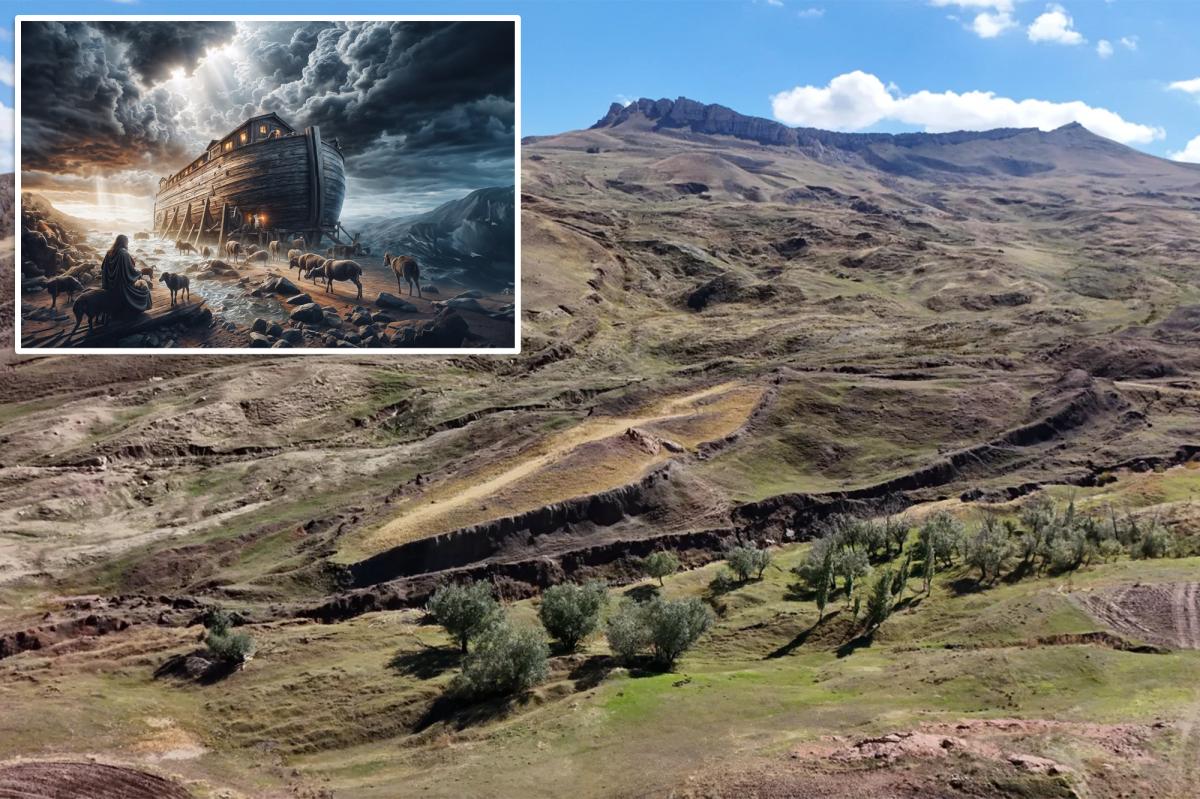


Recent revelations from a researcher have sparked renewed interest in a peculiar rock formation in Turkey, suggesting it might be evidence of the legendary Noah’s Ark, according to various reports.
Andrew Jones, affiliated with Noah’s Ark Scans, shared with GB News about groundbreaking discoveries related to a rock formation on Turkey’s Mount Ararat. Initially identified in 1959, this formation could potentially be the remnants of the ark from the Biblical Book of Genesis.
Utilizing ground-penetrating radar scans and analyzing soil samples, researchers have identified a network of “corridors” beneath the surface. Remarkably, these corridors correspond with the 515-foot dimensions traditionally attributed to Noah’s Ark, as reported by the outlet.
The scans unveiled tunnels running along the center and edges of what might be the vessel, converging into a central space that Jones refers to as an atrium. This configuration, according to Jones, aligns with the Biblical narrative of Noah’s Ark.
“God instructed Noah to gather the animals, and they, along with Noah and his family, would have sheltered in this structure,” Jones explained in his discussions with the outlet. “It’s fascinating how these voids are systematically arranged beneath the ground, rather than being haphazard.”
Jones further elaborated on the findings, stating that the tunnels exhibit a discernible pattern. He highlighted the use of Ground Penetrating Radar (GPR) to peer beneath the soil and mentioned additional studies employing Infrared Thermography (IRT), another geophysical method, which suggest the presence of a ship-like hull preserved deep within the earth.
Scientists also uncovered additional evidence from soil samples that could prove that humans constructed the rock formation.
“In 2024, we took 88 random soil samples inside and outside of that ship shape,” Jones recalled. “And what they showed was that the soil inside the ship shape had three times more organic matter than right outside, and 38 per cent more potassium.”
“What that shows is that the soil is unique. And the grass, in the fall, it has a yellower color just inside.”
“It’s exactly the link given to the Bible. It’s 300 Egyptian cubits. For us, these are all positive lines that we’re pursuing, and it’s showing that there’s more to be found,” he said.
Fossil remains found deposited around the boat-shaped site, which sits roughly 6,500 feet above sea level, could also show evidence of the Great Flood, Jones argued.
Ancient coral and seashells uncovered by researchers could prove that “one time this area was underwater,” he added.
The phenomenon, however, could be tectonic plates shifting and raising the rock formation high above the prehistoric ocean.
Jones and his team are now considering exploring the mysterious tunnels with a robotic device.
“We have a team that is designing a robotic, remote-controlled device that could go down inside the holes and explore the tunnels,” he told the outlet.