
Just a stone’s throw from the Thames, nestled in the churchyard of All Saints with its origins dating back to the 12th century, lies the grave of Victorian poet Matthew Arnold.
The village of Laleham in Surrey embodies the serene essence of old England, maintaining its quaint, sleepy charm.
However, in recent weeks, locals were taken aback as a young Afghan man was frequently seen loitering near the Church of England primary school, reportedly approaching female students and becoming aggressive when confronted.
According to a group of concerned parents, the man allegedly spat at them and implied that his journey to Britain via a £3,000 dinghy ride granted him certain freedoms. “I’m allowed to stand where I want – I paid £3,000 to be here,” he reportedly declared.
Police were called, and after the individual disregarded their warnings, he was arrested last week and taken into custody under the Mental Health Act.
It was only then revealed that the Afghan man, in his 20s, had been placed in a 1920s semi-detached house with five other migrants the previous month, a placement organized by the Home Office.
The house had been purchased by north London businessman Joshua Grunt, 48, in October for £500,000, who immediately let it out via an agent to house migrants.
However, the local authority, Spelthorne Borough Council, insists it had neither been informed nor consulted over the arrival of any migrants, saying: ‘The Council has written to the Home Office asking for an explanation and an assurance that this will not happen again.’

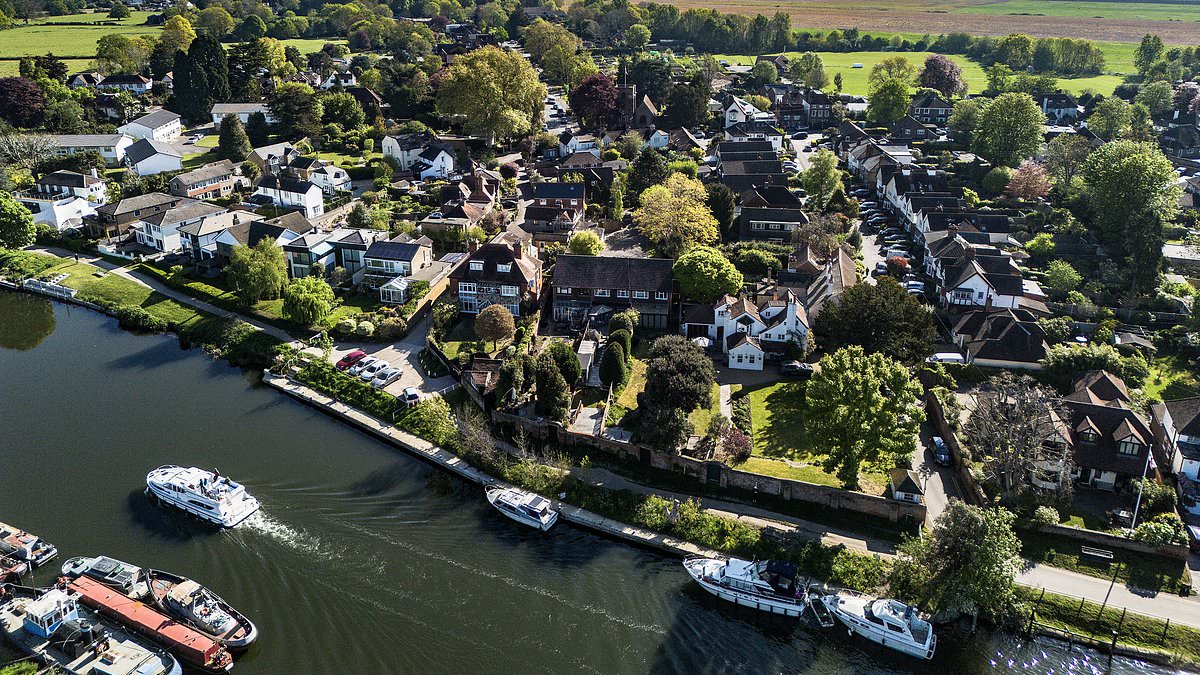
The Home Office has been placing migrants in the quintessentially English village of Laleham in Surrey (pictured)

An Afghan asylum seeker leans against a wall in Laleham. He was later arrested and detained under the Mental Health Act after reportedly approaching female pupils and becoming aggressive when spoken to
Yet a Daily Mail investigation has found that such sudden arrivals of migrants in villages and towns are about to happen on a huge scale – all over the country – as a direct result of Labour’s promises to close migrant hotels. And the only people celebrating will be those making fat profits as a result. At taxpayers’ expense.
Our inquiries began at the edge of the Garden of England, where the residents of Walderslade, a suburb of Chatham in Kent, were last week up in arms.
Thanks only to a leak to a local councillor they had learned that they, just like the residents of Laleham, were about to find out what Keir Starmer’s dispersal policy looks like in practice.
What it is going to mean in Walderslade – where oast houses and miles of countryside are on the doorstep – is the sudden arrival, on two quiet residential cul-de-sacs, of two groups of asylum seekers, amid long-standing residents.
In total, some 221 migrants are officially predicted to arrive soon on residential streets across the largely rural borough of Tonbridge and Malling.
And what is really remarkable is that this is likely to be the template for the whole country.
Although ‘dispersal’ is Labour Home Secretary Shabana Mahmood’s policy to quell growing disquiet about the concentration of young men in a few hundred migrant hotels, the new measures are instead likely to atomise the issue, spreading public concern to thousands of flashpoints around the country.
Last week the Home Office boasted it had emptied 11 out of around 200 migrant hotels.

An Afghan asylum seeker in his 20s is arrested for harassing schoolgirls and detained under the Mental Health Act

A picturesque vista of the River Thames flowing through Laleham on an early autumn day
Join the discussion
Would you feel comfortable if this happened in your area?
Its avowed aim is to move as many asylum seekers as possible into dedicated sites such as the former Army training facility at Crowborough, East Sussex, or the Cameron Barracks in Inverness. While those plans have also sparked local anger, more importantly, such large vacant sites are few, their conversion slow and expensive. The alternative, then, is ordinary houses.
Objectively, only a small percentage of residents of migrant hotels have been convicted of any offences – and only a tiny proportion of anything violent.
But that is not what the residents of Walderslade are thinking. They are thinking of the three dinghy passengers, from Egypt and Iran, convicted on Thursday of a gang rape on Brighton beach.
Or of Sudanese small-boat asylum seeker Deng Chol Majek, 26, jailed for life in January for the frenzied murder of Rhiannon Whyte after her evening’s work at his Walsall hotel.
They are thinking of the demonstrations last year outside the Bell Hotel in Epping, Essex, after Ethiopian migrant Hadush Kebatu tried to kiss a schoolgirl and groped a woman.
In Walderslade, on one of the two roads where migrants are due to arrive – out of 37 across the borough – the houses are bungalows. Retired power station worker Ernest Mackey, 86, a great-grandfather, lives right next door to the property being prepared to house six migrants, several in the converted loft. Mr Mackey told the Daily Mail: ‘I’ve been here since the bungalows were built in 1962.
‘My wife Denise died in October, aged 83, just as builders started knocking about in the house next door. We had an inkling something was up.
‘Only now have I found out through a neighbour that it’s for migrants. I’ve had nothing official. We don’t know who’s moving in, or what they’re like.
‘We’ve paid our taxes for years – but migrants get all these facilities for free. I’d deport them straight away.

The residents of Walderslade (pictured), a suburb of Chatham in Kent, were last week up in arms over an influx of migrants into their community
‘I’ve always been a Labourite. Not now. They’ve gone roughshod over everyone.’
Living next-door on the other side of the property is father-of-two Alan Bell, 59, and his Ukrainian wife Svetlana.
A previously Labour-voting university graduate, who works largely from home as a court stenographer, he is uneasy with the development.
Mr Bell said: ‘It’s a sense of not knowing, and fearing the worst. I can’t see how housing migrants on a street like this benefits anybody.
‘I thought the Government was going to be moving the migrants into old barracks, but they seem to be being sold to make housing estates. Instead, although it would be more sensible to keep them [the migrants] together, and supervised.
‘What are they going to do, packed into a house with no supervision? The only thing here is a corner shop a quarter of a mile away.
‘We want to be able to sit in our back garden and not be bathed in weed smoke. And we’re worried about when our eldest, 12, has to come home from school by bus and collect his brother from the primary. What are they going to run into?’
Living almost directly opposite the migrant house is grandmother Christine Tingley, 72.
A retired head of adult social care at Medway council, she is attuned to the housing needs of vulnerable people – as is her husband Barry, formerly a housing association manager. But not like this. She said: ‘I’m all for helping vulnerable people – but these people who are going to be housed here are going to be unvetted, and at a loose end in an isolated environment like this.
‘From what you can see through the windows – with a tiny kitchenette put in at least one room – I wouldn’t house a rat in there. And I’m mystified why they’ve boarded up some of the dormer windows.
‘There’s been absolute secrecy about what’s going on.’

A group of residents of Montfort Road in Walderslade
That anybody knows about the imminent arrival of the migrants is only thanks to Conservative Kent county councillor Andrew Kennedy, who said ‘a friend in Whitehall’ told him a fortnight ago about the plan.
‘Walderslade has a few pubs nearby, a corner shop, and a garage. There’s an Asda a mile away, but the M2 motorway runs in between.
‘There’s vulnerable older people living here. I’ve told them “You mustn’t assume they’re all criminals”. But they know what they’ve read.
‘When people come with no documentation, they should be held in facilities where they can receive support until their applications are processed.
‘Instead, they’re going to be dumped here in Walderslade.’
And that brings us to those who are, in contrast to the residents of Walderslade, or quaint Laleham, delighted by the relocation of asylum seekers to residential houses.
Those are the people profiting from the 40,000 or so dinghy migrants arriving annually.
Primarily that is the three companies with multi-billion-pound Home Office contracts to house asylum seekers.
Public sector service provider Serco has the contract for England’s North-West, Midlands, and East, while housing firm Mears covers Scotland, Northern Ireland and England’s North-East, Yorkshire and the Humber.
In southern England, and Wales, the contract is held by Clearsprings Ready Homes. Unlike the other two companies, the vast majority of its profits go to just one man, Graham King, of Essex, a former caravan park and teen-disco tycoon.
Personal earnings approaching £100million a year, so far mostly via hotels block-booked for years, mean he is predicted to become the first asylum billionaire.
The shift away from hotels will not dent King’s earnings. Clearsprings is not only operating the controversial migrant ‘camp’ in Crowborough, Sussex – but it is also moving fast to rent private houses.
That involves ‘long-term contracts’ with ‘zero hassle’ and ‘guaranteed rent’ promised to multiple landlords.

Neil Sears talked to locals at migrant housing in Walderslade on the edge of Rochester in Kent
Private investors are fast pitching in. In October, on one of the streets in Walderslade, whose dismayed residents we have already heard from, a bungalow was bought for £320,000 by north London-registered property speculator Yehudah Silberstein, 45, an American.
And just before Christmas, a detached house on a second Walderslade cul-de-sac was bought for £352,500 by another north-London-based investor, Joseph Sonnenschein, 71.
The Walderslade investors appear to have immediately signed up to long-term contracts with Clearsprings, which it seems has used the same builders to convert the properties.
Each has been fitted out with the signage required for a ‘House in Multiple Occupation’, or HMO – with generic ‘Fire Exit’ and ‘No smoking or vaping’ signs, and the same newly redone yet shabby air.
Because both were already used for housing, no planning application is required, which means local councils cannot reject them as unsuitable for asylum seekers and neighbours cannot object.
All Clearsprings and the landlords have to do is apply for HMO licences, granted solely on the basis of health and safety, hence the ‘Fire Exit’ signs.
A spokeswoman for Tonbridge and Malling council confirmed a figure of 221 migrants heading their way – 12 in our two cul-de-sacs in Walderslade – had been set out in ‘Home Office target figures in the asylum dispersal contracts held by Clearsprings’.
The spokeswoman said the council had no powers to stop the plans, but added: ‘The Council’s political leadership is clear that it considers it completely inappropriate that properties are being used for asylum accommodation when we have a significant housing waiting list.’
The Conservative leader of Tonbridge and Malling council, Matt Boughton, said: ‘The Government has tried to house these people in hotels – but they’re unpopular, so they’ve got Clearsprings to acquire properties under the radar.
‘The council don’t have the power to reject HMO applications on the basis it’s asylum accommodation – and the local population has absolutely no say at all.’
A spokesman for the Home Office refused to say what proportion of asylum hotel migrants would be rehoused in private housing, but said: ‘This government is removing the incentives drawing illegal migrants to Britain, and ramping up removals.
‘That is why we will close every single asylum hotel, moving asylum seekers into basic accommodation, such as military barracks. All local authorities are consulted on dispersed accommodation.
‘The population in asylum hotels has fallen by nearly 20 per cent in the last year and by 45 per cent since the peak under the previous government – cutting costs by nearly £1billion.’
Spokesmen for migrant housing contractors Serco and Mears said they operated under Home Office instruction.
Clearsprings did not respond to requests for comment.
In Walderslade, taxpayers are desperate for information about who is due to move in next door.
In the second cul-de-sac, soon to be home to six migrants – in a formerly three-bed 1980s house, fringed by woodland – retired materials controller Andrew Deal, 67, knew nothing beyond online gossip.
Mr Deal said: ‘The builders doing it up didn’t speak a word of English. They’ve been splitting rooms into two, turning the garage into accommodation.
‘There’s nothing for the migrants locally. And the taxpayer’s got to pay.’
Additional reporting: David Pilditch


