
Once celebrated as “Silicon Mountain” for its relaxed legal landscape, Colorado is now facing criticism as its attempts to regulate artificial intelligence are seen as a threat to its business-friendly image.
During the 2010s, Colorado was a hotspot for innovation, birthing a new startup every three days. Entrepreneurs and venture capitalists flocked to the state, attracted by its affordability compared to coastal tech centers.
However, the introduction of a significant AI bill has sparked controversy, with tech industry leaders expressing concerns that Colorado may be adopting the regulatory approaches they left behind in California.
In a bold move, Elon Musk’s company, xAI, has filed a lawsuit against Colorado over this legislation. Meanwhile, the U.S. Department of Justice has criticized the law as unconstitutional, arguing that it could undermine the nation’s tech competitiveness.
The Trump administration maintains that AI regulation should be managed at the federal level rather than by individual states, a stance that aligns with the views of Colorado’s Democratic Governor, Jared Polis.
“I generally support the direction the White House is taking to preempt state laws on AI,” stated Polis, indicating his preference for federal oversight.
But back in 2024, Polis signed a package of new AI regulations into law, hedging at the time by saying he hoped a revised, less burdensome version of the law would ultimately serve as a model for a broader federal framework.
The original law would have required companies to mitigate risks that AI systems would discriminate against certain kinds of people when it helped make high-stakes decisions in realms such as hiring or medical care.
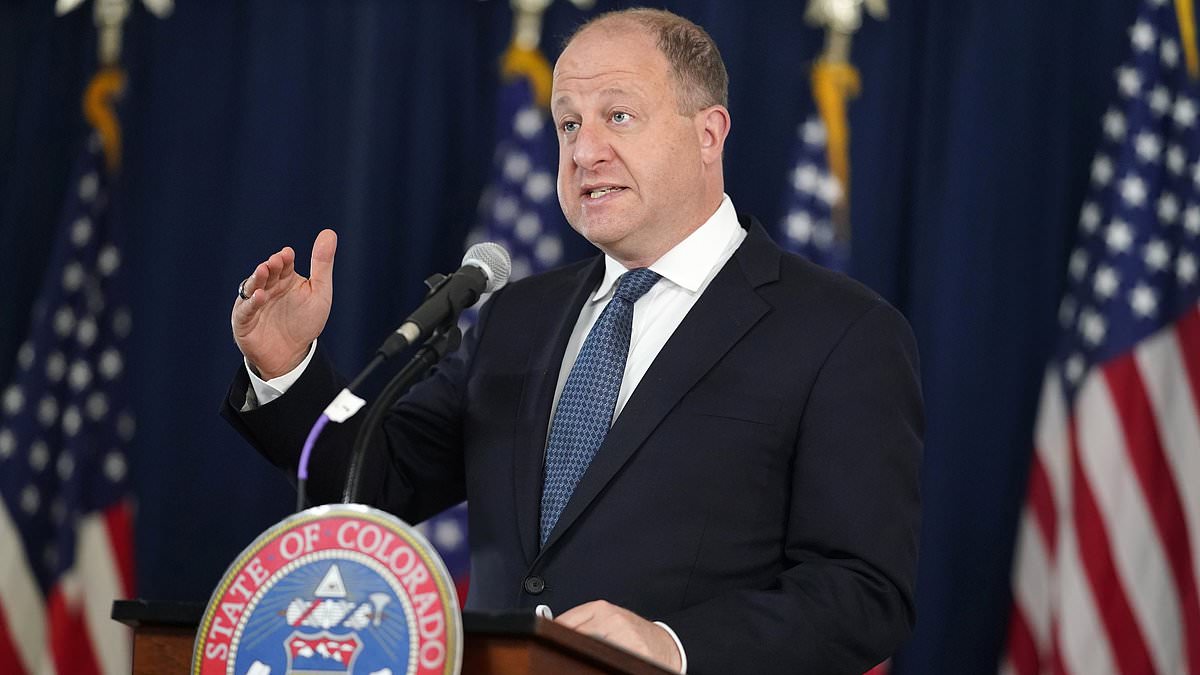
Colorado Governor Jared Polis a package of AI regulations into law in 2024
Colorado capital city Denver and the Rocky Mountains beyond; regulations are fueling tech industry complaints that ‘silicon mountain’ is turning into the California they fled
Now, pressure is mounting on lawmakers in Denver to pass a bill that would amend and revise the original 2024 law.
‘We can do a bill in three days if we don’t screw around,’ state Rep. Brianna Titone, an original co-sponsor of the legislation, told the Wall Street Journal.
A coalition of more than 300 business leaders says burdensome regulations such as the AI law are stifling economic growth.
Some businesses are already leaving the state, according to a report published by the Colorado Chamber of Commerce last month that found a decline in publicly traded companies headquartered in the state.
The report estimated that roughly 98 companies have either relocated out of Colorado or chosen not to move to the state since 2019.
This resulted in a loss of 13,000 jobs and 34 public company headquarters since 2022, with the majority of businesses moving to regulation-lite, low-tax states such as Texas and North Carolina.
In an interview with the Wall Street Journal, Polis refuted the report’s conclusions, arguing that ‘far more’ companies are moving to Colorado than are leaving the state.
He also highlighted the fact that the state was home to 21 ‘unicorns’ – startups valued at more than $1 billion – insisting that this helped prove that its tech economy remains strong.
The Trump administration has signaled that AI regulation should be handled at the federal level – not by states

Elon Musk’s xAI is suing Colorado over its laws regulating artificial intelligence
The xAI lawsuit and resistance from the Trump administration is beginning to crush Colorado’s dream of remaining a major tech hub that holds on to blue-state policies.
Even worse, economic data shows the state’s economy is projected to lose more nonfarm jobs this year than it gained last year – and the housing market is cooling rapidly.
According to the Chamber of Commerce report, Colorado is the sixth most regulated state in the nation.
Sixty-five percent of businesses with fewer than 100 employees rank regulations among their top three challenges, with most citing state-level rules as the primary burden.
Labor and employment regulations are the biggest concern for small businesses at 85 percent, followed by environmental regulations at 59 percent.
An overwhelming 96 percent of small businesses support reviewing existing regulations, and 82 percent believe there should be a cap on new ones.


