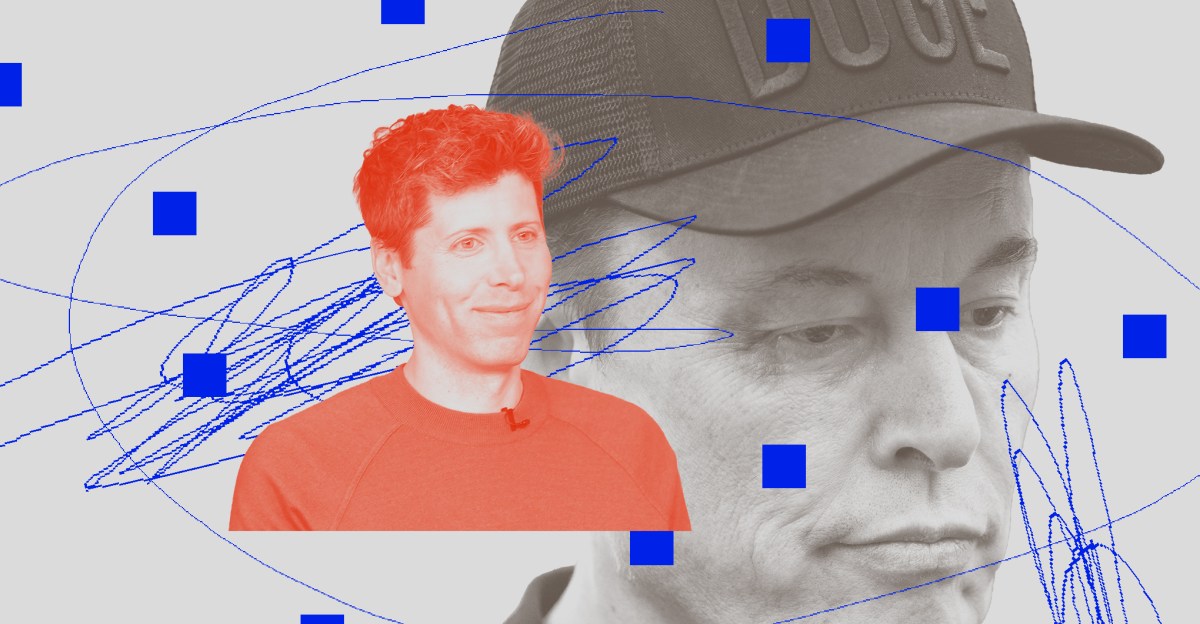
In the ongoing legal battle between Elon Musk and OpenAI, one of the most compelling pieces of evidence has emerged from the personal journal of Greg Brockman, a key figure at OpenAI. Brockman himself is also playing a significant role in the proceedings, providing testimony that alternates between insightful and contentious.
Brockman’s appearance on the witness stand was unconventional, beginning with a cross-examination rather than a direct one. During his testimony, he displayed a demeanor reminiscent of a high school debate champion, frequently correcting the phrasing of questions and clarifying statements with remarks like, “I wouldn’t characterize it that way,” or “I wouldn’t say it that way.” When Musk’s attorney, Steven Molo, presented evidence, Brockman was quick to point out even minor omissions, such as skipped articles like “a” or “the.” His response to a query about Microsoft’s substantial $10 billion investment was notably dismissive, remarking that it was the sole $10 billion investment, suggesting a level of pedantry that may not have endeared him to the jury.
It’s often advised that those with a penchant for philosophical intricacies, such as defining “epistemology,” might be better off avoiding self-representation in court. Brockman’s insistence on correcting minor errors consumed the jury’s time and seemed more focused on demonstrating his precision than addressing the core issues at hand. Such behavior might be more appreciated in familial settings than in a legal one.
The content of Brockman’s journal, however, presents a more damning narrative. The journal, a collection of text files from his computer, starkly reveals a mindset of ambition and opportunism dating back to 2017. One entry reads, “btw another realization from this is that it’d be wrong to steal the non-profit from him. to convert to a b-corp without him. that’d be pretty morally bankrupt and he’s really not an idiot.” In another, he contemplates the shift to a for-profit model, noting, “maybe we should just flip to a for-profit. making money for us sounds great and all.” He candidly admits, “cannot say we are committed to the non-profit. don’t wanna say we’re committed. if three months later we’re doing a b-corp it is a lie.”
Interestingly, the sentiment in Brockman’s journal entry that it would be “wrong to steal the non-profit from him” closely mirrors Musk’s own accusation of “stealing a charity.” These revelations from Brockman’s writings paint a picture of a strategic thinker weighing the moral and financial implications of OpenAI’s corporate structure, which could significantly influence the court’s perception of the case.
“It’d be wrong to steal the non-profit from him” is very close to Musk’s “steal a charity” line, I notice.
We haven’t finished the direct examination yet, so I’m sure we’ll be hearing something exculpatory about the events that inspired these entries. But between Brockman’s attitude toward the cross and the journal entries, I don’t think I’d trust him to watch my bag while I used the restroom.
Musk’s team is trying to paint Brockman as being greedy, which I buy. The infamous “What will take me to $1B?” from Brockman’s journal made an appearance. We established that Brockman’s stake in OpenAI’s for-profit was worth about $30 billion. Molo asked Brockman why he hadn’t donated $29 billion to OpenAI’s non-profit arm if $1 billion was enough for him.
“Why are we fighting about the fucking purple box?”
Brockman could have said something like, “If I dumped all my holdings all at once, OpenAI would receive a lot less than $39 billion, because that’s how supply and demand works.” He might have said something like, “It’s an important signal to other investors for me to have skin in the game.” Or maybe, “That’s just my net worth on paper. It’s not real.”
He didn’t do any of this. Brockman replied with nonsense about how much the non-profit’s stake in the for-profit was worth. Molo said that didn’t answer his question and asked again. We went back and forth on this for quite some time; the jury’s heads snapped to and fro as though they were watching a tennis match. Brockman never did answer the question.
No detail was too small to argue over. Molo asked if purple boxes were something OpenAI generally used to call attention to something important, and Brockman said no. Then we all read in the document that OpenAI generally used them in employee and investor paperwork to highlight important things. In my notes I have written, “Why are we fighting about the fucking purple box?”
Molo landed another major blow by bringing up the various deals that OpenAI had with companies Brockman had a stake in: Cerebras, CoreWeave, Stripe, and Helion Energy. Given the sheer number of companies that use Stripe, its OpenAI deal seems piddling — but the OpenAI commitments seriously matter to both Cerebras and CoreWeave.
“I do all the things.”
Brockman also has direct financial ties to Altman because of a compensation package he was offered when they started OpenAI. He holds a 1 percent stake in Altman’s family office, which Brockman got in lieu of Y Combinator stock because “we ran out of Y Combinator stock fulfilling other [employees’] offers.” In a 2017 email, Musk’s bodyman, Jared Birchall, writes to Musk that Altman disclosed that to him, and Musk forwards the Birchall email to Brockman with a “??” Apparently Musk didn’t know about the deal, and Brockman had to explain it.
I am dwelling on the various ways that Brockman made himself untrustworthy because it’s fun to watch powerful men squirm. But it also has colored my view of his direct testimony, which started afterwards. Brockman began by telling a story of OpenAI’s founding that sounded like it had been polished for a thousand podcasts and keynote speeches. When asked what he did as the president of OpenAI, he replied, “I do all the things.” If we had not been in a courtroom, I would have screamed. Millennial vocabulary is a fucking tragedy.
In this telling, OpenAI was Brockman and Sam Altman’s idea. Brockman had told Altman about his interest in AI as he was leaving Stripe (“I’m thinking about doing an AI thing,” to which Altman apparently said, “I’m also thinking about doing an AI thing.”). They kept in touch. The original idea was purportedly to have a Y Combinator research arm, which Musk shot down because he didn’t want to be affiliated with Y Combinator.
Musk seemed “very consistent and fixated” on Hassabis
Imagine a montage of cozy dinners, trips to Napa (“our van got stalled for an hour and a half in traffic and no one noticed” because the conversation was so good), AI conferences. Gee whiz! It was so neat-o! Everyone got along so well and had such great creative energy! We were treated to a very long retelling of Ilya Sutskever waffling about leaving Google, and then a photo Brockman took of the first day of OpenAI, with everyone working from his apartment. (In the photo: Altman. Missing: Musk.) I think you get my drift; I certainly got Brockman’s. This was Altman’s and Brockman’s baby. It was only after Musk had done closing calls with the team that Altman and Brockman had assembled that Musk told them he wanted to be more involved.
Musk appeared in the testimony as a distant and at times menacing figure. At one dinner, he asked if Google’s Denis Hassabis was evil. In fact, Musk seemed “very consistent and fixated” on Hassabis, and never so much as mentioned Larry Page, who in Musk’s telling was the reason OpenAI came to be. In text messages from Sutskever to Brockman, Sutskever wrote, “Elon might spend half a day a week with us. I imagined how it will be and I worry that our work environment can become very stressful.”
Sutskever was correct to worry; Musk is famously difficult. I imagine we will hear more about that tomorrow. But as it stands so far, the jury will have to decide who of two not-especially-trustworthy men it trusts more. I don’t envy them the task.