
Ted Turner’s legacy is taking a philanthropic route, as his five children will not directly inherit his two million acres of land or the bulk of his wealth.
The late CNN founder and America’s second-largest landowner has chosen to allocate his $2.8 billion fortune to his foundation, rather than passing it directly to his offspring. However, his children are actively involved with the foundation, serving on its board of directors.
The Turner Foundation is poised to receive the impressive land holdings, which encompass 13 expansive ranch-style properties located across Colorado, Kansas, Montana, Nebraska, New Mexico, and South Dakota.
Turner, a pioneer in media, was among the earliest to embrace The Giving Pledge in 2010, committing to donate ‘virtually all’ of his substantial wealth to charitable causes. This pledge aligns with his longstanding dedication to philanthropy.
In his final wishes, Turner humorously requested that only ‘just enough money for a funeral’ be left aside. He joins fellow billionaires Warren Buffett and Bill Gates in this charitable commitment, reinforcing a legacy of giving back.
Warren Buffett and Bill Gates also signed the pledge.
‘I don’t measure success in numbers, but I consider my contributions of more than 1.3 billion dollars to various causes over the years to be one of my proudest accomplishments and the best investment I’ve ever made,’ Turner wrote in his Giving Pledge letter.
‘Those dollars have improved lives, saved species, fought disease, educated children, inspired change, challenged ideas and opened minds; and at the time of my death, virtually all of my wealth will have gone to charity.’
‘Looking back, if I had to live my life over, there are things I would do differently, but the one thing I would not change is my charitable giving.’
‘I’m particularly thankful for my father’s advice to set goals so high that they can’t possibly be achieved during a lifetime and to give help where help is needed most.’
Ted Turner died aged 87 on Wednesday, according to CNN, which he founded. His Ted Turner’s five kids are not inheriting his two-million acres of land
Standing Butte Ranch was purchased by Turner Enterprises in 2015 and is located in central South Dakota. The property boasts 45,921 acres of natural prairie, the majority of which has been undisturbed for centuries
The 560,000-acre Vermejo Park Ranch, located in northern New Mexico and southern Colorado has a diverse landscape from short-grass prairie to alpine tundra mountains at 13,000 feet. It is one of the premier hunting, fishing and eco-tourism destinations in the Western US
‘That inspiration keeps me energized and eager to keep working hard every day on giving back and making the world a better place for generations to come.’
Rather than being divided among heirs, Turner’s land will transition into being run by his foundation and established trusts, ensuring that the land remains intact and continues to be operated with his same conservation-driven philosophy.
Turner was father to Laura Turner Seydel, an environmental advocate, Robert ‘Teddy’ Turner, a businessman, Rhett Turner, a documentary filmmaker and photographer focusing on nature, wildlife, and conservation, Beau Turner, a wildlife conservation manager, and Jennie Turner Garlington, a philanthropist.
Turner’s children all maintain board seats on the Foundation, according to their website.
The children were shared with his ex-wives Judy Nye and Jane Smith. Turner was also married to Jane Fonda from 1991 to 2001.
All 13 of the properties are managed under Turner Enterprises, which has a long-standing commitment that the land will remain dedicated to conservation and sustainable, ecologically sensitive use upon Turner’s death.
During his lifetime, Turner used the ranches for bison restoration, responsible land management, and the protection of native ecosystems, leading one of the largest private conservation efforts in the US.
Fawn Lake Ranch is comprised of 63,792 acres of contiguous prairie in the Nebraska Sandhills. The ranch includes 25 lakes, several fens and 55 miles of streams originating on or flowing through it
Snowcrest Ranch is a 13,343-acre ranch located along the Upper Ruby River in southwest Montana
Located in central South Dakota, Bad River Ranch comprises approximately 148,000 acres of diverse grassland with rolling hills. The ranch is situated in the mixed grass prairies of central South Dakota and plays a crucial role in bison production and conservation
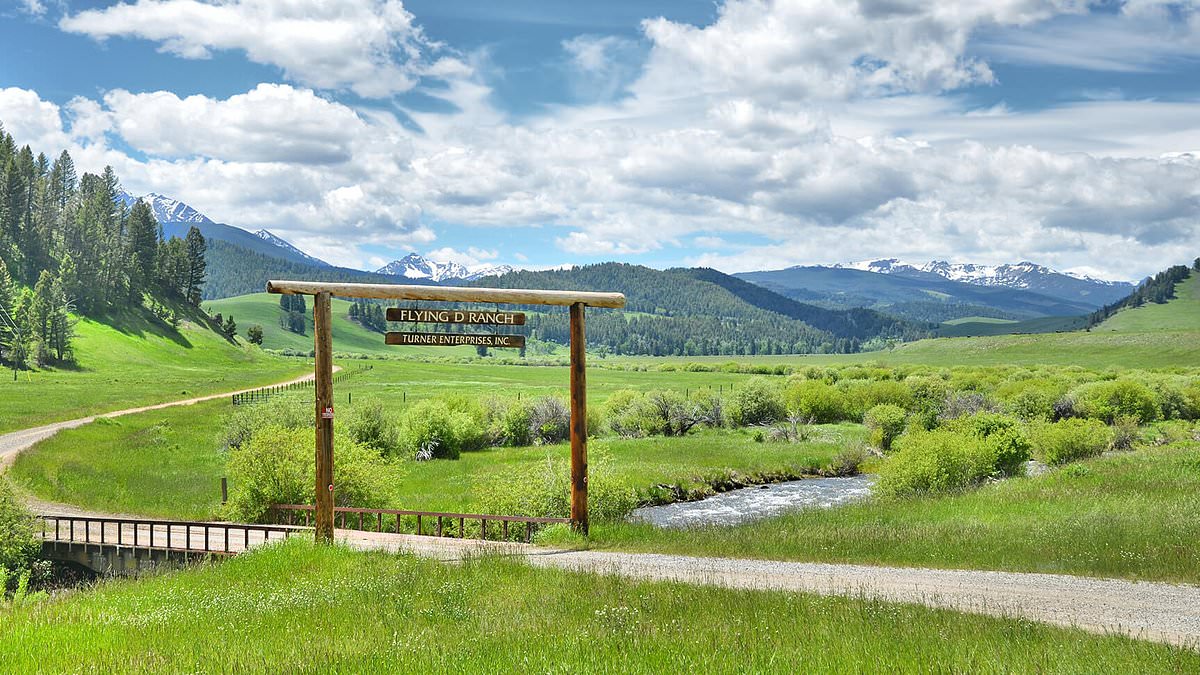
Flying D Ranch, Montana, stretches 113,000 acres, and is known for its large bison herds and wide-ranging conservation work
Ted Turner poses near a herd of his bison in this September 1991 photo at his 107,000-acre Flying D Ranch near Bozeman, Montana
A group of state and federal wildlife officials help release nearly two dozen Bolson tortoises at Turner’s Armendaris Ranch in Engle, New Mexico
The 560,000-acre Vermejo Park Ranch, located in northern New Mexico and southern Colorado is nothing short of spectacular with diverse terrain spanning from short-grass prairie to alpine tundra mountains at 13,000 feet
Turner’s earliest step into purchasing land began with Bar None Ranch in Montana, a property he bought in 1987 after entering the bison business in 1976.
He later sold the ranch as his vision expanded, but it marked the beginning of what would become his passion.
The remaining land, a sweeping network of working conservation land, will continue to be run by Turner’s estate and will be used for bison ranching, conservation, hunting and fishing forever.
In Kansas, Turner’s Z Bar Ranch spans approximately 48,000 acres of open Great Plains grassland, and bison production is balanced with the restoration of native prairie systems.
In Montana, his Snowcrest Ranch covers about 15,000 acres, and served as Turner’s primary residence. It has an abundant wildlife habitat and is designed for fishing and horseback riding.
Also in Montana, Flying D Ranch stretches 113,000 acres, and is known for its large bison herds and wide-ranging conservation work.
In Nebraska, Turner owns several ranches focused on prairie restoration and bison management.
Spikebox Ranch, at around 30,000 acres, is devoted to sustainable grazing practices, and Blue Creek Ranch, 50,000 acres, focuses on preserving native prairie ecosystems and bison production.
Turner’s Deer Creek ranch has an abundance of wildlife including sandhill cranes, turkeys, sharp-tailed grouse, mule deer, whitetail deer, pheasants, long-billed curlews, as well as geese and ducks. In addition, elk, nesting swans and bald eagles frequent select areas of the property
Turner Enterprises fish and wildlife technician Kevin Duffy looks for a way out of Cherry Creek Canyon on Ted Turner’s Flying D Ranch after a hike down to the waterfall
Turner’s four massive ranches in Nebraska’s wide-open sandhills are home to 9,000 head of bison, and area ranchers describe Turner as the perfect neighbor
Turner helps a biologist release a couple of wolves on his Ladder Ranch property
Turner’s Blue Creek Ranch is located on the southwestern edge of the Nebraska sandhills, and is home to over 5,000 bison and many bird species
Turner’s McGinley Ranch, spans 44,000 acres in Nebraska, has rolling grasslands and large bison herds.
His nearby Fawn Lake Ranch, 16,000 acres, has a mix of wildlife habitat and conservation.
Turner’s Deer Creek Ranch is 12,000 acres and is designed specifically for bison grazing.
In New Mexico, the scale and diversity of Turner’s land grows.
Ladder Ranch, spanning approximately 156,000 acres, lets guests participate in day-to-day ranching operations set against a mountain backdrop.
Armendaris Ranch covers 360,000 acres of desert landscape and is dedictaed to bison ranching.
Turner’s Vermejo Park Ranch is the largest of them all 550,000 acres, and is a sweeping expanse of mountains, forests, and valleys, designed for conservation and regulated hunting and fishing.
Further north, in South Dakota, Turner’s Standing Butte Ranch encompasses 46,000 acres and is focused on bison and wildlife conservation.
Turner’s Spikebox Ranch is comprised of some of the most majestic and remote rangeland in the state. From its beautiful wetlands and meadows to the choppy dunes of the Sandhills, the ranch provides a natural habitat to many species
The Salt Fork of the Arkansas River winds through the southern half of Turner’s Z Bar Ranch southwest of Medicine Lodge, Kansas
Bison on Turner’s Flying D Ranch south of Bozeman, Montana
At Ladder Ranch, Turner and Fonda take part in an Indian ceremony in homage to the wolves

McGinley Ranch straddles the state line of northern Nebraska and southern South Dakota. McGinley Ranch has made significant strides in the renewable energy arena by constructing five solar-powered wells on the property, a 200-mile, solar-powered electric fence, and building 185 windmills providing water for the bison herd
Turner’s aim during his life was to keep all the lands as ‘functioning Great Plains ecosystems, home to over 51,000 bison.’
Before his death, Turner had already begun transferring ownership of the ranches, including 80,000 acres in Nebraska, to his Turner Institute of Ecoagriculture, a nonprofit, which will continue running the land and paying property taxes.
Turner Enterprises, Inc. will ensure the land is managed for conservation and will never see traditional development.
Turner’s goals upon death for his foundation include: ‘improving air and water quality, developing a sustainable energy future to protect our climate, safeguarding environmental health, maintaining wildlife habitat protection, and developing practices and policies to curb population growth rates.’
While his children will not own property rights to the land, all five are involved in the foundation and plan to continue his conservation legacy.