
He was a brawling, self-taught attorney, an unlicensed childbirth assistant, a ferry boat captain, a seventh-grade school dropout, and a survivor of a harrowing highway shootout. Yet, for millions today, he is simply the friendly face representing comfort food: Kentucky Fried Chicken.
KFC is synonymous with crispy fried chicken, creamy mashed potatoes and gravy, and warm biscuits. For countless people, it epitomizes comfort food. However, for the man behind the brand, it was the peak of an unpredictable, adventurous, and often tumultuous life. Harland Sanders discovered he had a knack for selling fried chicken exceptionally well. From a humble gas station outlet, he built a global fried chicken empire. This is the tale of how a tenacious, quick-tempered farm boy became the iconic Colonel Sanders.
Today, many recognize Colonel Sanders only as the emblematic figure of a brand. Yet, not too long ago, he was a real person seen on television, actively promoting his brand. Harland Sanders was known to be a fierce and driven individual, with a reputation for using his cane on those who failed to meet his high standards for frying his legendary chicken.
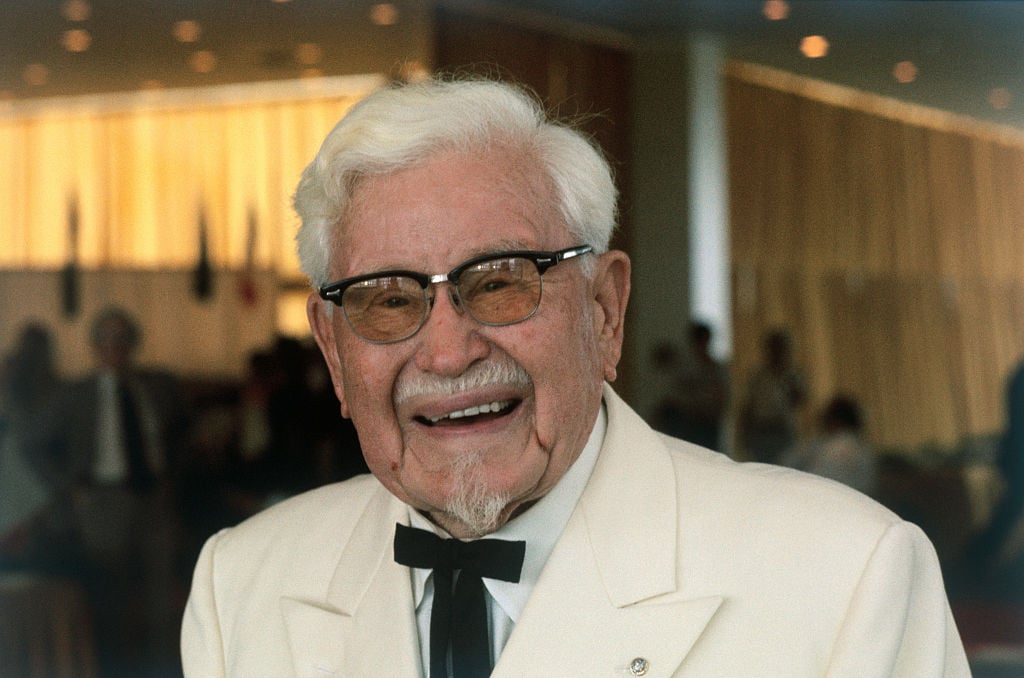
Founder of Kentucky Fried Chicken, Colonel Harland Sanders. (via Getty)
A Hardscrabble Beginning
Born on September 9, 1890, on a farm in Henryville, Indiana, Sanders entered the world at a time when few Americans completed high school. At just five years old, his father passed away unexpectedly, compelling young Harland to assist his mother in providing for their family, including his two younger siblings. He left school in the seventh grade to work full-time.
Although Sanders’ mother remarried, he struggled to get along with his stepfather, prompting him to leave home at 12. By 1906, at age 16, Sanders lied about his age to join the Army, serving in Cuba before being discharged after only four months. Despite his brief military stint, Sanders never held the rank of Colonel; instead, it was an honorary title granted in 1935 by Kentucky Governor Ruby Laffoon, acknowledging his charitable efforts and his chicken’s contribution to the state’s culinary landscape.
Jack of All Trades, Master of Brawling
Before rising to culinary fame, Sanders’ winding path to success reflected the rapidly evolving era he lived in. Despite his lack of clear direction, his determination and ambition were unwavering. Throughout the years, Sanders held various roles, including farmhand, mule tender for the Army, locomotive fireman, railroad worker, insurance salesman, ferry boat captain, and even a political candidate.
However, the recurring theme throughout his early life was his inability to hold down a job. He was a scrappy man who frequently found himself at odds with his employers and was often fired for getting into fistfights on the job. He lost his job on the railroad after a brawl. He worked as an attorney—at a time when lawyers did not have to be officially admitted to the Bar—but ruined that career after getting into a fistfight with his own client in the middle of a courtroom, right in front of the judge.
He started an acetylene lighting company just as electricity was becoming widely available, and thus failed at that. He was successful as a tire salesman, but that career ended when he wrecked his car and couldn’t afford another one. While he always tried to support his family, his constant firings and volatile temper wore on his wife, Josephine, who temporarily took their children and left him. He eventually opened a Standard Oil gas station in 1927, but that business was completely wiped out by the Great Depression.
The Gas Station, The Obstetrician, and The Shootout
Sanders did not have an easy run of it, but in 1930, he tried again, opening a new gas station in Corbin, Kentucky. To make ends meet, he decided to serve food from a small table inside the station. This was the humble seed from which Kentucky Fried Chicken would eventually grow.
Incredibly, at this exact same time, Sanders started a side business as an amateur obstetrician. During the Depression, many Corbin-area workers were part of President Roosevelt’s Works Progress Administration. Sanders realized that many of these men had pregnant wives but no money to pay a doctor. Always an opportunist with a charitable streak, he kept a bucket with scissors, gauze, and Vaseline handy so that when he got a call, he could dash off to deliver a baby.
Running a business in the 1930s was cutthroat, and in Sanders’ case, it was literally deadly. A business rival named Matt Stewart, who ran a competing gas station, kept painting over Sanders’ highway advertising signs. When Sanders caught Stewart in the act, a violent shootout erupted. Stewart shot and killed the Shell Oil manager who was accompanying Sanders. In return, Sanders shot Stewart in the shoulder. Stewart went to prison for murder, which conveniently eliminated Sanders’ local competition.
However, the recurring theme throughout his life was that he had a tough time holding down a job for any length of time. He was often fired for getting into fistfights on the job. And while he was always able to support his family, his constant firings wore on his wife, Josephine. She took their kids and left him for a while, because Sanders could not stay employed for any significant amount of time. He was fired from the railroad, fired from being an attorney after he got into a fist fight with his own client in court in front of the judge, and fired from being an insurance salesman. He started an acetylene lightning company just as electricity was becoming more available and thus failed at that. He was successful as a tire salesman, but that career also ended when he wrecked his car and could not afford another one. He opened a Standard Oil gas station in 1927, but that was wiped out by the Great Depression.
Fires, Highways, and Starting Over
Eventually, Sanders expanded his service station and small kitchen into a motel and legitimate restaurant known as Sanders Court and Café, which sold fried chicken, steak, ham, and biscuits.
But Sanders’ run of bad luck wasn’t over. On Thanksgiving Day 1939, his restaurant burned to the ground. Undeterred, he rebuilt it into a 140-seat establishment. This was where he began to pressure-fry his chicken, a method that locked in flavor and sped up cooking times, which he would later patent.
Just as his business stabilized and he was approaching retirement age, another massive obstacle was thrown in his path. A new interstate highway was being constructed that would re-route traffic completely away from Sanders’ restaurant. His café, now 20 years old and reliant on highway travelers, was doomed. In 1956, 65-year-old Harland Sanders auctioned off his restaurant for $75,000 (roughly $881,000 when adjusted for inflation today). The money barely paid off his taxes and outstanding bills.
Hitting the Road and The Wendy’s Connection
Sanders was left with his Social Security checks and little else. It was then that a desperate idea struck him, and the KFC we know today truly took shape.
Sanders became an early pioneer of the restaurant franchise model. He loaded up his car with his pressure cooker and bags of his secret 11 herbs and spices, and began crisscrossing the country. He often slept in the back seat of his car. His mission was to sell his secret recipe to other restaurant owners.
When he struck a deal, he taught the franchisees how to cook the chicken his specific way, and in return, they paid Sanders a royalty of a nickel for every chicken they sold. Pete Harman, a franchisee in Salt Lake City, decided to dedicate his entire restaurant to Sanders’ recipe, becoming the very first “Kentucky Fried Chicken.”
During this era of expansion, Sanders mentored a young, ambitious franchisee in Ohio who had taken over a few failing KFC locations. This young man invented KFC’s iconic rotating bucket sign, convinced the Colonel to appear in those famous TV commercials, and streamlined the menu to focus heavily on the chicken. That young man’s name was Dave Thomas. He eventually sold his KFC franchises back to Sanders for $1.5 million and used the money to start his own fast-food empire: Wendy’s.
Sanders’ approach to business remained highly unconventional. He didn’t charge a massive upfront franchising fee, which was unusual back then and unheard of today. In fact, Harland Sanders once told McDonald’s pioneer Ray Kroc that it was completely wrong for him to charge excessive fees for franchising. Kroc disagreed, but for as long as Sanders owned Kentucky Fried Chicken, he stuck to his nickel-per-chicken handshake deals.
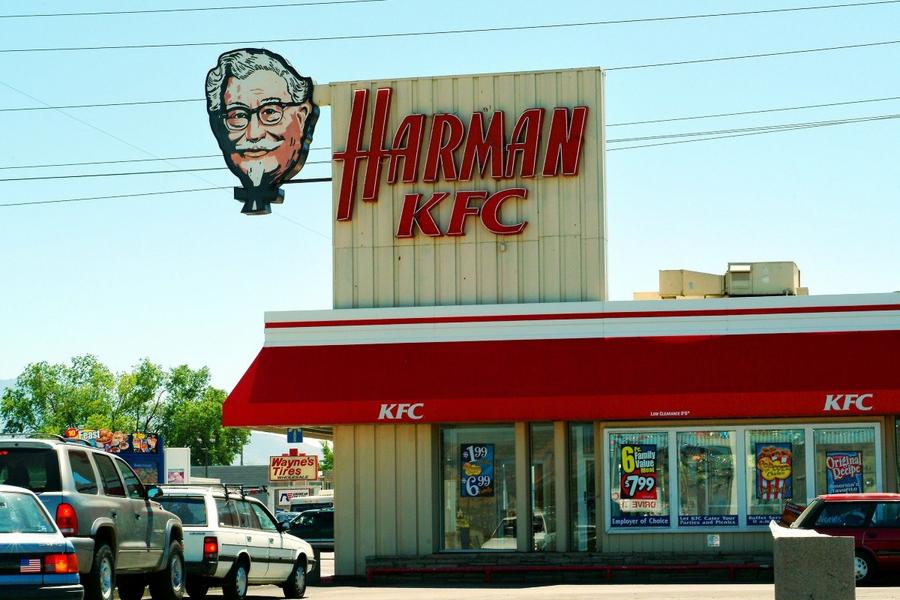
Danny La/Getty Images
Millions, Lawsuits, and Wallpaper Paste
By 1963, there were more than 600 Kentucky Fried Chicken locations. In 1964, a 74-year-old Sanders finally sold the company for $2 million (about $20.6 million today). By 1970, the brand had expanded to 3,000 restaurants in 48 countries.
Even though Sanders sold the company, he wasn’t ready to let go. He leaned into the theatrical persona of the “Colonel,” keeping his trademark white suit and goatee, and stayed on as a paid spokesperson. He became one of the most famous brand ambassadors in the world.
However, relations with the corporate executives who now ran KFC grew incredibly tense. The new owners relocated headquarters to Tennessee, started charging hefty franchise fees, and moved from the five-cent royalty to a percentage of total sales. Sanders hated all of it.
So, he did what he knew best: he started over. Sanders decided to open a sit-down restaurant called “Colonel Sanders’ Dinner House.” The corporate brass at KFC was furious, arguing they had bought the exclusive rights to his name. Sanders renamed it “Colonel’s Lady’s Dinner House,” but KFC insisted it owned the word “Colonel” too. Sanders sued the corporate giant for $122 million, and they countersued him for violating trademarks. They eventually settled out of court in 1975.
That wasn’t his only legal battle in his twilight years. A KFC franchisee in Bowling Green, Kentucky, sued Sanders for libel after the Colonel publicly complained that the corporate-mandated gravy tasted like “wallpaper paste.” The court threw out the lawsuit in 1978. (There’s no word on whether the judge tried the gravy to see if Sanders was right.)
A Finger-Lickin’ Legacy
Despite the lawsuits, Sanders remained intensely dedicated to the brand he built, traveling to Japan on a promotional tour for KFC in 1979 at the age of 89.
Harland Sanders died on December 16, 1980, at 90 years old. Having lived modestly and donated much of his wealth to charities like the Salvation Army, his net worth at the time of his death was a relatively modest $3.5 million (about $13.6 million today).
It is a small fraction of the empire he birthed—today, KFC’s annual revenue tops an astounding $26.1 billion. The original handwritten recipe he drove across the country with is now locked inside a literal high-tech vault at KFC headquarters in Louisville, guarded by motion detectors and cameras.
He didn’t die a billionaire, but he lived a dozen lives in one. Through sheer grit, a legendary temper, and a lot of hustle, Harland Sanders ensured that his name, his face, and his chicken would live forever.
(function() {
var _fbq = window._fbq || (window._fbq = []);
if (!_fbq.loaded) {
var fbds = document.createElement(‘script’);
fbds.async = true;
fbds.src=”
var s = document.getElementsByTagName(‘script’)[0];
s.parentNode.insertBefore(fbds, s);
_fbq.loaded = true;
}
_fbq.push([‘addPixelId’, ‘1471602713096627’]);
})();
window._fbq = window._fbq || [];
window._fbq.push([‘track’, ‘PixelInitialized’, {}]);