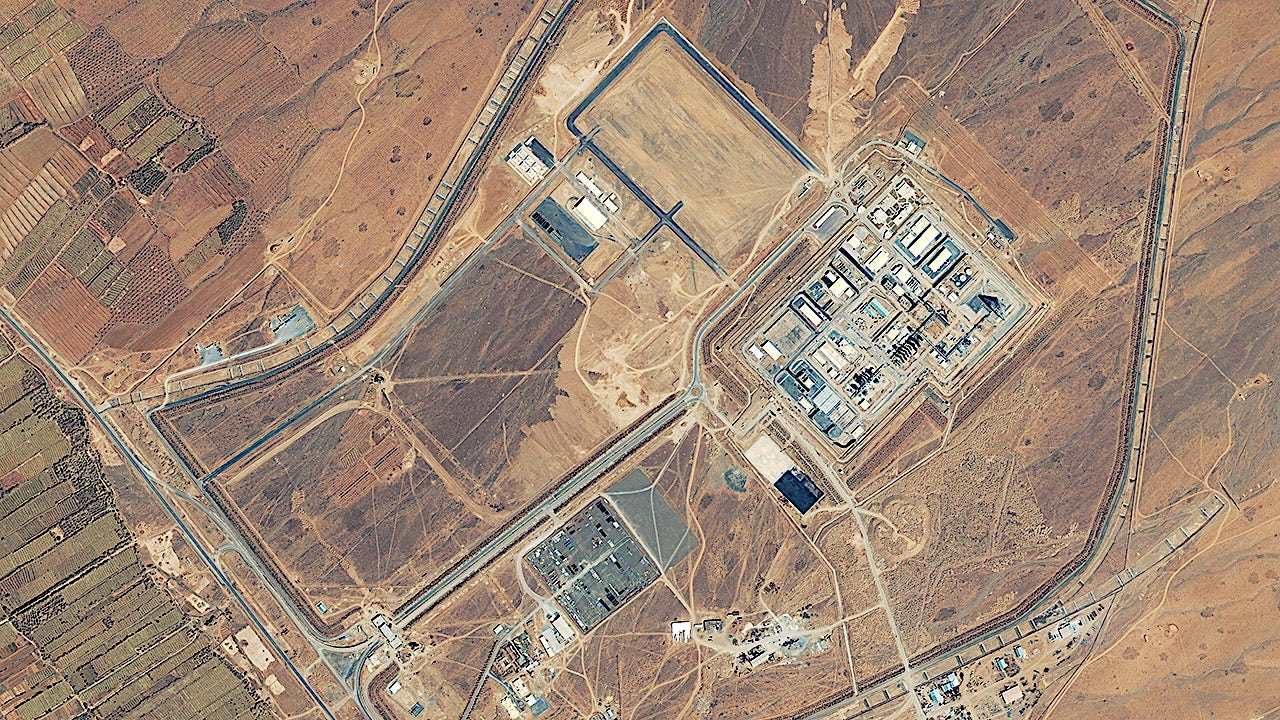

Experts in nuclear weapons are sounding an urgent call for the Trump administration to ensure that any new agreement with Iran explicitly prohibits the country’s efforts to utilize plutonium from its facilities to create an atomic bomb.
While the administration and non-proliferation specialists have primarily concentrated on Iran’s uranium-based atomic facilities, there’s a growing concern that Tehran might exploit this oversight to clandestinely develop a plutonium-based nuclear weapon.
Jason Brodsky, who serves as the policy director at United Against Nuclear Iran (UANI), emphasized the necessity of addressing this issue in any potential deal with Iran. He remarked to Fox News Digital, “I do believe any proposed deal with Iran needs to address the plutonium pathway to nuclear weapons. Israel struck the Arak heavy water reactor twice over the last year — in June 2025 and in March 2026. Intelligence suggested Iran had repeatedly attempted to reconstruct the facility even after the bombing, so any deal with Iran should cover the plutonium pathway.”
An illustration depicts several of Iran’s nuclear sites, including the Arak heavy water reactor and the Natanz enrichment plant, highlighting the potential risks. (FDD/Fox News)
Henry Sokolski, the executive director of the Nonproliferation Policy Education Center and a former deputy for nonproliferation policy at the Department of Defense, warns that Iran’s regime could exploit plutonium from the spent fuel at its Bushehr nuclear reactor to construct an atomic device.
In a piece he wrote for Real Clear Defense last month, Sokolski advised, “Washington should make sure that Iran doesn’t remove Bushehr’s spent fuel and strip out the plutonium. This can and should be done without bombing the plant.”
Sokolski wrote the “Pentagon should watch to make sure Iran does not remove any of the spent fuel at Bushehr. It could do this with space surveillance assets or, as it did in 2012, with drones. Second, any ‘peace’ deal President Trump cuts with Tehran should include a requirement that there be near-real-time monitoring of the Bushehr reactor and spent fuel pond, much as the IAEA had in place with Iran’s fuel enrichment activities.”
A satellite image the Heavy water plant of Arak, Iran is displayed. According to reports, the existence of this plant came to light in December 2002. Heavy water moderates nuclear fission chain reaction and can produce plutonium for use in a nuclear bomb. (DigitalGlobe via Getty Images)
In another article in the Bulletin of the Atomic Scientists in April, Sokolski argued that Iran has enough plutonium for more than 200 nuclear bombs. He said, “The last time IAEA inspectors visited Bushehr was August 27, 2025. Even when agency inspectors had routine access to the plant, they only visited every 90 days — more than enough time to divert the spent fuel and possibly fashion it into nuclear weapons.”
He added that “President Obama did not insist on such surveillance even though the IAEA asked Iran to permit it. Tehran said no.”
Recent IAEA reports have not addressed the plutonium path to a bomb with any specificity.
Iranian President Masoud Pezeshkian visits nuclear facilities in Tehran, Iran on Nov. 1, 2025. (Iranian Presidency / Handout/Anadolu via Getty Images)
A State Department spokesperson told Fox News Digital that, “Iran’s nuclear program poses a threat to the United States and the entire world.”
The spokesperson continued, “Iran today stands in breach of its Nuclear Non-Proliferation Treaty obligations by failing to provide full cooperation with the IAEA. Iran’s leadership must engage in serious diplomatic negotiations with the United States to resolve the nuclear issue once and for all.”
David Albright, a physicist and president of the Institute for Science and International Security, told Fox News Digital that he is “Highly skeptical that Iran would use plutonium from Bushehr’s spent fuel to make nuclear weapons.”
Bushehr nuclear plant in Iran, on April 29, 2024. (Photo by Morteza Nikoubazl/NurPhoto via Getty Images)
The former weapons inspector, Albright, argued that, “One, Iran would need a design it has not developed. There is nothing in the Nuclear Archive on a plutonium-based nuclear weapon. Two, a diversion from Bushehr would be detected and undoubtedly lead Russia to suspend enriched uranium supplies, leading to a shutdown of a multibillion-dollar investment that supplies the area with electricity. Third, almost all the plutonium in the spent fuel is reactor-grade, and it is feasible that none is weapon-grade.”
Albright added that “Reactor-grade plutonium can be used to make a nuclear weapon, but it is tricky to do so if a significant explosive yield is wanted.” He added that Trump’s former National Security Adviser John Bolton “has been raising this issue for decades, and it is a remote possibility. It was rejected first in the Bush administration.”
Concerns persist about Iran’s devious behavior and its aim to build a nuclear weapon at all costs. As a result, there are calls to outlaw Iran’s plutonium reprocessing and impose rigorous surveillance on Iran’s plutonium infrastructure in a future deal with the U.S.
Andrea Stricker, the deputy director of The Foundation for Defense of Democracies (FDD) Nonproliferation and Biodefense Program, told Fox News Digital. “The United States must insist on a permanent and verified ban on plutonium reprocessing in Iran under any deal.”
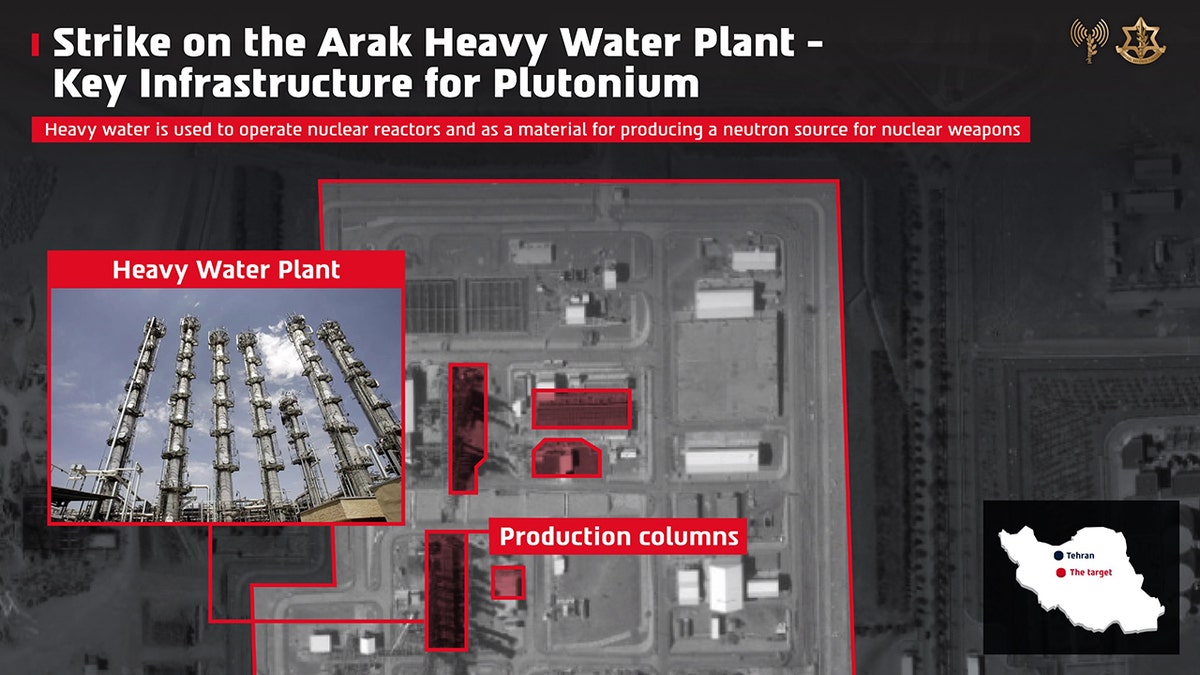
An IDF infographic shows Iran’s Arak heavy water plant, described as a key infrastructure for plutonium production. (IDF)
Stricker noted that Moscow had realized the danger too. “To Russia’s rare credit, it insisted Iran let inspectors back in to safeguard the Bushehr reactor after the June 2025 strikes. Those inspections resumed last August. Plutonium produced at the reactor is not of desirable quality for nuclear weapons, and Iran has not focused on the plutonium route to nuclear weapons since the early 2000s, so it could be difficult for Tehran to work with. They would also need to illicitly acquire and outfit a plutonium reprocessing plant as well as sophisticated equipment to handle and chemically convert the fuel. All of this creates significant obstacles to its use as fuel for nuclear weapons.”
She continued that “The IAEA (International Atomic Energy Agency) could mitigate any proliferation risk at Bushehr by increasing the frequency of inspections to monthly. Russia could also remove the spent fuel that has accumulated at the site.”