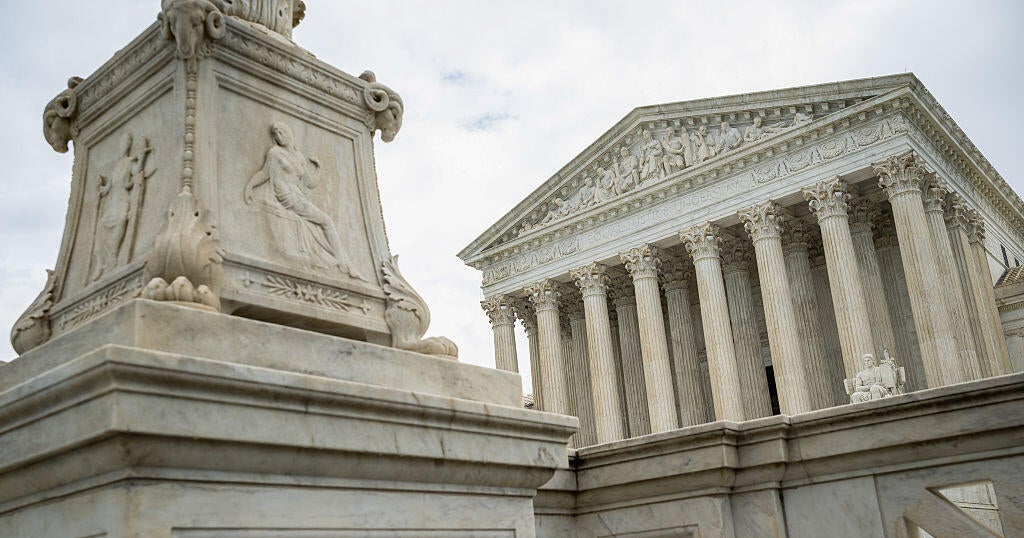

Washington — In a pivotal decision Thursday, the Supreme Court upheld the availability of the abortion pill mifepristone through mail delivery, temporarily overriding a lower court’s order that had restricted its prescription via telehealth. This ruling is a significant moment in the ongoing legal battles surrounding abortion access.
This unsigned decision by the Supreme Court ensures that mifepristone remains widely accessible to patients across the nation as legal proceedings continue. The ongoing challenge, spearheaded by the state of Louisiana, questions the Food and Drug Administration’s (FDA) relaxed regulations on acquiring the drug.
Notably, Justices Samuel Alito and Clarence Thomas dissented from the majority opinion.
This development follows an earlier ruling by a federal appellate court that had reinstated a requirement for mifepristone to be dispensed in person. Pharmaceutical companies Danco Laboratories and GenBioPro, which manufacture the drug, expressed that this decision led to significant confusion for patients, abortion providers, and pharmacies alike. They consequently appealed to the Supreme Court to intervene, arguing for the continuation of mail-order availability.
Conversely, officials from Louisiana advocated for the reinstatement of the in-person dispensing rule, which had been lifted by the FDA in 2021. They raised concerns that the removal of this requirement allowed out-of-state providers to bypass Louisiana’s abortion ban, resulting in over 1,000 medication abortions within the state. Interestingly, the FDA did not advise the Supreme Court on whether to maintain mail access for mifepristone during this process.
In anticipation of the Supreme Court’s deliberations, Justice Alito had previously issued a temporary order halting the appellate court’s restrictions, with this pause set to expire on Thursday. With the full Supreme Court’s recent agreement, the broader accessibility of mifepristone through mail channels remains intact for the foreseeable future.
The justices’ intervention arose out of a lawsuit Louisiana filed against the FDA last year that threatened to cut off mail access to mifepristone for women nationwide, including in states where abortion is legal. Mifepristone is taken with a second drug, misoprostol, to terminate an early pregnancy.
Medication was used in 65% of all clinician-provided abortions in 2023, according to the Guttmacher Institute, a research organization that supports abortion rights. More than 1.1 million abortions were provided by health care workers last year, a figure that includes medication abortions provided by telehealth to patients in states where abortion is restricted, Guttmacher found.
Preserving access to the abortion pill garnered newfound urgency after the Supreme Court overturned Roe v. Wade in 2022, after which more than half of the states imposed limits on the procedure. In Louisiana, abortion is banned, with narrow exceptions. The state also enacted a law in 2024 that designates mifepristone and misoprostol as controlled substances and criminalizes possession without a prescription.
But the Biden administration made mifepristone easier to obtain when it suspended enforcement of the in-person dispensing rule during the COVID-19 pandemic, finding that the drug “may be safely used without in-person dispensing.” The FDA formally allowed mifepristone to be prescribed through telehealth and dispensed through the mail in 2023.
In its lawsuit, Louisiana officials said because of those actions, mifepristone is flooding into the state, causing “thousands” of unlawful abortions each year and costing the state tens of thousands of dollars through its Medicaid program.
A federal district court had paused Louisiana’s case against the FDA in April while the agency reviews mifepristone’s safety. The Trump administration has said that while studies typically take at least a year to conduct, the FDA’s plan is to complete the review “sooner than that timeframe.”
But Louisiana officials appealed that decision, and the U.S. Court of Appeals for the 5th Circuit agreed to temporarily block the 2023 policy allowing mifepristone to be prescribed remotely and sent through the mail.
In emergency appeals to the Supreme Court, Danco and GenBioPro, warned that the appellate court’s decision caused chaos and threatened to abruptly eliminate nationwide access to mifepristone by mail.
“Patients and clinicians have, for years, relied on dispensing mifepristone without an in-clinic visit, particularly for women from rural areas and those for whom transportation, childcare, or occupational constraints make it difficult to see providers in person,” GenBioPro said. “As a direct result of the Fifth Circuit’s order, patients nationwide may face delay or denial of access to time-sensitive medical care, supply-chain disruptions, and attendant health risks.”
Louisiana officials, meanwhile, said that while in-person abortions have “virtually vanished” in the state following the end of Roe, medication abortions have “skyrocketed.” Beyond the Medicaid costs, the state said it has also spent more than $17,000 investigating out-of-state providers who shipped mifepristone into Louisiana.
The emergency appeals landed the issue of mifepristone’s availability before the Supreme Court for a second time. Months after the high court rolled back the constitutional right to abortion, anti-abortion rights groups filed a lawsuit challenging the FDA’s 2000 approval of mifepristone and several steps the agency took that eased the conditions for its use.
The groups argued that the FDA has failed to adequately consider the drug’s safety and effectiveness. Major medical associations, including the American Medical Association and the American College of Obstetricians and Gynecologists, have said that major adverse events occur in less than 0.32% of patients when mifepristone is used in medication abortions.
The Supreme Court in 2024 unanimously rejected the challenge from the anti-abortion rights doctors and medical groups, ruling that the plaintiffs did not have the legal right to sue the FDA.