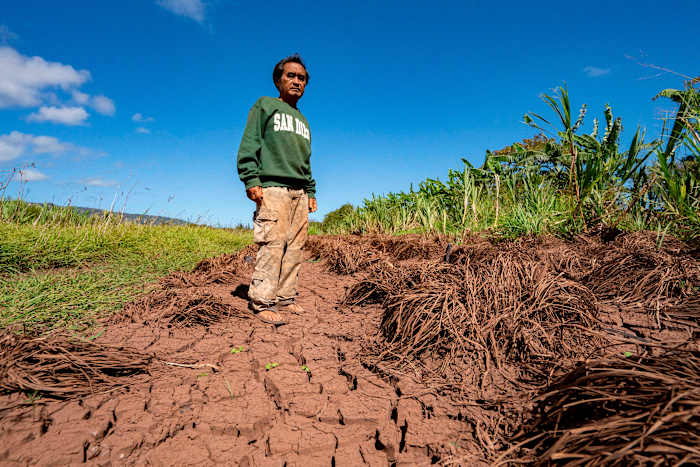


WAIALUA, Hawaii – Under the relentless tropical sun, the reddish-brown mud that engulfed Bok Kongphan’s farm in Hawaii has solidified, leaving behind a chaotic tangle of irrigation tubes where vibrant lemongrass, cucumbers, and okra once thrived.
His niece, Jeni Balanay, also faced devastation, losing her harvest of choy sum, bitter melon, and tomatoes. The leaves of her newly planted banana, coconut, and mango trees have turned yellow, casting doubt on their survival.
On Oahu’s North Shore, renowned for its iconic big-wave surfing, small farms play a critical role in the island’s food supply. However, these farms are now grappling with the aftermath of severe flooding following consecutive storms in March, marking Hawaii’s worst flooding in two decades. Officials urge farmers to persevere, highlighting the importance of local agriculture for the state’s remote archipelago.
“Entire farms have been wiped out in some cases,” Brian Miyamoto, executive director of the Hawaii Farm Bureau, noted. “Farmers who were just days or weeks from harvest now face the daunting task of starting all over again.”
Data from farming advocates reveals that over 600 of Hawaii’s 6,500 farms have reported nearly $40 million in damages, impacting crops, livestock, and machinery. However, Miyamoto states that the Hawaii Farm Bureau estimates the true scale of the devastation is more substantial, affecting close to 2,000 farms with damages approaching $50 million.
The unique nature of Hawaii’s agricultural landscape is at stake, as the community rallies to support and rebuild these vital farms.
For most of the late 19th and 20th centuries, plantation-style agriculture dominated Hawaii, as companies like Dole and conglomerates founded by missionary descendants grew immense fields of sugarcane or pineapple for export. The operations drew large numbers of immigrants, primarily from Asia and Portugal.
But that large-scale monoculture faded by the 1990s amid international competition, and officials began to promote smaller farms — some, like Kongphan’s, just a few acres — with a wider array of crops that could be sold to local grocery stores or at farmers markets.
Worldwide shipping disruptions during the COVID-19 pandemic reinforced the importance of having a local food supply in Hawaii, and the state in recent years has offered additional support to the farms. That includes money for infrastructure, a farm-to-school program and loans for those who have been denied credit from banks.
But they still face challenges. Unlike many of their counterparts on the mainland, Hawaii farms are often too small and diversified to be able to afford or qualify for crop insurance.
Many of the farmers are immigrants who were barely eking out a living even before the storms, Miyamoto noted.
The majority of Hawaii’s farms report less than $10,000 in annual sales, according to the U.S. Department of Agriculture. The flooding, along with high winds and power outages, killed or stressed livestock and destroyed equipment, vehicles and infrastructure.
Farmers in despair
Without insurance, Kongphan, an immigrant from Thailand, has been trying to obtain government aid and figure out how to level earth moved by the floodwaters. His niece has been helping him and other Thai farmers navigate the process. Available help includes federal disaster relief, one-time $1,500 emergency grants and long-term loans from the state, and a charitable fund that raised about $850,000 in the weeks after the floods. Many farmers also have online fundraising pages.
In an interview interpreted by Balanay, Kongphan called the floods “very devastating,” but said he will continue working the 5-acre (2-hectare) plot he’s leased for five years, growing vegetables he sells at farmers markets, a swap meet, and at shops and stalls in Honolulu’s Chinatown.
Kongphan pointed to a faint, thigh-high line on a plywood wall showing where the water reached inside his home, which he built from a shipping container. Inside, there’s now a donated tent, but he usually sleeps outside.
Flies swarmed as he carried a dirt-caked generator he hopes to salvage. Nearby sat a Toyota Yaris, covered inside and out in the same dried sludge.
Balanay, who learned farming from her mom after the family immigrated to Hawaii, isn’t sure she wants to keep at it. She recalled the torrent rising to her waist in seconds and wiping out her crops in the middle of the night.
“Will it happen again?” she asked. “When you look at the land and it’s all destroyed, you want to give up.”
The flooding is the latest crisis for Hawaii’s farmers, on top of wildfires, pests and volcanic tephra — ash and debris ejected by an erupting Big Island volcano, said the state’s top agriculture official, Sharon Hurd.
“These are the farms that we really need to get started again,” Hurd said. “We cannot have them give up.”
Officials have been conducting tests to assure farmers that their soil is safe and providing them with seeds and plant starts, she said.
Sparser offerings at farmers markets
Some farmers have been unable to make it to farmers markets, a key source of their income. Many who do have less to offer, Miyamoto said.
Farmer Kula Uliʻi said her family has been bringing roughly one-quarter of their usual output. Instead of 200 pounds (90.7 kilograms) of tomatoes at weekend farmers markets, they might sell 60 pounds (27.2 kilograms).
They lost starts that were due to be planted this month and face months of limited harvest, she said. She’s unsure about the status of her farm’s contracts with grocery stores, given that it can’t meet demand.
Even the taro, which thrives in water, is lost, she said, after it was submerged in the contaminants carried by the floods.
“It’s all gone,” Uliʻi said. “We can’t use any of it.”
___
Associated Press writer Audrey McAvoy in Honolulu contributed.