
The Church of Scotland has faced criticism for what some describe as ‘woke folly’ following its formal apology for historical involvement in the slave trade.
An internal review shed light on the Church’s connections to the slave trade during the 17th to 19th centuries, prompting the Kirk to express regret for its ‘historical participation in transatlantic chattel slavery and its ongoing repercussions.’
The Church acknowledged its theological endorsement of slavery, both direct and indirect involvement in economies reliant on enslaved labor, and the material gains acquired from such practices, while recognizing the persistent racial injustice and inequality that ensued.
Nonetheless, Lord Biggar, an emeritus professor of theology at Oxford University and author of “Slavery and the Tyranny of Imaginary Guilt,” criticized the Church’s apology as merely ‘well-intentioned folly.’
Speaking to the Daily Mail, he remarked that the Church’s apology is rooted in a narrative that paints a simplistic picture of White oppression and Black victimhood.
He pointed out that long before the British engaged in the slave trade, Africans had been enslaving other Africans and selling them to the Romans and Arabs for centuries.
‘The total of African slaves traded across the Atlantic, the Sahara and the Indian Ocean amounted to more than 41million.
‘Of these, the British were responsible for under eight per cent. Africans were complicit in almost all the rest.
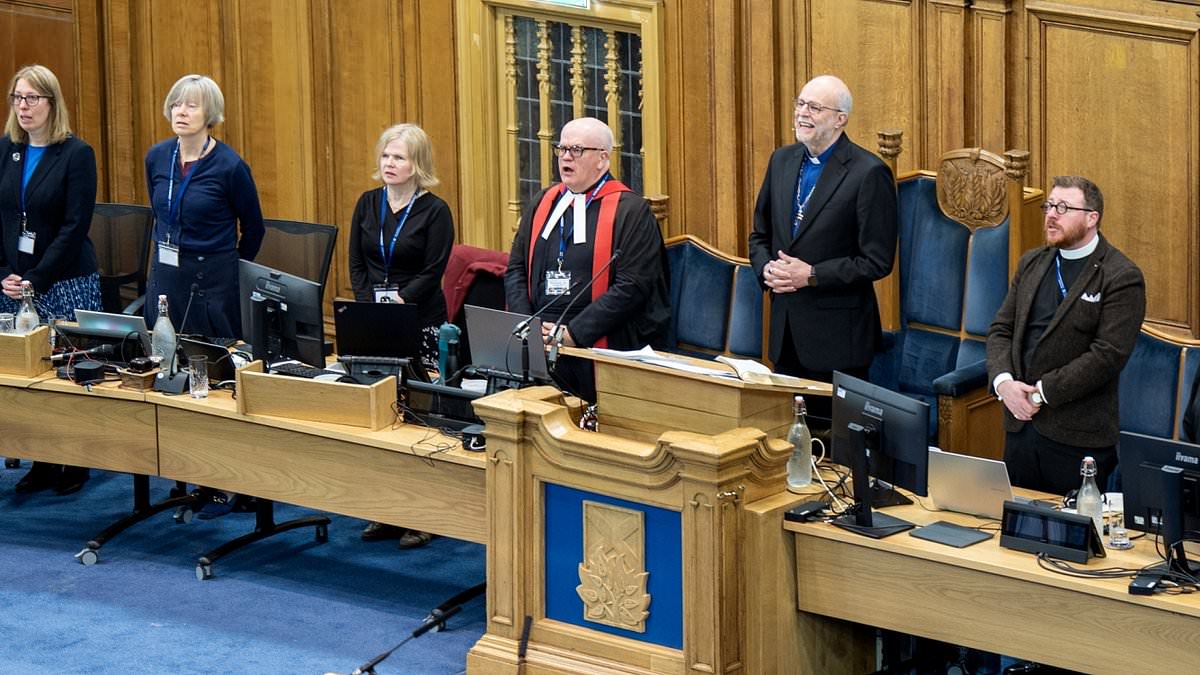
First Minister John Swinney (top, centre), alongside High Commissioner Lady Elish Angiolini (top, second right) at the General Assembly of the Church of Scotland in Edinburgh
‘What drives the current apology is slavery’s allegedly “enduring effects”.
‘It might be that the descendants of slaves continue to suffer from historic slavery. But that needs demonstration, not just assertion.
‘Today, Barbadians, descendants of slaves, are better off on average than Nigerians, some the descendants of enslavers.
‘The Church’s apology rests on politically partisan research. It’s not just well-meaning folly. It’s worse, it’s dishonest.’
He added that Britain was one of the first countries to abolish slavery, later using its military might to dismantle the slave trade across the globe, including in Brazil, Africa, the Middle East, India and Australasia.
The Kirk declared in its report: ‘We, the Church of Scotland, are sorry for the ways in which the Church of Scotland, collectively and individually, contributed to and benefitted from the enslavement of people of African descent.
‘We are grieved beyond telling by the extraordinary suffering we have inflicted – through our actions and our inaction – on our brothers and sisters.
‘As bearers of God’s image loved by God, they should have been loved by us. Not only did we fail to love them, we failed to treat them with basic human respect.

However Lord Biggar said the Church’s apology was nothing more than ‘well-intentioned folly’
‘We repent, committing ourselves to changing course and bearing fruit worthy of repentance.’
At the Church of Scotland’s General Assembly in Edinburgh on Saturday, the Very Rev Sally Foster-Fulton presented the report telling members it was a ‘humbling moment’ for the Kirk and a ‘gracious opportunity to say we are sorry’.
She added that the Church should take responsibility for its historical wrongs.
The apology and accompanying report was developed following engagement with groups within the Church, including members of African heritage, presbyteries and ministers, the Kirk said.
Several overseas delegates from Africa and the Caribbean were present and responded to the apology and report.
Mrs Rose Wedderburn, General Secretary of the United Church in Jamaica and the Cayman Islands, commended the ‘courage’ needed to acknowledge wrong and appreciation to those who contributed to the apology.
She said: ‘For many in the Church of Scotland, this report has been an eye opener.’
‘While the process has understandably evoked deep emotions – the effort invested in truth-telling and honest engagement is worthwhile.
‘And we pray it will continue to bear fruit in greater understanding, healing, justice and reconciliation.’
Rev Dr Victor Okoe, from Abbey Trinity Presbyterian Church in Ghana, said: ‘I pray the Church and its members will be bold and continue to be committed to walk the talk and implement the demands of its apology.’