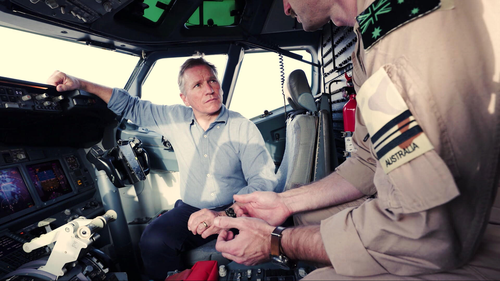
“It was a bit confronting,” the Squadron Leader admitted, reflecting on the haunting sight.
“It was something I never imagined witnessing firsthand.”
We find ourselves in the cockpit of his E-7 Wedgetail, stationed on a discreet runway somewhere in the Middle East. The aircraft, a key player in the region’s aerial surveillance and defense, sits poised for action.
“While flying some missions, we could see ballistic missiles launched from Iran through the front windows,” H recounted, the memory still vivid. “They light up the sky, soaring high and leaving a surreal impression when viewed from above.”
Known to us only as Squadron Leader H, he oversees this critical task unit, ensuring operations continue smoothly amidst the region’s ongoing tensions.
Squadron Leader H, as we have been asked to call him, is the commander of the task unit.
He always wanted to be a pilot and he has the quiet confidence of a man who must have sensed he’d always get to live his dream.
Perhaps that’s what gives him maturity beyond his years.
With a fetching charm and an Errol Flynn moustache, H has a family back home â a wife and two kids â but for the past 10 weeks or so, his family has been a bunch of young professionals who are having the adventure of their lives.
Two-thirds are on their first deployment and most are in their 20s and 30s.
They have job titles that reflect the lingo of clinical modern warfare: air battle managers, mission aircrew, force protection and air surveillance operators.
Others simply call themselves IT experts or electricians, but one nuggety fellow describes himself as an expert in survival, should there be an emergency on the ground or in the air.
The E-7 Wedgetail is at the heart of this deployment. A mission can be as long as 12 hours, with air-to-air refuelling.
But the surveillance secret of the plane is the ludicrously shaped dorsal fin on top of the modified Boeing 737.
Its technical name is a Multi-role Electronically Scanned Array, or MESA, but it looks like a giant surfboard connected to the fuselage by a near full-length fin.
The genius radar embedded in the surfboard and broadside fin can see 360 degrees both out and down, allowing air and surface threats to be quickly observed by the 10 specialists monitoring the signal on 10 consoles inside the plane.
As one of them puts it, the Wedgetail “doesn’t get wet feet”; its missions in the Middle East are largely confined to those above land on the southern side of the Arabian Gulf.
That’s the operational strength of the E7 Wedgetail: the aircraft doesn’t have to venture across the water or over the Strait of Hormuz to see hundreds of kilometres into Iran.
“The radar’s incredibly powerful, so it gives us really good coverage across the Arabian Gulf,” Flight Lieutenant “C” said.
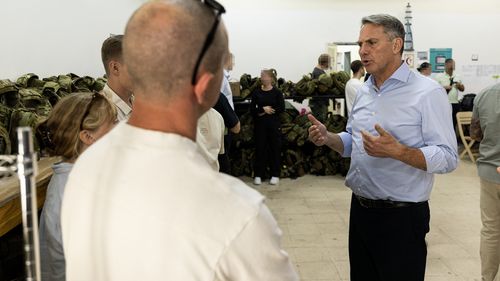
Defence Minister Richard Marles, who visited ADF personnel at their secret Middle East base, said the Wedgetail will be Australia’s key commitment to a future multi-nation mission to keep the Strait of Hormuz open, but said that other assets may be promised.
“We have said that we will commit the E7 and we will also work with France and the UK who are leading that, as to what other contributions we can make,” he said.
“We are a maritime nation where an increasing part of our national prosperity is derived from seaborne trade â this waterway really matters to Australia, it matters to the world.”
“Almost 3000 drones and missiles have been fired at the UAE, and about 95 per cent of them were intercepted, so the UAE armed forces did an incredible job in defending the country.”
He said restoring stability to the region is in everyone’s interest.
“You ignore the Middle East at your peril,” he said.
“The fuel crisis around the world has shown why the Middle East remains so important to average Australians.”
NEVER MISS A STORY: Get your breaking news and exclusive stories first by following us across all platforms.