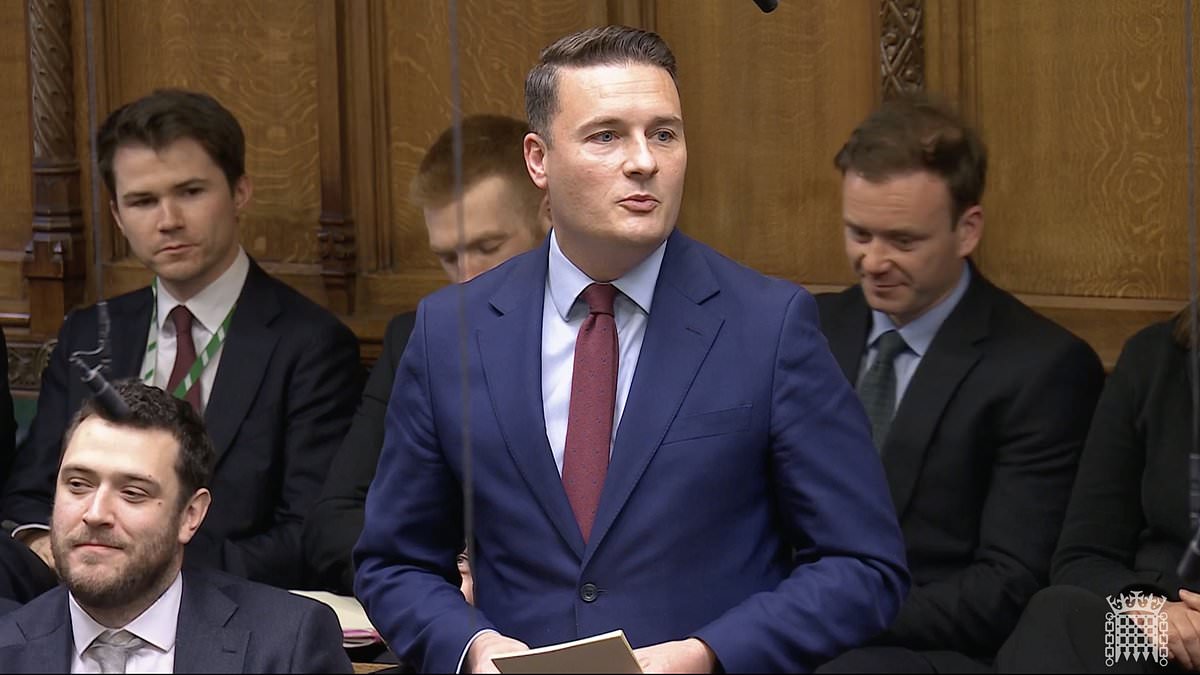

Wes Streeting has unveiled a proposal for a wealth tax that would align the taxation of capital gains with income tax rates.
Streeting, who has expressed his intention to compete in a leadership contest to succeed Sir Keir Starmer, argues that the current tax system lacks fairness.
Speaking on the BBC Political Thinking podcast, he stated, “A pound earned from merely owning assets should not be taxed less than a pound earned from a day’s hard work.”
Streeting claims that his plan could generate £12 billion for the Treasury, appealing to Labour Party members who have long advocated for wealth taxes.
However, with tax rates already at unprecedented heights, Streeting’s proposal might backfire by causing investors to retain their gains, potentially reducing overall tax revenue.
Here, we break down Streeting’s proposal and explore its potential effectiveness.
What do Streeting’s proposals mean for investors?
Capital gains tax is levied on profits over £3,000 from assets ranging from shares to second homes.
Former Conservative Chancellor Jeremy Hunt slashed the annual allowance from £12,300 to £6,000 effective from April 2023, then to the current £3,000 limit a year later.
Rachel Reeves hiked capital gains tax rates in the 2024 Budget, from 10 to 18 per cent for basic rate taxpayers. Higher-rate taxpayers now pay 24 per cent, up from 20 per cent previously.
Under Streeting’s plans, the CGT rates would align with income tax bands at 20 per cent for basic-rate taxpayers, 40 per cent for higher-rate and 45 per cent for additional-rate taxpayers.
Wealth tax: Wes Streeting laid out a proposal to equalise capital gains with income tax
However, Streeting says there’ll be a carve-out to protect entrepreneurs, with lower rates for those taking risks building companies, and long-term investment to boost the economy.
He also pledged to close the loopholes used to disguise income, including taking pay in shares rather than as income.
Dan Neidle, tax expert and founder of Tax Policy Associates, welcomed the proposals, saying: ‘It’s too easy for people to convert income (taxed at top rate 45 per cent) into capital gains (top rate 24 per cent). The rate is too low.’
Streeting claimed the plan would raise £12billion a year, pointing to calculations by the Centre for the Analysis of Taxation.
Will it work?
Left-wing campaigners have been vocal advocates of equalising income and capital tax rates, but it has previously gained support across the political spectrum.
In his 1988 Budget, former Tory Chancellor Nigel Lawson said: ‘In principle, there is little economic difference between income and capital gains… it is by no means clear why one should be taxed more heavily than the other.
‘Taxing them at different rates distorts investment decisions and inevitably creates a major tax avoidance industry.’
Capital gains are more lumpy than your average income, though, so tax experts say higher rates should only apply to real gains.
That would need a form of indexation to allow companies or individuals to offset the effects of inflation.
It would mean lower effective rates, helping to soften the blow and reward long-term investment.
The Resolution Foundation has previously called for a reintroduction of CGT indexation so only real returns are taxed and ‘substantially reduce the disincentive to invest and amount to a major pro-growth reform.’
The Laffer Curve shows that raising taxes by too much changes investor behaviour
The Labour Growth Group, aligned with Streeting, last week set out similar proposals with reform that would ‘not just tax paper gains created by inflation.’
Critics of higher CGT rates will point to the Laffer curve, which shows that increasing taxes will impact behaviour to such an extent that the tax take will be lower.
Anna Warren, tax director at wealth manager Bentley Reid, says Wes Streeting will need to introduce indexation or taper relief to combat that, but it ‘brings back the complexity the last Labour Government under Gordon Brown decided to scrap.’
If the cost of selling assets becomes more expensive, it raises the risk that investors delay or avoid realising gains entirely.
‘It may also entrench a ‘hold until death’ mindset, as investors defer sales to benefit from the capital gains uplift on death, further undermining the tax take,’ said Rachael Griffin, tax and financial planning expert at Quilter.
Reeves’ changes to capital gain tax rates have already triggered behavioural changes among investors.
Recent data showed CGT receipts reached £22.2billion in 2025/26, up from £13.7billion in the previous year.
‘Investors appear to have brought forward disposals to crystallise gains under a changing regime,’ says Griffin.
‘Once that passes, activity may slow as higher tax rates take hold and investors adjusted behaviour.’
She adds: ‘Higher rates change behaviour. Investors may hold assets for longer, defer rebalancing decisions or rely more on tax wrappers.
‘Over time, that can suppress transaction levels and make tax receipts more volatile rather than consistently higher.’
Any further changes could prompt further capital flight at a time when Labour needs to woo wealthy investors.
Join the discussion
Should hard work and savvy investing really be taxed the same way, or does this punish ambition and success?
DIY INVESTING PLATFORMS
AJ Bell
AJ Bell
Easy investing and ready-made portfolios
Hargreaves Lansdown
Hargreaves Lansdown
Free fund dealing and investment ideas
interactive investor
interactive investor
Flat-fee investing from £4.99 per month
Freetrade
Freetrade
Investing Isa now free on basic plan
Trading 212

Trading 212
Free share dealing and no account fee
Affiliate links: If you take out a product This is Money may earn a commission. These deals are chosen by our editorial team, as we think they are worth highlighting. This does not affect our editorial independence.
Compare the best investing account for you