
Investing always carries a degree of risk, but when financial markets become turbulent, it’s natural to reassess how vulnerable your investments are to current challenges.
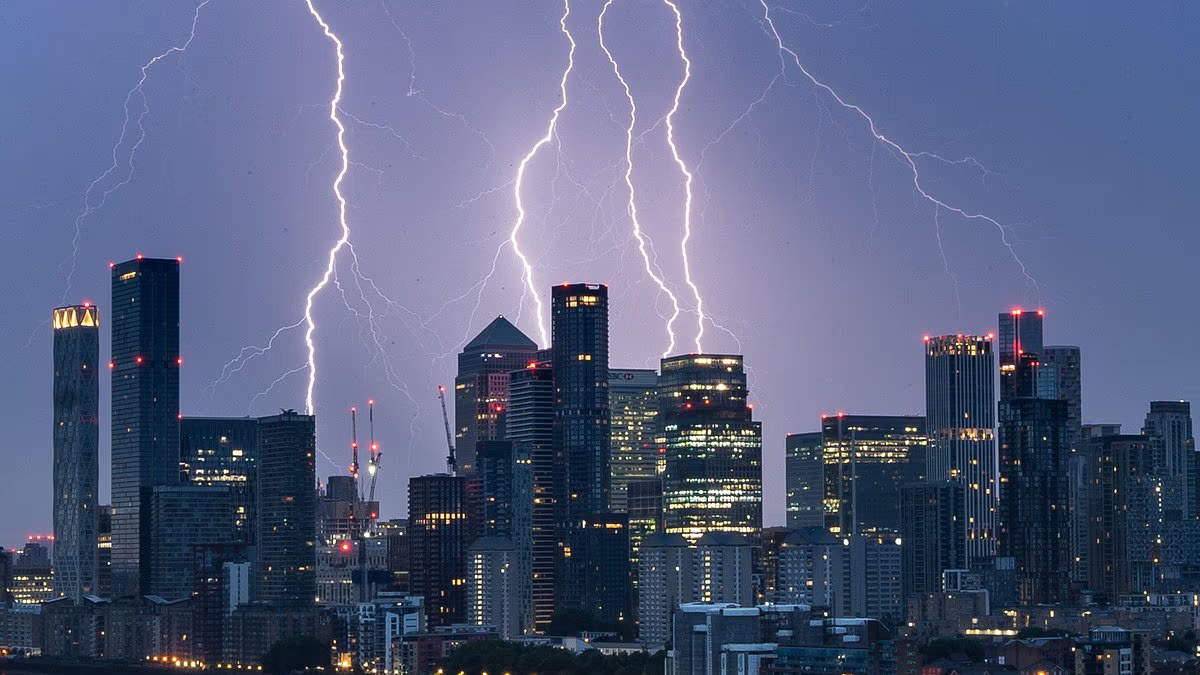
The conflict involving the United States and Israel against Iran, following President Donald Trump’s series of global tariffs, has understandably created anxiety among investors.
The potential for a summer marked by shortages and inflation, combined with political unrest both domestically and internationally, adds to the uncertainty.
“The reality is, there aren’t any safe havens right now,” comments Tom Becket, co-chief investment officer at Canaccord Wealth.
“Market correlations are high, and they don’t truly reflect the world’s current events.
“There aren’t many active investors in the markets at the moment. Last year, both institutional and retail investors were quick to buy during market dips, but now they’re choosing to stay on the sidelines.”
He says only traders and passive funds are getting involved, making markets highly volatile and less predictable.
Safe havens: Where can you take refuge from the current hazards in financial markets?
Jeff Simpson, head of wealth management at Hymans Robertson Personal Wealth, also cautions against the idea that any one investment can be considered “safe”.
‘In periods of uncertainty, clients often step back from short term market movements and instead focus on the robustness of their long term strategy.
‘The key concern is not trying to predict what markets will do next, but ensuring that financial plans are resilient enough to cope with a range of outcomes over time.’
Below, we look at traditional safe haven investments and the pros and cons of each at the moment.
But investing experts stress that diversifying is the best way of playing it safe. So we also explore the best ways to spread your risk around in the current climate.
Oil
The oil shortage caused by the closure of the Strait of Hormuz has caused the price to soar.
It’s had knock-on effects like higher petrol prices for drivers, and jet fuel inflation for airlines, but benefited the oil giants.
But Becket sounds a note of caution to investors who think it’s a safe place to put their cash, rather than a hedge against other risks.
‘Due to the war in Iran, by far and away the best performing asset recently has been oil with the price up over 100 per cent.
‘On the outside it could appear to be the perfect safe haven – but in reality, it’s a geopolitical hedge.’
Tom Becket: The truth of the matter is there are no safe havens at the moment – so diversify
Gold
Gold soared amid geopolitical tensions early this year but is well below the record high of around $5,600 set then, trading at around $4,500 at the time of writing.
Traditional safe havens like gold are losing their defensive credentials, according Daniel Bland, head of sustainable investment management at EQ Investors.
‘Gold, for instance, has become increasingly volatile as speculative trading grows.’
Becket says gold has been driven up by central bank buying and retail investors following the latest trend, but excitement has since levelled off.
‘Central banks started selling gold to fund necessities like defence spending,’ he points out. ‘The real question is to whether it remains a safe haven cyclically (in the short term) or structurally (in the long term).’
Bonds and fixed income
‘Bonds fell out of favour for much of the post-financial crisis era,’ says Bland. ‘Ultra-low interest rates and quantitative easing left fixed income investors earning almost nothing while bearing more risk than the asset class traditionally warrants.
‘The picture looks quite different today. Bonds are once again offering meaningful positive returns.’
He has one important caveat, which is to avoid longer-dated bonds – those with maturity dates furthest in the future – because their prices remain highly sensitive to political uncertainty.
‘The smarter defensive play is short-dated bonds, whose returns are anchored closely to central bank base rates.
‘UK investors can currently access yields of around 4.5 per cent on three-year gilts [UK government bonds], rising to approximately 6 per cent by adding investment grade corporate bonds, those issued by companies with strong credit ratings.’
Daniel Bland: Bonds are once again offering meaningful positive returns
Bland suggests that if you are investing in international bond funds, ensure you select a GBP-hedged share class.
‘Without currency hedging, exchange rate movements introduce an additional layer of risk that sits awkwardly in what is meant to be the cautious corner of your portfolio.’
Becket says traditionally investors move into bonds during times of stress, but the relationship has become more complicated because inflation, debt levels and geopolitical risks are all happening at the same time.
He also notes that investors are favouring short duration bonds over long duration government bonds, because the latter suffer badly when inflation and yields rise together.
Infrastructure
‘A consistent theme in recent earnings seasons has been the strength of infrastructure-related investment supporting the build-out of AI capabilities,’ says Becket.
‘Infrastructure is generally viewed as a defensive sector, offering some protection when wider markets fall – and areas within infrastructure, notably utilities, were among the strongest performers within wider markets in 2025.’
But he says a wider group of investors are showing interest in infrastructure, despite the threat of inflation, due to the underlying fundamentals in infrastructure – policies around electrification and grid expansion, plus rising expectations for AI-related power demand
Join the discussion
With global crises shaking markets, how are you now choosing where to put your hard-earned money?
Rob Morgan: A balanced approach might be 60-80 per cent exposure to shares and 20-40 per cent to bonds and other assets
Seeking safe havens? Best strategy is to diversify
Review your portfolio
Investing experts have a good old fashioned remedy for anyone seeking safety in current markets.
Ensure your investments are properly diversified to protect against nasty shocks.
So, how do you check whether you have spread your risk sufficiently well.
Rob Morgan, chief analyst at Charles Stanley Direct, says these are the warning signs you need to carry out a review.
– Your portfolio value is very volatile – it experiences big ups and downs.
– You only hold a small number of shares or specialist funds, or you hold few broad investments such as trackers and multi asset funds.
– Most of the investments you own appear to move in tandem – they all go up and down at the same time to a greater or lesser extent.
Morgan says if you only hold one asset class like shares, you could be diversified in that area but not among other asset classes.
‘The longer the time horizon for the intended investment the more an investor could consider allocating to shares.
‘For instance, when investing for retirement multiple decades away investing in shares exclusively, or almost exclusively, could be considered.’
He says more cautious investors or those with less time until they draw on their investments should consider more of a mixture..
‘A “balanced” approach might be to consider 60-80 per cent exposure to shares and 20-40 per cent to bonds and other assets that could have the effect of dampening down the typically greater ups and downs of the stock market,’ he says.
Jeff Simpson: Most clients are concentrating on how well their portfolios are structured
A neutral plus approach
‘There are no hard and fast rules to how portfolios should be diversified at the moment,’ says Becket.
‘Our approach is to remain neutral across bonds, equities, cash and alternatives, but have specific biases in underlying allocations.’
His current ‘bias’ is mostly towards quality, because it acts as a decent each way bet in an uncertain environment.
He suggests: quality companies, many of which have underperformed recently and so present a buying opportunity; fixed income, where his firm has moved up in quality; and commodities, which can offer inflation protection.
Focus on long-term discipline
‘Rather than gravitating towards any single asset or trend, most clients are concentrating on how well their portfolios are structured,’ says Jeff Simpson of Hymans Robertson Personal Wealth.
‘That means having an appropriate mix of growth and defensive assets, sufficient liquidity, and a time horizon that matches their objectives.’
He tries to ensure portfolios are designed so clients are not forced to sell assets at the wrong time to meet spending needs.
‘Having a range of investments that behave differently, alongside adequate cash or lower risk assets, can help smooth the journey through periods of volatility.
‘Overall, our emphasis with clients is on long term discipline, diversification and planning ahead.’
Daniele Antonucci: Government bonds can cushion against recession risks, though they’re vulnerable to inflation
What’s ‘safe’ isn’t fixed
Safe haven assets are linked to diversification in portfolios, says Daniele Antonucci, chief investment officer at Quintet Private Bank, parent of Brown Shipley.
‘If there’s a wobble in one part, for example European equities given the proximity to the Iran conflict, then commodities might benefit as oil prices rise.’
He also says what’s ‘safe’ isn’t fixed – you need to see it in context.
Antonucci explains: ‘Take inflation risks. We seek to invest in “real” assets, such as gold or inflation-linked bonds, which can benefit when inflation rises. These, and the former more than the latter, could be considered safe-haven assets, too.
‘Cash can provide liquidity but, at longer horizons, inflation would erode its purchasing power and so we tend to invest most of the cash.
‘Government bonds can cushion against recession risks, though they’re vulnerable to inflation.’
DIY INVESTING PLATFORMS
AJ Bell
AJ Bell
Easy investing and ready-made portfolios
Hargreaves Lansdown
Hargreaves Lansdown
Free fund dealing and investment ideas
interactive investor
interactive investor
Flat-fee investing from £4.99 per month
Freetrade
Freetrade
Investing Isa now free on basic plan
Trading 212

Trading 212
Free share dealing and no account fee
Affiliate links: If you take out a product This is Money may earn a commission. These deals are chosen by our editorial team, as we think they are worth highlighting. This does not affect our editorial independence.
Compare the best investing account for you