
Iranian officials have announced that they are nearing a peace agreement with the United States, although some disagreements persist over certain terms.
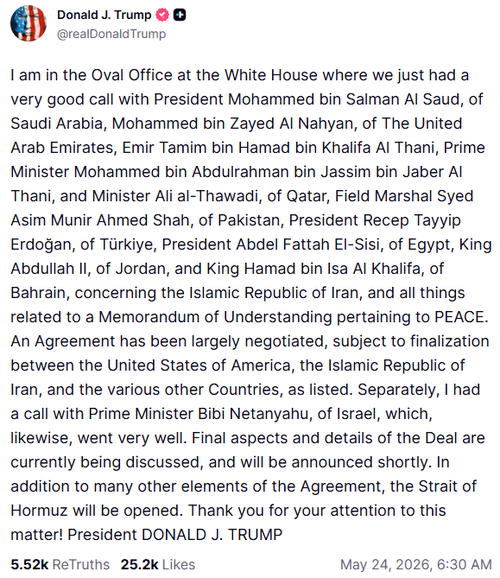
“A significant portion of the agreement has been negotiated, pending final approval between the United States, the Islamic Republic of Iran, and other involved countries,” stated former President Trump.
“We are in the final stages of discussing the agreement’s specifics, which will be revealed soon. Among the key components, the reopening of the Strait of Hormuz is included,” he mentioned.
Additionally, Trump reported a separate conversation with Israeli Prime Minister Benjamin Netanyahu, describing the exchange as “very positive.”
In an interview on television, Iranian Foreign Ministry spokesperson Esmail Baqaei indicated that both parties are edging closer to “finalizing” the deal.
“Current discussions primarily revolve around ending the conflict, ceasing what they term as the US’s ‘naval blockade,’ and addressing the release of Iran’s frozen assets,” Baqaei explained, as covered by Iran’s semi-official news outlet, Fars.
He said Iran’s nuclear program had not been included in the talks, but that it would form one of the points of understanding in the memorandum.
“In later stages â within 30 days, 60 days, or whatever timeframe is ultimately agreed upon â we can discuss the nuclear issue or other mutually agreed matters separately,” he said.
“But at this stage, as stated, all our focus is on ending the war.”
Baqaei also said the Strait of Hormuz had “nothing to do” with the US, while Al Jazeera reported state media had dismissed the notion that Iran would relinquish its “management” of the strait, outright disputing Trump’s assertion as unrealistic.
“Although Iran has agreed to allow the number of passing ships to return to the level before the war, this does not at all mean ‘free passage’ to the pre-war situation,” a report on Fars said.
“The management of the strait, determining the route, time, manner of passage, and issuing permits, will remain exclusively under the control and discretion of the Islamic Republic of Iran. Therefore, Trump’s claim in this regard is incomplete and does not correspond to reality.”
Bumpy road to peace
Trump recently once again called off a threatened resumption of hostilities in the Middle East, claiming progress in negotiations.
The US Navy continues to blockade Iranian ports, while Iran maintains it will keep control of the crucial trade channel in the Strait of Hormuz.
In Trump’s post, there was no mention of Iran’s nuclear program and highly enriched uranium, which Iran has sought to discuss later.
The US and Iran were closing in on a deal to end the war, a regional official with direct knowledge of the Pakistan-led mediation efforts said earlier this weekend.
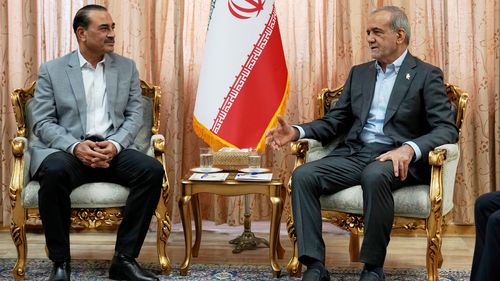
Pakistani army chief Field Marshal General Asim Munir visited Tehran to speak with President Masoud Pezeshkian this weekend.
The anonymous official, speaking on condition of anonymity to discuss closed-door deliberations, cautioned that “last-minute disputes” could blow up the efforts. This is not the first time in recent weeks that a deal has been described as close.
He said the potential deal would include an official declaration of the war’s end, with two-month negotiations on Iran’s nuclear program. The Strait of Hormuz would be reopened and the US would end its blockade of Iran’s ports.
Iran, meanwhile, had signalled “narrowing differences” in negotiations with the US after Pakistan’s army chief held more talks in Tehran, and US Secretary of State Marco Rubio told journalists in India that “there’s been some progress made” and “there may be news later today”.
Both Iran and the US emphasised their key positions and have warned of the risks of resuming attacks and disrupting their ceasefire. Rubio repeated the US stance that Iran can never have a nuclear weapon and must turn over its highly enriched uranium, and the Strait of Hormuz must be open.
Iran state TV earlier quoted Foreign Ministry spokesperson Esmail Baghaei as describing the draft as a “framework agreement” and adding: “We want this to include the main issues required for ending the imposed war and other issues of essential importance to us. Then, over a reasonable time span, between 30 to 60 days, details are discussed and ultimately a final agreement is reached.”
“Over the past week, the trend has been toward narrowing differences,” Baghaei told Iran’s official IRNA news agency, adding that nuclear issues are not part of current negotiations.
“Our focus at this stage is on ending the war on all fronts, including Lebanon,” Baghaei said, adding that lifting sanctions on Tehran “has explicitly been included in the text and remains our fixed position.”
â with Associated Press.
NEVER MISS A STORY: Get your breaking news and exclusive stories first by following us across all platforms.