
On Sunday, Russia’s Defence Ministry announced it deployed the Oreshnik missile, among other types, in an operation targeting Ukrainian military command and control centers, airfields, and military industrial sites. The locations of these targets were not disclosed. This offensive was described as a countermeasure to Ukrainian attacks on what Russia claims were civilian sites within its borders, although specific details about these incidents were not provided.
In a subsequent statement via social media, the ministry emphasized that no civilian structures were targeted during the overnight strikes on Ukraine.
Russian President Vladimir Putin had previously condemned a drone attack on a college dormitory in the Russian-occupied eastern Ukraine region, attributing blame to Kyiv. He emphasized that there were no military or law enforcement installations in proximity to the college and demanded that the Russian military draft proposals for a retaliatory response.
The aftermath of the attack in Starobilsk saw the death toll climb to 21, with search-and-rescue efforts concluding, according to a late Saturday report from Russia’s Ministry of Emergency Situations. Additionally, 42 individuals were reported injured from the incident the night before. In response, the Kremlin-appointed authorities in the Luhansk region declared a two-day mourning period on Sunday and Monday to honor the deceased.
During an emergency meeting of the UN Security Council, convened at Russia’s behest to address the strike, Ukrainian Ambassador Andrii Melnyk refuted the allegations of war crimes made by his Russian counterpart. He dismissed these claims as a “pure propaganda show,” asserting that the operations carried out on May 22 were solely targeted at dismantling the Russian military apparatus.
At a UN Security Council emergency meeting on the strike, held at the request of Russia, Ukrainian Ambassador Andrii Melnyk denied his Russian counterpart’s accusations of war crimes, calling them a “pure propaganda show” and asserting that the May 22 operations “exclusively targeted the Russian war machine”.
Ukraine and its allies have accused Russia of routinely targeting civilians and key civilian infrastructure since the early days of the war. The Kremlin denies this.
Russia says the Oreshnik is immune to any missile defence system
Russia first used the multiple-warhead Oreshnik on the Ukrainian city of Dnipro in November 2024. It was used a second time in January in the western Lviv region.
The latest combined attack included 600 strike drones and 90 air, sea and ground-launched missiles, according to Ukraine’s Air Force. Ukrainian air defences destroyed and jammed 549 drones and 55 missiles. Around 19 missiles failed to reach targets, the Air Force said.
Earlier, Zelenskyy warned that Russia was planning to use the Oreshnik, citing intelligence from the US and Western partners.
Kyiv’s European allies, including France’s Emmanuel Macron and Germany’s Friedrich Merz, condemned the Russian strikes and use of the Oreshnik in online statements published on Sunday.
“Russia hit a dead-end on the battlefield, so it terrorises Ukraine with deliberate strikes on city centres. These are abhorrent acts of terror meant to kill as many civilians as possible,” Kaja Kallas, the European Union’s foreign policy chief, posted on X.
She added that top diplomats from EU states will meet within days to “discuss how to dial up the international pressure on Russia”.
President Vladimir Putin earlier said the Oreshnik, which means “hazelnut tree” in Russian, streaks at 10 times the speed of sound, or Mach 10, and is capable of destroying underground bunkers “three, four or more floors down”.
The weapon travels “like a meteorite” and is immune to any missile defence system, Putin said, adding that several such missiles, even fitted with conventional warheads, could be as devastating as a nuclear strike.
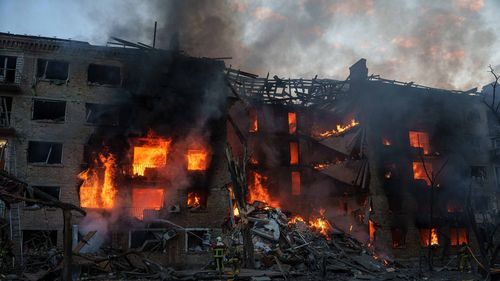
Air raid sirens blared through the night as smoke billowed across the city from strikes. Associated Press reporters heard powerful explosions near the city centre and close to government buildings.
Kyiv residents who have stayed until now consider relocating
Damage was recorded in 50 locations across several districts of the capital, including residential buildings, shopping centres and schools, Ukraine’s emergency service said in a Telegram post. Police department buildings were also damaged, it said.
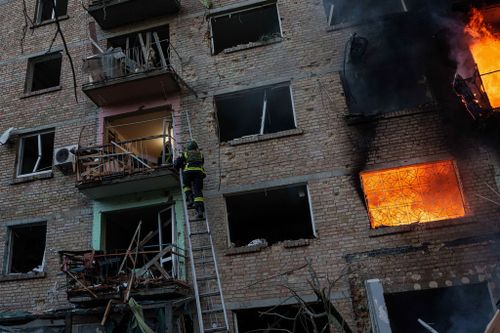
Fires continued to rage into the morning, complicating rescue efforts as buildings collapsed from the blasts.
“It was a terrible night, and there had never been anything like it in the entire war,” said Kyiv resident Svitlana Onofryichuk, 55, who had worked in the market that was damaged for 22 years.
“I am very sorry that I have to say goodbye to Kyiv now, I am not staying there anymore, there is no possibility,” she added.
“My job is gone, everything is gone, everything has burned down.”
Yevhen Zosin, 74, a Kyiv resident who witnessed the attack, said the moment he heard the explosion he rushed to grab his dog.
“Then there was another explosion and she and I were thrown back like a pin by the shock wave. We both survived, she and I. My apartment was blown to pieces,” he said.
Attack highlights Ukraine’s air defence missile shortage
Zelenskyy said not all the ballistic missiles were intercepted and that most of the strikes hit Kyiv, which was the primary target of the attack.
The attack and the apparent interception failures underscored Ukraine’s chronic shortage of air defence missile systems capable of downing ballistics. Kyiv relies heavily on US Patriot air defence systems to intercept such weapons, but interceptor missiles remain in critically short supply and are among Ukraine’s most urgent requests to its Western partners.
Developing a domestically produced alternative has become a top priority for Ukraine’s Defence Ministry, though doing so will require significant time and funding.
By saturating Kyiv with large numbers of ballistic missiles on Sunday, Russia may also be seeking to deplete Ukraine’s limited stocks ahead of what could be an even more intense wave of attacks this summer.
In Kyiv’s Shevchenko district, a five-storey residential building was hit, which caused a fire, and one person was killed, Ukraine’s state emergency service reported.
A school building was damaged by an attack while people sheltered inside, Mayor Vitali Klitschko said. Local authorities reported supermarkets and warehouses across the city also were damaged.
Multiple communities recorded damage throughout the Kyiv region, according to Mykola Kalashnyk, the regional governor.
Elsewhere, a Ukrainian drone killed a civilian in the Russian town of Grayvoron, in the Belgorod region bordering Ukraine, local authorities reported on Sunday morning.
Russia’s Defence Ministry said its forces shot down or jammed 33 Ukrainian drones overnight into Sunday, including over the Moscow region, western and southwestern Russia, and Russian-occupied Crimea.
NEVER MISS A STORY: Get your breaking news and exclusive stories first by following us across all platforms.