
A Spanish national, who was previously evacuated from the MV Hondius cruise ship and is currently in isolation in Madrid, has been diagnosed with hantavirus.
This individual is among 14 Spanish citizens who were aboard the cruise ship. The vessel, which set sail from Argentina in early April, became the center of a hantavirus outbreak—an illness primarily transmitted through contact with rodent droppings—that resulted in three fatalities.
Following their departure from the ship, passengers have been repatriated to their respective countries. To date, 12 cases of hantavirus have been confirmed among these former passengers. Due to the virus’s incubation period, which can extend up to 42 days, they are required to remain in quarantine during this time.
The most recent case identified in Spain involves a passenger who had close contact with an infected individual during the initial outbreak onboard.
The patient’s identity remains confidential, but they have been under isolation at Gómez Ulla Hospital since May 10. The Spanish health ministry confirmed the infection through routine testing procedures.
Details regarding the patient’s symptoms have not been released by the Spanish government. However, hantavirus is known to cause severe respiratory issues or, in certain strains, kidney failure.
Spanish health officials say the latest case does not raise the risk for the general public or change current public health measures, since the patient was already inside the country’s isolation system.
The CDC is monitoring 41 Americans exposed to hantavirus, including quarantined passengers in Nebraska and Georgia, those who returned home before the outbreak was identified and people potentially exposed to a symptomatic case on a flight.
Dutch authorities are pictured removing the body of a deceased German passenger of the MV Hondius, one of three fatalities
Health officials added that so far, no infections tied to the cruise ship have been confirmed in the US.
The confirmed case in Spain marks the second positive test among the Spanish group evacuated from the MV Hondius.
Infectious disease experts note that passengers who were on board as recently as early May remain within the virus’s incubation window, which averages about three weeks but can extend to six weeks.
For now, Spanish officials say the situation remains contained.
The patient at Gómez Ulla Hospital is receiving appropriate care, which can include close monitoring in a high-level isolation unit, respiratory support such as oxygen or a ventilator if needed and potential use of ECMO for severe heart or lung failure.
The first signs of the deadly hantavirus emerged on April 6, when a Dutch man fell ill on board the ship. He died five days later.
His body was not removed until April 24, when the vessel docked on St Helena Island. That’s when his wife also got off and she flew to South Africa the next day, where she later died.
Pictured is the Gómez Ulla Hospital, funded by the Defense Ministry, in Madrid. The second case of hantavirus in Spain linked to the cruise ship is in isolation here
In the weeks that followed, 18 Americans were among those evacuated from the ship. They are now in federal quarantine.
In total, three passengers have died from the virus: the Dutch man, his wife and a German woman who died on board May 2.
Health officials believe the outbreak traces back to two passengers who may have picked up the virus during a birdwatching tour at a landfill in Argentina.
The outbreak is believed to be one of the rare instances in which the virus may have spread from person to person. This strain is known as the Andes virus.
Different strains of hantavirus exist worldwide, and they cause different types of illness depending on the region.
In South America, the Andes virus is the most concerning strain because it is the only one known to spread from person to person. It causes a severe lung disease called Hantavirus Pulmonary Syndrome (HPS).
In North America, the most common strain is Sin Nombre virus, which is carried by deer mice.
Unlike the Andes strain, it does not typically pass between humans, though it also causes serious respiratory illness.

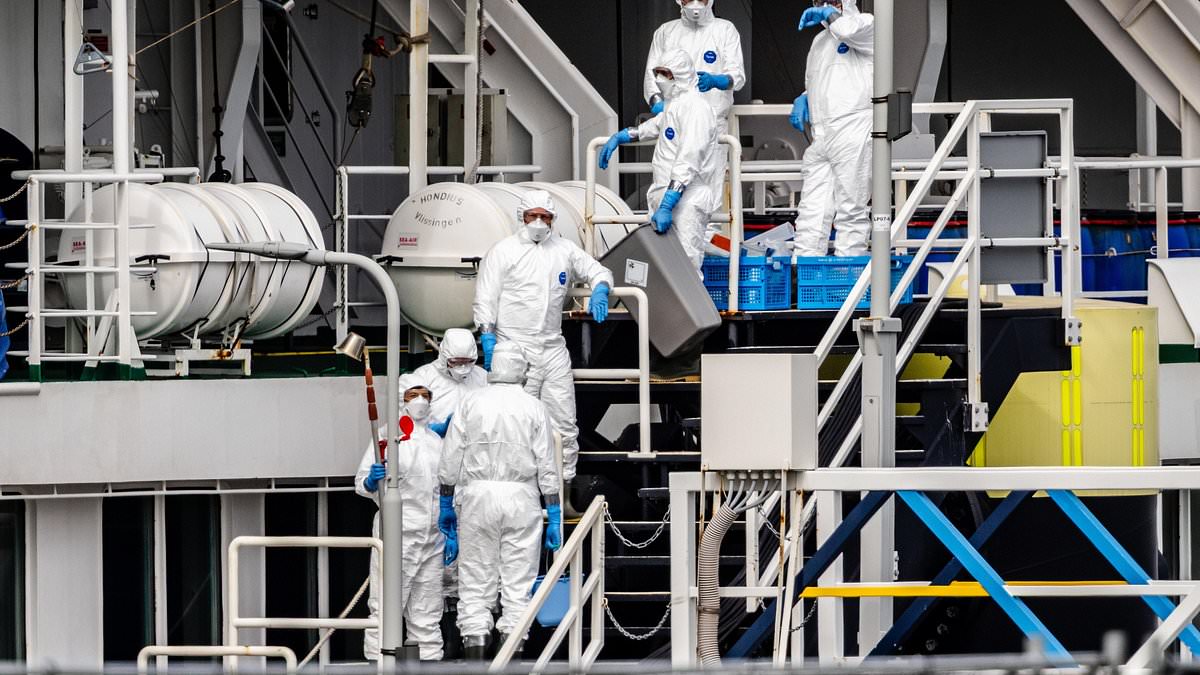
Staff are pictured as they prepare to clean the MV Hondius in Rotterdam on May 19, 2026. So far, 12 former passengers have tested positive for the virus. There have not been any cases in the US but 41 people are being monitored for symptoms
In Europe and Asia, the ‘Old World’ strains, including Hantaan, Puumala and Seoul viruses, behave differently.
Instead of attacking the lungs, these strains tend to cause a kidney disease known as hemorrhagic fever with renal syndrome (HFRS).
While all hantaviruses can be dangerous, the South American Andes strain poses a unique public health challenge because it can spread from person to person, which is why the outbreak on the cruise ship has drawn such intense global attention.
According to the CDC: ‘This outbreak is evolving rapidly and the situation will continue to change.’
But the agency added: ‘The risk of a pandemic caused by this outbreak and the overall risk to the American public and travelers is extremely low.’