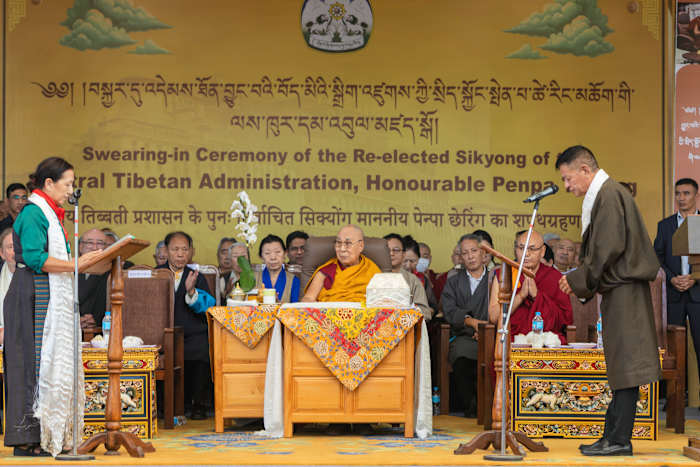

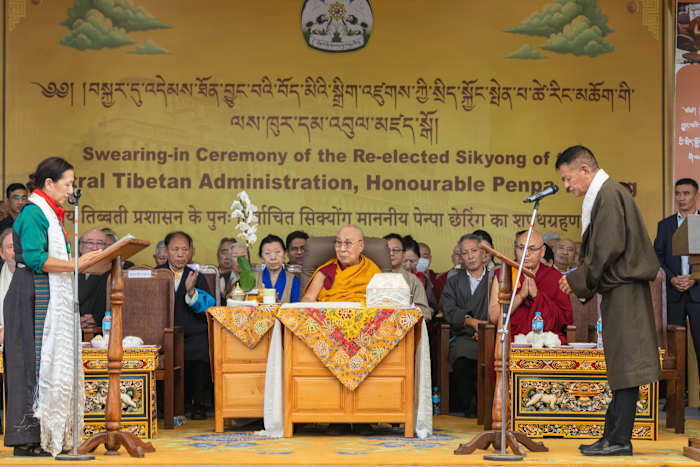
DHARAMSHALA – On Wednesday, Penpa Tsering took the oath of office for a second term as the leader of Tibet’s government-in-exile, following his reelection earlier this year.
At 58, Tsering has been at the helm of the exile government located in Dharamshala, India, since 2021. His victory in February granted him another five-year tenure, with votes cast by Tibetans residing in India and abroad. Tsering’s political journey began in 1996 when he joined the Tibetan Parliament-in-Exile, later serving as its speaker from 2008 until he ascended to the highest executive position.
Established in 1959, the Central Tibetan Administration, formerly known as Tibet’s government-in-exile, consists of executive, judicial, and legislative branches.
On Wednesday, Tsering emphasized the administration’s steadfast dedication to the ‘Middle Way Policy,’ a vision introduced by His Holiness the Dalai Lama. This policy advocates for resolution through peaceful means, dialogue, and mutual benefit.
“We will maintain cautious and steady back-channel communications with the Chinese government until a resolution is reached,” Tsering stated.
The swearing-in ceremony unfolded in the presence of the Dalai Lama, who was accompanied to the venue by monks clad in red robes, amid the rhythmic beats of drums and solemn prayer chants. Attendees included hundreds of monks and Tibetans who witnessed Chief Justice Commissioner Yeshi Wangmo of the Tibetan Supreme Justice Commission administer the oath of office to Tsering.
The February vote marked the fourth direct election of the Tibetan exile leadership since the Dalai Lama, the Tibetan spiritual leader, formally ended his role in the administration’s governance in 2011.
China says Tibet has been part of its territory since the mid-13th century and its Communist Party has governed the Himalayan region since 1951. But many Tibetans say they were effectively independent for most of their history and the Chinese government wants to exploit the resource-rich region while crushing its cultural identity.
China does not recognize the Central Tibetan Administration and hasn’t held dialogue with the Dalai Lama’s representatives since 2010. India considers Tibet as part of China, but hosts the Tibetan exile government.
Beijing accuses the Dalai Lama of seeking to separate Tibet from China, which he denies. Some Tibetan groups advocate independence for Tibet, since little progress has been made in talks with China.
Yu Jing, a spokesperson for the Chinese Embassy in India, on Sunday dismissed the legitimacy of the exile administration, saying it was “not recognized by any sovereign country” and had no authority to represent Tibetans or oversee the reincarnation process of the Dalai Lama.
On his 90th birthday last year, the Dalai Lama insisted Chinese authorities would have no role in identifying his successor and the institution of the Dalai Lama would continue after his death.