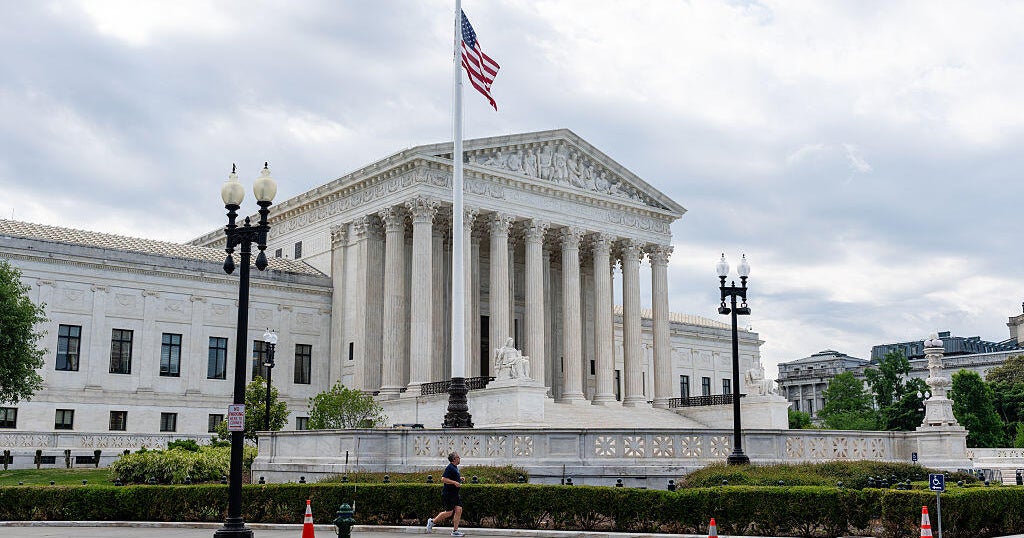

Washington — On Wednesday, Alabama Republicans petitioned the Supreme Court, seeking approval to implement a 2023 congressional map favoring the GOP in the midterm elections. This request comes after a district court ruled the redistricting plan was racially biased.
The state’s officials urgently sought intervention from the Supreme Court after a district court mandated Alabama to use a different map, one approved by the court, featuring two majority-Black districts for future House elections. The decision by the three-judge panel indicated that the redistricting map created by the GOP-led Alabama legislature in 2023, which included only one majority-minority district, was found to deliberately marginalize Black voters.
In their legal filing, Alabama officials argued, “Alabama and the public face irreparable harm unless a stay issues because they will be unable to use the State’s ‘duly enacted plans’ for the 2026 election.” They further stated, “Worse still, voters will be forced to vote under a court-drawn racially gerrymandered map that does not meet Alabama’s legitimate districting goals.”
Officials maintained that the 2023 map “was lawful then, and it is lawful now.”
The move to revert to the 2023 congressional lines follows a recent Supreme Court decision that weakened a significant aspect of the Voting Rights Act. In the 2024 elections, Alabama proceeded with a court-approved plan featuring two majority-Black districts.
For the upcoming House elections, Republicans aim to reclaim a seat currently held by Black Democrat Rep. Shomari Figures by reinstating their 2023 map.
In anticipation of the three-year-old map being put in place, Alabama Gov. Kay Ivey, a Republican, set a special primary election for Aug. 11 for the four House districts that would be recrafted under that plan. Primaries for the state’s three other House seats unaffected by redrawing were held last week.
The ongoing battle over Alabama’s congressional map is part of the fallout from the Supreme Court’s Voting Rights Act decision. In response to that ruling, which involved Louisiana’s House district lines, several states in the South have rushed to reconfigure their congressional maps to help bolster Republicans’ odds of holding onto their House majority.
The effort is in line with President Trump’s push over the past few months for GOP-led states like Texas, Florida and Missouri to recraft their congressional maps for partisan gain.
Alabama’s congressional map has been ensnared in legal wrangling since 2021, when the state drew new House districts after the 2020 Census. In 2023, after the Supreme Court ruled that earlier redistricting plan likely violated Section 2 of the Voting Rights Act, state lawmakers drew the map with one majority-Black district out of seven congressional seats, even though Alabama’s population is 27% Black.
But those House lines were invalidated by the district court. It went on to put in place its own congressional map that bolstered Black voting power, and that was used for 2024 House races.
On the heels of the voting rights decision, Alabama officials asked the Supreme Court to set aside the injunction that had blocked the state from using the 2023 map. The high court agreed to do so earlier this month and sent the case back to the district court for more proceedings.
But when the district court took another look at the House districts drawn in 2023, it said there was “undisputed evidence” that the map intentionally discriminated based on race in violation of the Constitution.
“Ultimately, we cannot see our way clear to requiring Alabamians to cast their votes in the 2026 elections under a districting plan tainted by intentional race-based discrimination,” Circuit Judge Stanley Marcus and District Judges Anna Manasco and Terry Moorer found.