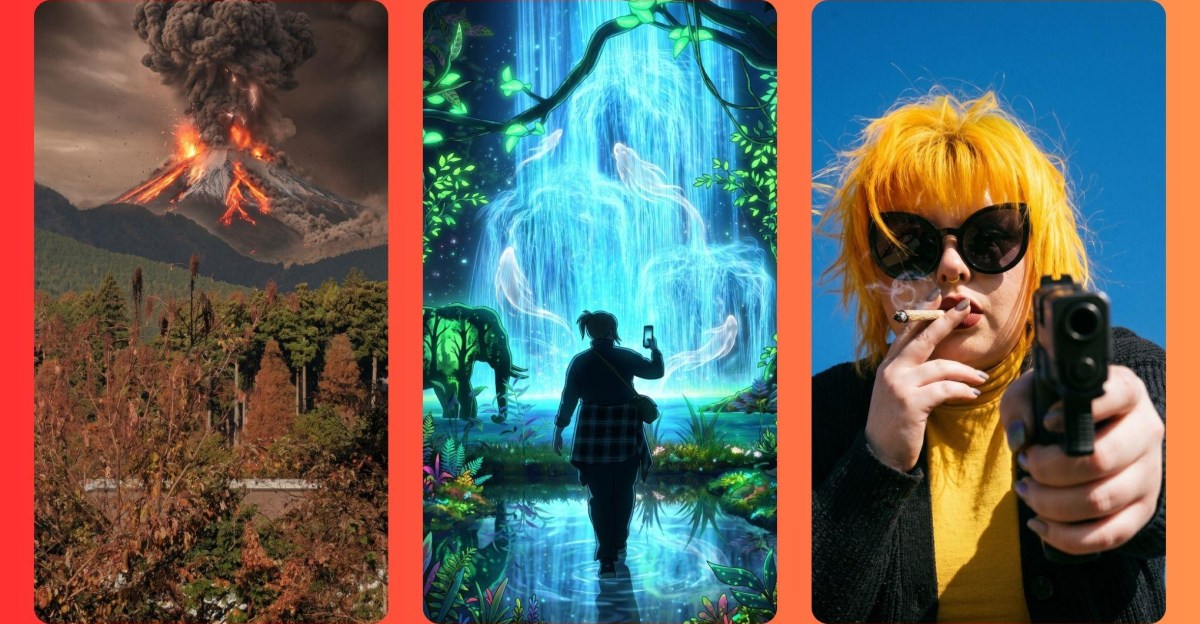

AI image tools often leave me feeling disconnected from the creative process. Typically crafted for those without design expertise, these tools allow users to input a few keywords and receive a ready-made outcome. However, Adobe’s newest AI image assistant pleasantly surprised me. This innovation aims to alleviate routine tasks while still allowing users to maintain their creative influence.
Adobe’s Firefly AI Assistant stands apart from traditional AI generators built for direct image or video creation and editing. Having tested its beta version, I found it to be a versatile intermediary capable of operating Adobe’s suite of design applications on the user’s behalf. According to Adobe, users can simply instruct the Firefly AI Assistant, and it will seamlessly employ tools from platforms like Photoshop and Illustrator to accomplish complex tasks swiftly.
The assistant’s interface resembles a standard chatbot, featuring a text input box and an option to upload media files. Although it doesn’t directly use the Adobe applications on your device, it harnesses essential functionalities such as masking, object detection, and image creation. This conversational AI allows you to request tasks like “enhance the colors in this photo,” executing the request while providing an explanation of its actions.
1/3
At first glance, the edits and illustrations produced by Adobe’s AI appear quite convincing. For instance, it altered my hair color in one image and adjusted the background and lighting in another. While not flawless—some results had overly vivid colors or poorly integrated modifications—the average observer might not deduce that AI was involved, as the adjustments resemble those of a beginner designer.
The true allure of the Firefly AI Assistant lies in its interactive nature. When I presented it with a photo of my cat near a window and requested a cloudless, sunny sky, it didn’t merely produce the edited image. The chatbot provided a detailed description of the original scene (accurately identifying my cat as a Maine Coon despite mostly showing its rear) and outlined the steps to achieve the desired outcome. It referenced specific Photoshop and Lightroom tools, employing professional editing terminology and detailing the process in stages. Although you don’t witness the live editing, the chatbot explains which features it utilizes to reach each result.
Impressively, the Firefly AI Assistant candidly acknowledges its limitations. When I attempted to separate objects within a JPG into distinct layers, it admitted this was beyond its capabilities but suggested alternative methods, highlighting the advantages and disadvantages of each. Upon selecting an option, the bot elaborated on its editing approach, even noting when a method fell short: “I notice the Gaussian blur approach isn’t providing true transparent cutouts—it’s generating full-image PNGs,” it remarked. The chatbot then recalibrated its strategy, employing masks and Adobe’s image cropping and resizing tools instead.
1/2
You can also ask the chatbot to add new objects into images, akin to Photoshop’s Generative Fill or Google’s Magic Editor features. It didn’t hesitate to add cigars, doobies (erm, “hand-rolled cigarettes”) and even guns to my photographs, but refused to generate anything outright illegal. I could make an obviously fake album cover of myself pointing a gun at the “camera,” but not make myself look like I’m shooting anyone. The results for these sort of edits are also visually subpar compared to asking for things that won’t necessarily require generative AI tools, such as lighting adjustments, but I wouldn’t say they’re outright bad — they’re just not good enough that they could fool me. It also refused to alter the shape or size of my face and body, or put me in revealing clothing — something Grok could use some notes on.
Prompting chatbots usually makes me feel like I’m asking a theme park mascot for directions — the constant enthusiasm is unnerving, and not at all like talking to another adult human being. The Firefly Assistant is still guilty of gushing out pointless and unnecessary praise (I do not need it to tell me that my edit request is a “great idea”), but for the most part, what it’s saying is actually useful.
When the bot needs additional information, you’ll be prompted for it. I asked it to turn a photograph I took of two cocktails into an illustration-style graphic that can be used to advertise a bar on social media. It then asked me what platforms I was planning to post the design on, providing a list of options like TikTok, Instagram, and Facebook that I could select, alongside the standard pixel dimensions for such content. If I wasn’t already familiar with Instagram Square posts being 1080x1080p, I’d have come away from that experience having learned something.
This is the most intriguing way a creative chatbot has interacted with me so far. By asking it to make changes I never bothered to learn how to do myself, the AI assistant shows me where I need to focus on building those skills by explaining its own workings. I’d say it’s less useful than asking Google Search or YouTube for tutorials, but those services won’t complete the task for you while you learn. I personally enjoy manual creative processes too much to ever delegate that to a chatbot in the real world, but for folks who want to make edits that wouldn’t otherwise be worth their time? I can see the appeal for this.
Canva also recently launched its own conversational design agent. That too, is rife with tendencies to communicate through flowery language and infantilizing praise, but it doesn’t explain its working process like Adobe’s chatbot does, and the results didn’t quite hold up to what I saw Adobe’s producing. You just give the Canva assistant instructions, and keep prompting until you’re happy with the outcome. For those willing to learn, Adobe’s tool may actually help to demystify some design and editing basics while delivering on your requests.
But Adobe is mostly pitching this Firefly assistant as a means to save creative professionals time by undertaking labor-intensive tasks. I have middling editing skills at best, and I don’t feel the chatbot would be useful to me unless I’m happy to pump out sub-quality work. For people with very established design skills, I fear using this would feel more like babysitting a new intern than having a helpful colleague. It may become easier to pitch this AI assistant to creatives if it can deliver work that’s indistinguishable from something professionally edited. But for now, it’s far too much of a novice.