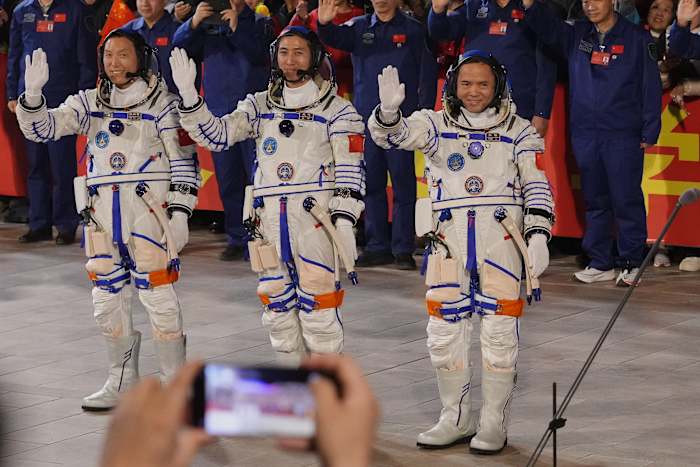


BEIJING – A trio of Chinese astronauts safely returned to Earth on Friday after an extensive seven-month mission in space, successfully completing a transition with a new crew earlier this week.
The spacecraft carrying astronauts Zhang Lu, Wu Fei, and Zhang Hongzhang from the Shenzhou 21 mission landed at the Dongfeng site located in China’s Inner Mongolia region on Friday evening. This return marks a significant step as China gears up for its ambitious goal of a lunar landing by the year 2030.
During their mission, the astronauts executed a range of tasks. These included processing and sending back experimental data, as well as handing over leftover supplies, according to the China Manned Space Agency, as reported by the official Xinhua News Agency. They also exchanged insights and experiences with the incoming Shenzhou 23 crew, who arrived at the space station on Monday, Xinhua noted.
Earlier reports from Xinhua highlighted that the team completed three spacewalks. Zhang Jingbo, a spokesperson for the space agency, mentioned that Zhang Lu, who previously participated in the Shenzhou 15 mission, has now achieved a total of seven spacewalks, earning him the title of the Chinese astronaut with the most spacewalks to date.
Among the new arrivals at the Tiangong space station via the Shenzhou 23 craft, one astronaut is set to remain stationed there for an entire year. Tiangong, which translates to “Heavenly Palace” in Chinese, is the name of the space station.
The new crew includes Zhu Yangzhu, who serves as the commander, alongside Zhang Zhiyuan and Lai Ka-ying. Lai, who also goes by Li Jiaying based on the Mandarin pronunciation of her name, was born and raised in Hong Kong, making her the first astronaut from the city to participate in a space mission.
As China steps up its space program, its astronauts have carried out multiple missions to the Tiangong space station, developed after China was effectively excluded from the International Space Station on U.S. concerns over national security.
The U.S. is seen as China’s top space rival, with NASA aiming to land astronauts on the lunar surface in 2028.