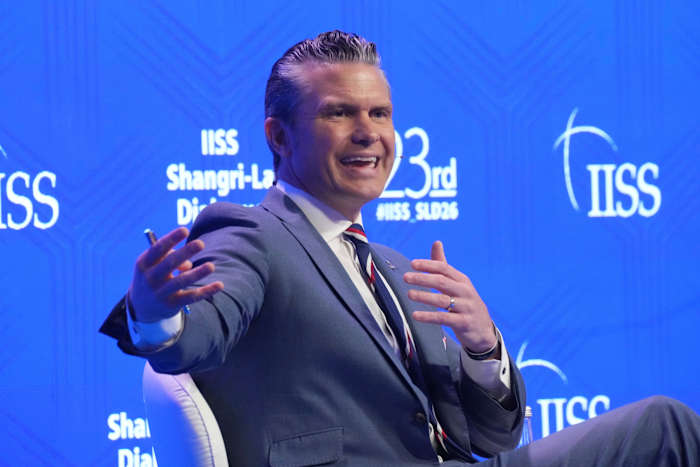


On Saturday, U.S. Defense Secretary Pete Hegseth reassured allies in the Pacific that the United States remains steadfastly dedicated to the region, while softening earlier rhetoric that labeled China as a threat.
Addressing a gathering of global leaders, diplomats, and senior security officials at the Shangri-La defense summit in Singapore, Hegseth emphasized the critical importance of the Pacific for U.S. security and economic well-being. He highlighted Washington’s aim to establish a stable and favorable power balance in the area.
This marked Hegseth’s second appearance at the forum. During his previous address, he provoked Beijing by highlighting emerging threats from China, particularly regarding its assertive posture towards Taiwan, stating that China was not only expanding its military capabilities but also engaging in daily preparations for potential action.
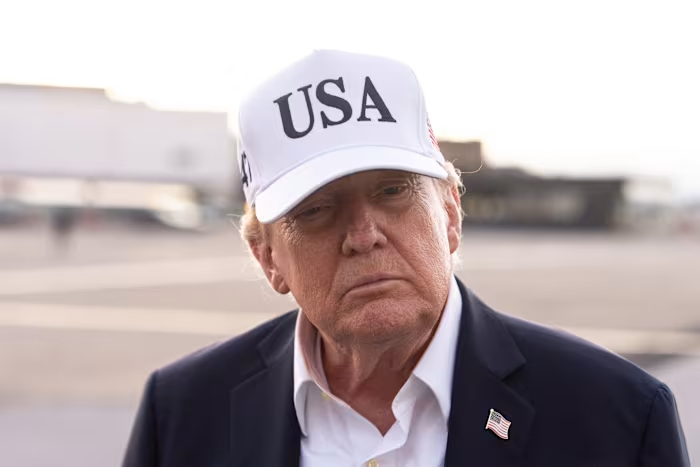
This year’s conference followed closely on the heels of U.S. President Donald Trump’s visit to Beijing, where he met with Chinese President Xi Jinping. Following their discussions, Trump praised Xi as a “great leader” and expressed optimism about a promising future for U.S.-China relations.
Hegseth, who accompanied Trump during his China visit, shared that both leaders agreed on the importance of fostering a constructive and stable strategic relationship, emphasizing fairness and reciprocity. They acknowledged the need to protect national interests while pursuing mutually advantageous agreements where possible.
Nonetheless, Hegseth reiterated that a key U.S. objective remains preventing China from asserting dominance over the Indo-Pacific region.
“There is rightful alarm regarding China’s historic military buildup and the expansion of its military activities in the region and beyond,” he said.
“We share a clear-eyed assessment of that security environment and a mutual understanding that a Pacific dominated by any hegemon would unravel the regional balance of power and undermine the equilibrium we all seek to preserve.”
After the meetings between Xi and Trump, the American president raised questions about Washington’s willingness to defend Taiwan, calling a new $14 billion arms package that he has yet to greenlight “a very good negotiating chip for us” with China.
China claims the democratic self-governing island as its own, and Xi has not ruled out using force to take it. The U.S. is required by law to help provide Taiwan with the means to defend itself, though follows a policy of “strategic ambiguity” on whether it would intervene militarily if China were to attack the island.
Hegseth told the forum that there was “no change in our status” toward Taiwan, but would not comment on the arms deal.
“Any decision about future Taiwan arms sales, as the president said, will rest with him,” he said.
He underscored the Trump administration’s insistence that allies increase defense spending, saying “we need partners, not protectorates.”
He lauded several countries in Asia for their efforts, while reiterating criticism of European allies, without naming names, who he suggested got “distracted by empty globalist rhetoric about the rules-based international order.”
“Our partners in Asia have long understood that the bedrock of a durable partnership is not based on idealistic values but on the concrete alignment of national interests,” he said.
“When our interests diverge, we adjust pragmatically, without the drama or the moralizing,” he added. “I think Western Europe might take note — this is a mindset we fully embrace.”
Hegseth did not mention either the war in Ukraine or Iran war in his speech. When asked about Iran, he only said that Trump had assured him that when negotiations with Tehran had concluded, “any deal will be a good deal.”