
On Wednesday, Donald Trump made history by becoming the first sitting U.S. president to personally attend a Supreme Court session for oral arguments. The occasion, however, saw conservative justices, some of whom were appointed by Trump himself, critically evaluate his administration’s arguments to end birthright citizenship.
The justices expressed doubt over the legal standing of the Trump administration’s case, known as Trump vs. Barbara, signaling skepticism about the efforts to revoke the constitutional right to birthright citizenship.
Trump, dressed in his signature red tie, observed the proceedings from the front row of the public seating area, positioned several rows behind the lectern where U.S. Solicitor General John Sauer presented arguments on his behalf.
Throughout the session, Trump was noted to be sitting calmly, his hands resting in his lap as he watched the proceedings unfold.
Following the court session, Trump took to social media to express his views, stating, “We are the only Country in the World stupid enough to allow ‘Birthright’ citizenship!”
Trump’s presence at the Supreme Court is unprecedented for a sitting president, as the nine justices deliberate over the validity of his executive order. The court’s decision is anticipated to be announced in June or July, potentially setting a significant legal precedent.
The plaintiffs are represented by the American Civil Liberties Union (ACLU), which argued that the plain language of the 14th Amendment provides those born on US soil automatic birthright citizenship.
This courtroom sketch depicts Solicitor General John Sauer with President Donald Trump seated behind him
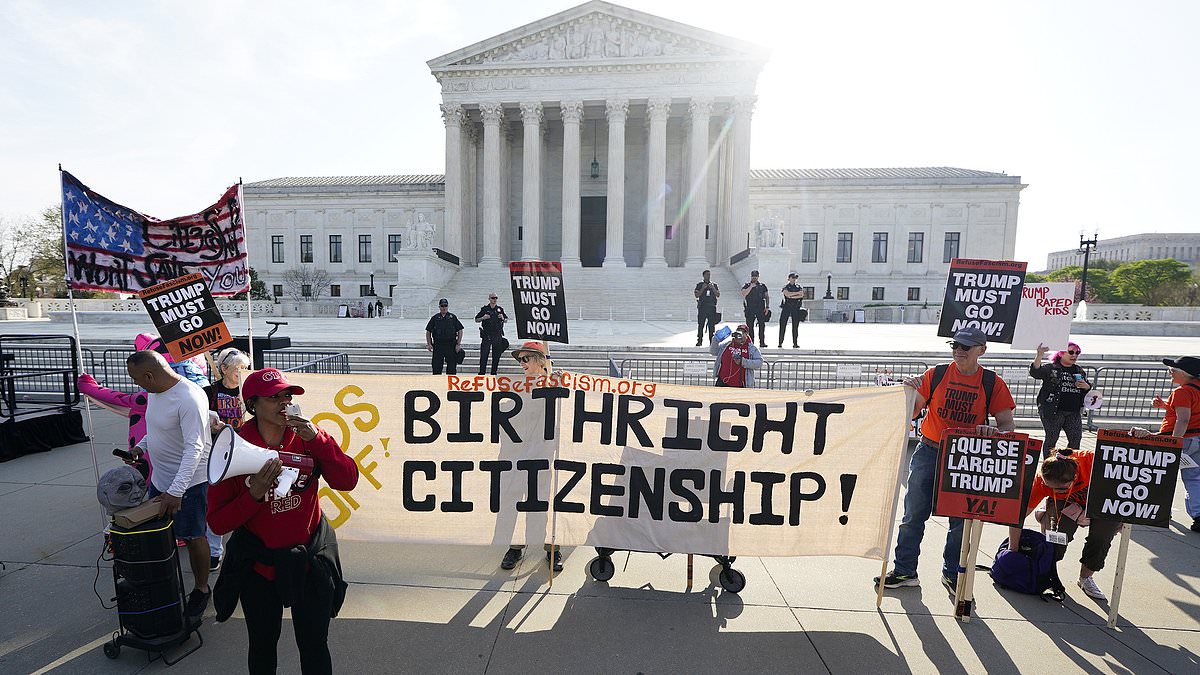
People demonstrate outside the Supreme Court ahead of Trump’s expected arrival on April 01, 2026 in Washington, DC. The Supreme Court is hearing oral arguments in Trump v. Barbara to determine if President Trump’s executive order ending birthright citizenship is constitutional
Trump signed an executive order on his first day in office to crack down on birthright citizenship. The order has since been held up in court
Birthright citizenship was enshrined by the 14th Amendment, ratified in 1868 to guarantee citizenship to freed slaves, but has since applied to every person born on US soil or its territories. Trump moved to end it by executive order on Inauguration Day 2025 – a move subsequently struck down by lower courts as unconstitutional.
In a blow to the President early on in the session, Chief Justice John Roberts threw cold water on Sauer’s position, calling a key piece of his argument ‘quirky.’
Trump, wearing his iconic red tie, was in the front row of a public seating area roughly half a dozen rows behind the lectern from which Sauer is arguing on his behalf
Trump exited the courtroom after Sauer concluded his presentation
The plaintiffs are represented by the American Civil Liberties Union (ACLU), which plans on arguing that the plain language of the 14th Amendment provides those born on US soil automatic birthright citizenship
The Solicitor General sought to convince the Justices that the world has fundamentally changed since the precedent for birthright citizenship was set hundreds of years ago by the Founding Fathers.
‘We’re in a new world now,’ Sauer argued before the court. ‘Some 8 billion people are one plane ride away from having a child who’s a U.S. citizen.’
Roberts appeared unconvinced: ‘It’s a new world, but it’s the same constitution.’
Justice Amy Coney Barrett, who was appointed by Trump, said the administration’s interpretation of the 14th Amendment introduces ‘a new kind of citizenship,’ signaling her skepticism of the President’s team’s argument.
‘Do you think Native Americans today are birthright citizens under your test?’ Justice Neil Gorsuch, who was also added to the bench by Trump, asked Sauer.
‘I think so,’ the Solicitor General responded tepidly. After Gorsuch asked Sauer again, he laughed and told Trump’s legal team: ‘I’ll take the yes.’
Justice Kentaji Brown Jackson asked Sauer how the administration would determine the citizenship of newborn children, ‘Are we bringing pregnant women in for depositions?’
Sauer suggested that social security numbers could be used to check.
ACLU Legal Director Cecillia Wang also received pushback from the Justices.
Justice Samuel Alito asked her a hypothetical about whether a child born in the US to an Iranian father who entered the country illegally ‘is not subject to any foreign power’ despite being mandated by Iran to provide military service.
She said that under the 1866 Civil Rights Act, ‘no.’
US Supreme Court Chief Justice John Roberts Jr, Justice Elena Kagan, Justice Brett Kavanaugh and Justice Amy Coney Barrett are seen at the House Chamber before President Donald Trump delivers the State of the Union in February

Trump rides in the Beast to the Supreme Court on Wednesday morning
Trump has long fixated on birth tourism – the practice of foreigners traveling to the US to give birth and secure citizenship for their children – arguing it is being unfairly exploited by wealthy foreign nationals.
‘Birthright Citizenship is not about rich people from China, and the rest of the World, who want their children, and hundreds of thousands more, FOR PAY, to ridiculously become citizens of the United States of America,’ Trump wrote in a separate post on Monday.
‘It is about the babies of slaves! We are the only Country in the World that dignifies this subject with even discussion. Look at the dates of this long ago legislation – The exact end of the Civil War!’
House Democratic Leader Hakeem Jeffries and Congressman Jamie Raskin have filed an amicus brief against the Trump case, arguing the administration’s position violates ‘the Constitution and over a century of Supreme Court rulings, as well as laws enacted by Congress.’
A majority of Americans oppose ending birthright citizenship, according to a December poll from Quinnipiac.
Another survey from Washington Post-ABC News Ipsos from April 2025 found that 67 percent of US adults oppose ending it.
Trump’s executive order reinterprets the 14th Amendment’s citizenship clause to exclude children born after February 19, 2025, to parents who are in the US illegally or on a temporary basis.
The case turns on a fundamental constitutional question: does the 14th Amendment guarantee citizenship to virtually everyone born on US soil, or can the President narrow the scope of its ‘subject to the jurisdiction thereof’ clause?
Trump’s presence in the courtroom is certain to intensify the atmosphere, coming as it does after he has openly ridiculed the Justices for blocking his sweeping tariff agenda.